Ebook Info
- Published: 2013
- Number of pages: 432 pages
- Format: PDF
- File Size: 5.38 MB
- Authors: David Kynaston
Description
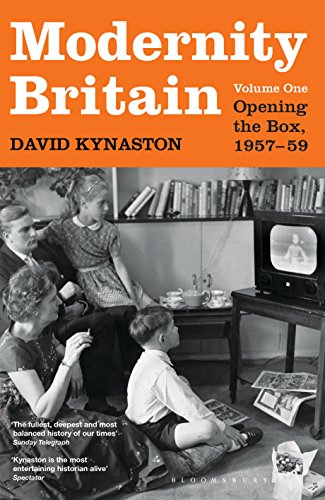
The late 1950s was an action-packed, often dramatic time in which the contours of modern Britain began to take shape. These were the ‘never had it so good’ years, when the Carry On film series and the TV soap Emergency Ward 10 got going, and films like Room at the Top and plays like A Taste of Honey brought the working class to the centre of the national frame; when the urban skyline began irresistibly to go high-rise; when CND galvanised the progressive middle class; when ‘youth’ emerged as a cultural force; when the Notting Hill riots made race and immigration an inescapable reality; and when ‘meritocracy’ became the buzz word of the day. The consequences of this ‘modernity’ zeitgeist, David Kynaston argues, still affect us today.
User’s Reviews
Reviews from Amazon users which were colected at the time this book was published on the website:
⭐I have read both Austerity Britain and Family Britain, and have been looking forward to Dr. Kynaston’s succeeding volumes with interest. However, as soon as I began Modernity Britain I was reminded of just how clumsy and difficult is his style. He really doesn’t `write’ – rather, he rambles, littering his work with an excess of parentheses and overlong `sentences’. Here is an example taken almost at random:Yet there were two fundamental ironies involved; not only did most Bethnal Greeners of the 1950s and after, especially younger ones, have a much greater desire to leave the area and move upmarket than Family and Kinship suggested (as the authors would explicitly concede in their introduction to the 1986 edition); but in the climate of the time, `urbanism’ inevitably meant the wholesale demolition of rundown (if homely) Victorian terraced’ cottages’ and, in their place, large-scale erection of high-rise blocks of flats – this despite Young and Wilmott’s adamant insistence that such blocks were at best only a partial solution to the housing problem.This is the sort of extract I might have given my Matriculation students with the instruction to `simplify’. If this were an isolated example, it might not be so bad, but the whole tome reads very much like this. In short, fascinating material beleaguered by a terribly irritating and obfuscating style!
⭐The latest installment of David Kynaston’s wonderful history Britain between WWII and the Thatcher Revolution is the best yet. Historical details are woven together with diaries and man-on-the-street interviews to give readers a crystal clear viewpoint into daily life of late ’50s Britain. I can’t wait for the next installment. This series is a must read for anyone who wants to understand Britain’s post war struggles.
⭐As with all of this series, this book is hard to put down, if you lived through the post-WWII period in England, and wondered what your parents were talking about. We lived in a council flat in Shepherds Bush, and in a tiny council house in South Oxhey, and yet somehow (amazingly) I grew up relatively sane.
⭐Excellent book, latest in a trilogy. Not your usual dry history book because of the use of peoples journals. I was a teenager at the time the book relates to and it has been a real pleasure to help bring back the memories. Hope there are more to follow.
⭐Was bought as a gift.It was well received.
⭐Another in this unique detailed series of penetrating studies.
⭐Another title in David Kynaston’s magisterial series of histories of post-war Britain. This one concentrates on the period in the mid-Fifties under the Conservative government of Harold Macmillan, when the country prospered both economically and socially, marked by the famous phrase from the Prime Minister telling people they had “never had it so good.” Kynsaston’s book actually represents this period as one of fundamental change, as Britain tried to get used to its new status in the postcoloniaL world, while its people accommodated themselves to changing value-systems. The book shows how difficult it was for people to adjust themselves to new patterns of immigration; changing systems of sexual and social morality; and the rapid growth of a meritocratic society. Not that older behavioral patterns had been obliterated: Kynaston’s book still reveals how privilege-conscious British society still was, especially in the sphere of education, where many influential commentators resented the idea of comprehensive schools and anti-selective education. The research, as ever, is massive; Kynaston has provided a wealth of evidence from official documents as well as diaries and other reminiscences provided by people living at that time. MODERNITY BRITAIN is a great dipping-book, as well as something to be read from cover to cover.
⭐Continuing David Kynaston continues his history of post-war Britain, moving on to the mid-fifties and looking intensively at the years 1957-59.The country is changing in many ways by this time. Architects have decided that people should live in flats, despite most wishing to live in houses. New estates are springing up and Labour’s influence is still strong in the number of industrial disputes, with those ‘representing the workers,’ in Ford, at Dagenham, inspiring Fred Kite in, “I’m all Right, Jack,” released a year or two later. National Service was planned to end in 1961, race riots explode in Notting Hill, CND march, Carry On films are released and working class novels and plays continue, to mixed receptions.On the other hand, much remains the same. Hand wringing over education and grammar schools already becoming unpopular with many politicians, even if they remained popular with parents. With the country being constantly told that it should wish to live in a high rise block and send their children to a comprehensive school, it’s no wonder that they turned to television and retreated to home and hearth, wherever it was. Also, despite the changing times, homosexual men were still targeted and a twenty two year old Brian Epstein was arrested for ‘persistent importuning,’ at Swiss Cottage tube station. His time at RADA ending in disgrace, he was set to return to Liverpool and try to settle at the family business, which was undoubtedly a good decision in the long run. Although he was yet to see The Beatles (still The Quarrymen at that point) on the 6th July, 1957, at St Peter’s Church fete, Paul McCartney would be introduced to John Lennon and a musical revolution sparked which would change not only the country, but the world. Still, in this book it is still, “Six-Five Special,” and the quickly becoming respectable Cliff Richard (seamlessly moving from ‘Move It,” to “Living Doll”), while Buddy Holly died in a plane crash and music said to have died.The end of this book discuses a rather lacklustre election. Macmillan, telling the country they had, ‘never had it so good,’ won, with a notable new MP being Margaret Thatcher, warning the electorate they should not shirk their duty as any vote not for the Conservatives, was a vote for Socialism. I look forward to reading on and think this is an excellent, detailed and well written history of a post-war Britain and the many challenges it faced.
⭐Although this book is the third volume (so far) of a series covering British life since 1945, it stands well on its own as a fascinating insight into a time, which although relatively recent, is in many ways so different from our experience today. Much of the narrative is made up of quotes made at the time by people from all walks of life, giving a real sense of the lifestyles and attitudes held by various social groups and individuals in the late 1950s.Britain in the 1950s was still preoccupied by class differences and divisions – in education, entertainment, sport, housing and much else. But this was also a time when Britain was changing and just beginning to be a more open society. The debate about education was underway, with the 11 plus exam, the structure of secondary education, and the value of grammer and public schools under some scrutiny.Homosexual acts were just on the verge of being legalised, immigration from the commonwealth was unrestricted but discrimination widely practiced, television was growing with the development of commercial broadcasting(ITV was much more widely watched than the BBC, causing much angst about the impact it might have on the young),and rock and roll was starting to be heard. The young Cliff Richard appeared on stage at Butlins, Bruce Forsyth, then in his twenties was just breaking through, and more forthright plays and books were capturing attention. White good sales were rising rapidly – particularly washing machines and fridges – but less than a quarter of the population owned a carThis all makes for enjoyable and informative reading, and is highly recommended whether or not you have read the volumes
⭐Austerity Britain, 1945-1951 (Tales of a New Jerusalem)
⭐and
⭐Family Britain, 1951-1957 (Tales of a New Jerusalem)
⭐covering the preceding years.
⭐As someone who has thoroughly enjoyed the previous volumes in the series, I second all the favourable comments made in the reviews of them and those of the latest volume. However, here I really want to comment on the fact that ‘Modernity Britain’ is only half the length of earlier volumes, which has puzzled some of the reviewers here (notably Mr. Perks.) Given the length of time that has passed since the previous volume, ‘Family Britain’, much longer (by about two years) than the interval between the first two volumes – due perhaps to Mr. Kynaston having a rather heavy work load in recent years – the publishers may have decided to just release what is effectively the first of two ‘books’ within the volume rather than wait for the entire volume’s completion. Actually, the second part (1960 to 1962) now figures in the Amazon list of Mr. Kynaston’s works (not the personal page but that which appears when his name is typed in the Amazon search) where it is scheduled for publication on September 11th, 2014, though when the link is opened up, the publication date is left open.So there may be a long wait ahead for that second part now, not to mention subsequent volumes if the recent pace is anything to go by. Oh well, one can always fall back on Dominic Sandbrook’s excellent two-volume history of the 1960’s in the meantime.
⭐This is the third volume in what is becoming the greatest work of narrative history ever written by an Englishman. It covers the “hinge” years of 1957-59 when something of the country Britain was to become was increasingly clear. Thus we have the tensions of paternalism versus individualism, the increasing appeal of consumerism as a way of life and the rebuilding of our cities by naive modernists. In a way the different visons of the future were embodied by the BBC and the new commercial televison the one representing our elitist, intellectual, cautious and paternalistic side the other being more materialist, youthful and demotic. It is the dialectical interplay of these two visions which Kynaston synthesises with his genius.
⭐This is the third in Kynaston’s amazing series – Austerity Britain and Family Britain are the first two. It is Part One of two, as the rest of the book will take us up to 1968 I think. They are an amazingly accessible vox pop journey through post WWII Britain, and the insight and immediacy of the writing and content is quite outstanding. I was born in 1942, so for me it is as if I am watching my own lifetime unfold in front of me. Don’t be put off if you usually avoid history – these are different. One follows individuals through time, hearing what they feel about events, what they were doing, what they were buying, how they see politicians and celebrities. Don’t delay – buy them today!
Keywords
Free Download Modernity Britain: Book One: Opening the Box, 1957-1959 (Modernity Britain Series 1) in PDF format
Modernity Britain: Book One: Opening the Box, 1957-1959 (Modernity Britain Series 1) PDF Free Download
Download Modernity Britain: Book One: Opening the Box, 1957-1959 (Modernity Britain Series 1) 2013 PDF Free
Modernity Britain: Book One: Opening the Box, 1957-1959 (Modernity Britain Series 1) 2013 PDF Free Download
Download Modernity Britain: Book One: Opening the Box, 1957-1959 (Modernity Britain Series 1) PDF
Free Download Ebook Modernity Britain: Book One: Opening the Box, 1957-1959 (Modernity Britain Series 1)