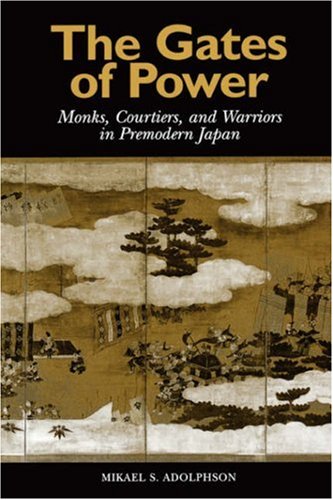
Ebook Info
- Published: 2000
- Number of pages: 472 pages
- Format: PDF
- File Size: 4.16 MB
- Authors: Mikael S. Adolphson
Description
The political influence of temples in premodern Japan, most clearly manifested in divine demonstrations―where rowdy monks and shrine servants brought holy symbols to the capital to exert pressure on courtiers―has traditionally been condemned and is poorly understood. In an impressive examination of this intriguing aspect of medieval Japan, the author employs a wide range of previously neglected sources to argue that religious protest was a symptom of political factionalism in the capital rather than its cause. It is his contention that religious violence can be traced primarily to attempts by secular leaders to rearrange religious and political hierarchies to their own advantage, thereby leaving disfavored religious institutions to fend for their accustomed rights and status. In this context, divine demonstrations became the preferred negotiating tool for monastic complexes. For almost three centuries, such strategies allowed a handful of elite temples to maintain enough of an equilibrium to sustain and defend the old style of rulership even against the efforts of the Ashikaga Shogunate in the mid-fourteenth century. By acknowledging temples and monks as legitimate co-rulers, The Gates of Power provides a new synthesis of Japanese rulership from the late Heian (794–1185) to the early Muromachi (1336–1573) eras, offering a unique and comprehensive analysis that brings together the spheres of art, religion, ideas, and politics in medieval Japan.
User’s Reviews
Editorial Reviews: Review A judicious, detailed, and highly informative account of a complicated history. Relations between the court and the religious elite are extremely confusing, and Adolphson has done an admirable job of sorting out the conflicts and guiding us through them. ― Journal of Japanese StudiesAn impressive contribution on many levels ― The Journal of ReligionWithout question, one of the most thought-provoking non-Japanese works to be written on Japanese medieval history in years ― Japanese Journal of Religious Studies[Adolphson’s] ideas are often very interesting and deserve to be considered by those who teach survey courses in Japanese and East Asian history as well as by … specialists ― American Historical ReviewValuable … This book is worth considering for advanced undergraduates. ― Harvard Journal of Asiatic Studies Review The Gates of Power offers new insights into the dimensions of government in premodern Japan. While focusing on the crucial role of Buddhism from the 11th through the 14th centuries, it also prompts the reader to reflect on the intricate balance between power elites and the complex interdependencies of religion and politics. — Florian Coulmas, The Japan Times About the Author Mikael S. Adolphson is Keidanren Professor of Japanese Studies at the University of Cambridge . Read more
Reviews from Amazon users which were colected at the time this book was published on the website:
⭐If you are a serious scholar in Japanese history or a student on Oriental studies, I would probably recommend to put this book on your “must” list. Far from being a leisurely evening read, this book sheds light into depths of Japanese medieval concept of state governance and interplay between the Emperor’s court, powerful courtiers, prime religious institutions and warrior governments of Minamoto (and Hojo regents) and Ashikaga.Starting with Prince Shotoku’s introduction of Buddhism as the state religion in Japan and blending of Buddhist practices with native Japanese beliefs, religious institutions, temples and shrines started competing among themselves for patronage and, obviously coming with it, donations. The author considers three main sects of Shingon, Tendai and Hosso and their relationships with the court, involvement into court politics and tracks down their development through the times of eighths to early fourteenth century. In light of the politics and main economic concerns of the era, it becomes much clearer, for example, why the capital was moved from Nara to Kioto, or why the warrior government of Ashikaga lobbied the development of the Zen sect of Buddhism and it is much easier to understand a lot of other questions.Kofukuji, the centre of Hosso sect and the family temple of a powerful Heian family of Fujiwara grew into the shugo (the governor) of Yamato province and accumulated so much influence that it employed excommunication of Fujiwara clan chieftains (its hereditary patrons!) in its arsenal of measures exercising the pressure on the court to defend its economic interests. Enryakuji, the Tendai centre and the main provider of ceremonies for the imperial court, expelled head abbots appointed by the Emperor and marched into the capital with sacred symbols showing thereby the anger of gods caused by incursion of warriors into the Temple’s estates. Lovers of samurai history such as myself can see what overwhelming reasons Oda Nobunaga had to destroy this immense complex in his swift operation viewed as an example of cruelty of the Sengoku era.The work is full of names, facts and dates and occasionally I personally found myself swamped by the wealth of information. However, the author does a good job at overthrowing some well established myths in official history relating to the role of Buddhism by putting under a microscope the practice of “divine demonstration” (or “forceful protests”, or “goso” in the original language) and describing the economic and social environment and bases for the all-powerful temple-shrine complexes serving as gates of power, or kenmon.
⭐All great historians share an ability to peel layers and intellectually exercise issues. Adolphson, however, manages an unusual success with “The Gates of Power” by, one, bringing to light poorly understood, often unjustly disregarded, subjects in Japanese history (the precise role of temples, courts and warriors in medieval Japan) and, two, challenging the insipid historiography frequent among Japanese academics; something non-Japanese with experience in Japanese academia can relate to and appreciate.Adolphson also posses a serious and necessary challenge to non-Japanese students and scholars of Japanese history who disservice the profession by willingly accepting and regurgitating the subjective interpretations of the aforementioned Japanese scholars.The Gates of Power is an excellent read and resource into temple, court and bakufu motivations and policies of the pre-Onin period.
⭐For a book centered around religious aspects, the authour does nothing whatsoever to explore the theology of the monks. Basically a timeline in book form.
Keywords
Free Download The Gates of Power: Monks, Courtiers, and Warriors in Premodern Japan in PDF format
The Gates of Power: Monks, Courtiers, and Warriors in Premodern Japan PDF Free Download
Download The Gates of Power: Monks, Courtiers, and Warriors in Premodern Japan 2000 PDF Free
The Gates of Power: Monks, Courtiers, and Warriors in Premodern Japan 2000 PDF Free Download
Download The Gates of Power: Monks, Courtiers, and Warriors in Premodern Japan PDF
Free Download Ebook The Gates of Power: Monks, Courtiers, and Warriors in Premodern Japan