Ebook Info
- Published: 2005
- Number of pages: 608 pages
- Format: PDF
- File Size: 6.92 MB
- Authors: Peter Heather
Description
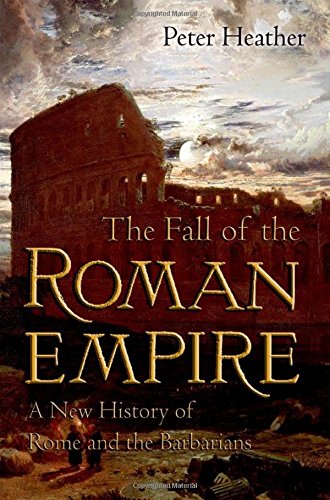
The death of the Roman Empire is one of the perennial mysteries of world history. Now, in this groundbreaking book, Peter Heather proposes a stunning new solution: Centuries of imperialism turned the neighbors Rome called barbarians into an enemy capable of dismantling an Empire that had dominated their lives for so long. A leading authority on the late Roman Empire and on the barbarians, Heather relates the extraordinary story of how Europe’s barbarians, transformed by centuries of contact with Rome on every possible level, eventually pulled the empire apart. He shows first how the Huns overturned the existing strategic balance of power on Rome’s European frontiers, to force the Goths and others to seek refuge inside the Empire. This prompted two generations of struggle, during which new barbarian coalitions, formed in response to Roman hostility, brought the Roman west to its knees. The Goths first destroyed a Roman army at the battle of Hadrianople in 378, and went on to sack Rome in 410. The Vandals spread devastation in Gaul and Spain, before conquering North Africa, the breadbasket of the Western Empire, in 439. We then meet Attila the Hun, whose reign of terror swept from Constantinople to Paris, but whose death in 453 ironically precipitated a final desperate phase of Roman collapse,culminating in the Vandals’ defeat of the massive Byzantine Armada: the west’s last chance for survival.Peter Heather convincingly argues that the Roman Empire was not on the brink of social or moral collapse. What brought it to an end were the barbarians.
User’s Reviews
Editorial Reviews: Review “A rich and dramatic synthesis of the latest research on Gibbon’s old story….The drama of Mr. Heather’s book lies not just in the world-changing story he has to tell, but in his behind-the-scenes view of how historians work. Like a master detective, Mr. Heather employs the most various techniques–everything from pollen sampling to archaeology to literary criticism–to wring the truth from the reticent past….What Mr. Heather offers is not easy analogies but a realization of the complex strangeness of the past–the achievement of a great historian.”–Adam Kirsch, New York Sun”Like a late Roman emperor, Heather is determined to impose order on a fabric that is always threatening to fragment and collapse into confusion; unlike most late Roman emperors, he succeeds triumphantly.”–The Times of London”Gibbon’s ‘awful revolution’–the decline and fall of the Roman Empire in the West–still casts a pall. Yet, as Peter Heather’s brilliant mixture of rapid flowing narrative and deeply thought analysis fully brings out, it still exerts a pull too. ‘Lepcisgate’, Alaric’s Goths, and Attila’s Huns are all thrown into Heather’s melting pot along with Roman imperial aims and mismanagement. The outcome is a conclusion Heather finds pleasing–and Gibbon would not have despised–that Roman imperialism was ultimately responsible for its own demise.”–Paul Cartledge, University of Cambridge”To a period that has often appeared as impenetrable as it is momentous, Peter Heather brings a rare combination of scholarship and flair for narrative. With this book, a powerful searchlight has been shone upon the shadow-dimmed end of Rome’s western empire.”–Tom Holland, author of Rubicon: The Last Years of the Roman Republic”Deftly covering the necessary economic and political realities of decline and fall, Heather also presents the stories and the characters of this tumultuous epoch, in a colorful and enthralling narrative.”–The Independent”Masterful, lucid….Always rewarding.”–ForeWord Magazine About the Author Peter Heather teaches at King’s College, London. A leading authority on the barbarians, he is the author of The Goths, Goths and Romans, and The Huns.
Reviews from Amazon users which were colected at the time this book was published on the website:
⭐This is a truly wonderful book, of the kind that I wish I had had when I studied this stuff in school. Unlike the dry textbook that I suffered through, this book brings the process of discovery alive as well as tells a great story. You follow an inspired scholarly mind as he puts together a compelling narrative with loads of delicious detail. I was utterly riveted by this for more than a month.Heather begins with a description of the Empire as it stood about 300 A.D. Rome itself had become a religious and ceremonial capital, far from the frontier, where the real political power had migrated to serve military necessity. It was a vast and integrated world, unified not just by military power, economic activity, and the most advanced administrative system to have yet existed, but it had a literate culture that, once mastered, allowed indigenous (conquered) populations to make their own careers within it. Heather describes this culture in sensuous detail, relying largely on the words of its most illustrious citizens, many of whom were accomplished letter writers and poets – you get to know them. Of course, they were all super-rich landowners, but then Rome represented them aboveall, which became the model for the European aristocratic states that arose and lasted until the 19C. He also describes both the brutality of life at the top – losing a political battle meant losing not only your head but those of your entire family – and the limits of administrative reach across such a huge expanse of territory.He then shifts to the barbarians. After centuries of contacts with Rome, they had adopted many of the economic methods of the empire. This led to an extraordinary increase in population among the Germanic tribes with more diversified economies and societies; they were also uniting politically into far greater groups and better organized as war machines. Even worse, there was a major empire – the Huns – who were pushing the Germans into the Roman Empire, first as refugees and then as roaming pillagers. As one of the world’s experts on them, Heather offers a wealth of detail on their cultures, war techniques, and origins. There are many surprises: Alaric, the first sacker of Rome in 410, was a Christian and hence reluctant to sack the capital; Theodoric the Great was bought up in Byzantium and hence classically educated and trained. He also describes their technology, such as the Hunnic bow, of uniquely lethal power.This is his way of refuting the arguments that the Roman EMpire was in some kind of inexorable moral decline, from the adoption of Christianity to demographic stagnation and economic exhaustion. To strengthen his case, Heather relies on new archeological evidence of the economic prosperity, particularly in African and the Near East, but also within the graves of germanic tribes, who “taxed” the empire by the threat of pillage. While I found his treatment of the impact of its christianization a bit too quick, he makes a solid and fascinating case that is very very fun to read.If you accept his premise – that the empire’s fall was not at all inevitable – then the author’s argument becomes entirely geo-political. Once certain Germanic tribes were inside its borders, they undermined the fragile structure of the huge economy: Vandals captured the North African breadbasket provinces, which lessened tax revenues and food exports to Italy, fatally weakening it as the pressure from the Huns was greatest. Thus, while the Huns never invaded Rome the city, their actions did lead indirectly to Rome’s fall.Heather also incorporates fascinating theories on empires and how they evolve. Rome was different: it unified and co-opted local elites, which enabled it to survive 500 years. In contrast, the others were based on plunder by their troops, requiring continual victories (via charismatic leaders like Attila, who was viewed as infallible) that eventually stretched their supply lines too far. After the failures began, the troops (often multi-ethnic) fell to fighting eachother; no unifying culture and economy could channel their energies, leading to quick collapse. I had never thought of this so succinctly, but this is only one of the many details that Heather explains and examines in the course of his argument.What is amazing about this book is what a pleasure it is to read. Heather is a master stylist, has the erudition you expect from Oxford scholars without the stuffiness, and can transmit his love of the subject on every page. While my interest began to flag towards the end, the book left me very hungry for more.Warmly recommended.
⭐Fast delivery and excellent quality.
⭐Peter Heather has written a very informative and readable book on the late Roman Empire and his take on the reasons for the fall of the Western Empire. In essence, his thesis is that the fall of the Western Empire was not due to internal imperial breakdown, but rather by the nature and extent of the impact of various groups collectively known as the Barbarians. Rome’s imperial expansion, as he concludes in the last chapter, laid the seeds of its own ultimate destruction by the late fifth century AD. Heather begins by laying the groundwork for our understanding of the history and status of the Roman Empire, how it functioned and how it evolved, in other words, what Romanness was about. He also gives us a glimpse of the Barbarians who lived outside the boundaries of the Empire, in Central and Northern Europe and other locations. The great pressure points of the Roman Empire fell roughly along the Rhine and Danube Rivers and Persia to the East. Long before the great challenges during the Fourth and Fifth Centuries AD, Rome had faced the annihilation of three legions under Varus near the Teotoburg Forest in the Empire’s early history. During the Third Centrury AD, the Eastern part of the Empire had been threatened and humbled by the Sasanian Dynasty of Persia, which for a time posed the greatest threat to the Empire. His descriptions of the changing nature of Rome are very good and give us a good sense of how the empire was evolving while at the same time adhering to its basic traits. The landowning classes, the military, the division of power at the top (i.e. two emperors, one East, one West), the imperial bureaucracy and other facets are all discussed. The changing nature of the Germanic speaking regions and their economy are also discussed, even with fairly limited evidence. The conflicts between Rome and those across its borders had been occurring for some time, but by the late fourth century AD, things changed in dramatic ways. In AD 376, thousands of these Barbarians sought refuge in Roman territory, a decision that would have grave consequences for Valens and his army at Hadrianople a few years later. Heather argues that it was the Huns migration westwards, in turn pushing these other groups like the Goths into Roman territory, that ultimately had more impact on the decline and fall of the Western Empire than Attila’s own raid on the West in the mid fifth century. In AD 410, Alaric’s Goths had sacked Rome, though Heather makes it out to be more of a symbolic blow than a life threatening blow for the Empire. There were imperial leaders like Flavius Constantius and later Aetius who managed to check and defeat numerous barbarian forces and usurpers who sought to exact more territory from the Empire, which was gradually weakening the Empire’s revenue source and hence it’s ability to survive. Ironically, Aetius had been able to enlist the support of Hunnic forces to confront the Visigoths at one point and later when Attila was attacking the West, Aetius employed Visigoths, including their king, Theoderic, against the Huns. The seizure of most of the Roman territory in North Africa by the Vandal-Alan coalition, including its richest provinces like Carthage, was a major blow to the Empire’s revenue and supply source. Heather also argues that Attila’s death in some ways precipitated the decline of the West as the Hunnic Empire would soon dissolve and the various tribes would be asserting their own desire for independent kingdoms. A final attempt to take back Carthage and Rome’s former territories in North Africa with massive assistance from Constantinople in terms of their large fleet would end up in total failure by AD 468. In AD 476, the last Western Emperor was deposed, thus ending the Western Roman Empire. As Heather argues, if internal problems had been the sole reason for Rome’s fall, why did the Eastern Empire continue and even flourish for some time afterwards? He also uses the later Carolingian Empire as an example of an empire possessing fatal internal problems. Heather’s arguments are sound and seem to be based on pretty solid research. I still don’t think there will ever be one definitive explanation for the reasons or the events that led to the fall of the Western Roman Empire. I guess since I’m not an expert on it I’m taking a safe approach to this issue. Heather’s book is still impressive and displays some sturdy interpretations. Of course one of the difficulties in understanding this period is the lack of surviving evidence from written sources to material remains. There will always be so many unanswered questions. Heather utilizes both the written records and archaeological evidence very effectively. Many of the historians and writers from this period I had never heard of. Overall, a very good book.
⭐I have been very disappointed by the book. Half of it is indeed an history of the end of the roman republic and early roman empire. Then, the thesis is : the roman empire was strong and rich, there is are no clues about an internal weakness that could have led to its dissolution. It is only the fault of the barbarians… and then nothing new, except that the author suggest the huns were not very numerous and could have hardly frightened the goths. The goths themselves were hardly 100.000, so how come they could have destroyed the roman empire with 600.000 crack troops ? the story is unconvincing and the author provide very few novelties to the topic according to me. Any video on you tube provide more insight. Not woth buying.
⭐I was surprised when opening a book on the LATER Roman Empire to be confronted by an episode from Book V of Caesar’s ‘Gallic Wars’ which took place in 54 B.C. I remembered studying this episode as part of Latin O.L. (over 50 years ago). I should add that it comes from Book V: 26-37 and NOT Book 6 as the endnote states. Even so, I realised why it was there. Peter Heather starts with what Rome once was, then passes on to what it thought it should be (e.g. the writings of Symmachus (345-404) and then examines the fall of Rome in the west.Unlike Edward Gibbon in ‘The Decline & Fall…’, who threw away the Western Empire for love of Byzantium, Heather remains true to his title. It is an enormous subject and, although familiar with the subject, I found myself constantly introduced to new aspects. The work ,really in a way is like a spiral in reverse. It starts at a narrow point – Caesar, SPQR, the Principate etc. – and widens out gradually. So he deals with Rome’s vulnerability at three points – the Rhine, the Danube and Mesopotamia. Then pops over the borders to look at the causes of such pressure, the Sasanian dynasty in Persia, the Goths the other side of the Danube and the Germanic peoples beyond the Rhine. As relations between Rome and the barbarians are described the reader can recognise both variation and flexibility in such relations but also how so much of historical scholarship has been forced to see matters from the Roman standpoint.After looking more closely at the barbarians, Heather produces a masterly examination on ‘the limits of empire’. The basic premise is that the Roman Empire had outgrown its chance of survival. So distances and shortcomings in both administration and communications undermined the effectiveness of the imperial rescript. The Emperor could only act on what he knew and the results could be modified on what both he and the locals knew. Heather dwells on the work of Tchalenko who questioned the thesis of rural decline largely due to imperial taxation after c.300 – as I’d been taught re’ Roman Britain when studying AL History fifty years ago. There is a problem: evidence would indicate that the outdated image of rural decline actually persists in Italy and the northern frontiers. Heather cannot explain why? Might I suggest that a couple of factors might be that these areas were more under the imperial eye (& fiscal effectiveness); also I suspect a higher degree of ‘out-sourcing’ (to use a modern term) by those controlling the wheels of power at the centre. Again Heather notes the decline in ‘civic display’, pointing out how those with influence migrated away from local to central areas of power – e.g. the rapid rise in the numbers of upper imperial bureaucracies laying down the rules, although ‘the process was taken over by locals responding to the rule changes and adapting them to their own interests’ (P.117). In sum, life became too complex for central bureaucracy to handle, as contemporary governments are discovering nowadays. Heather argues that the army was neither under-manned nor under-paid when first it had to face unprecedented problems. Thankfully, he dismisses the arguments of Gibbon that the Empire was undermined by the conversion to Christianity. Apart from the theological quagmire of ‘orthodoxy’ during these centuries affecting the ‘chattering classes’ (my phrase not Heather’s) the population was probably little troubled by this. Wealth granted to the Church simply replaced that granted to pagan institutions (N.B. Coptic Egypt); another point was that the numbers rushing off to a ‘religious life’ were a tiny minority. ‘At the top end of Roman society, the adoption of Christianity made no difference to the age-old contention that the Empire was God’s vehicle in the world’ (P.125). He compares the system to the one-party state as seen in the Soviet Union, I would suggest Mao’s China c. 1960 being a better example: however, he does describe the expansion of a legal ‘apparatchik-style’ privileged minority, as also seen in the contemporary growth of lawyers and accountants, dealing with the complexities central authority couldn’t handle. Finally, his conclusion is quite clear: ‘there is no sign in the fourth century that the Empire was about to collapse……. the late Empire was essentially a success story'(P.141). Nevertheless, within a couple of pages the reader DROPS into the section labelled ‘Crisis’. May I suggest this relates to the unfashionable ideas of Arnold Toynbee regarding ‘Challenge and Response’ in ‘A Study of History’ (1934-61)?The crisis came with the intrusion of Goths across the Danube border in 375, supposedly seeking asylum from the Huns. Why this occurred is obscure. The Gothic ruler, Ermanaric, features little in Heather’s work, but large in legend. Might I suggest that Ermanaric applied pressure vs. the Huns who resisted, found defences weaker than expected and overthrew Ermanaric, forcing the Goths to flee westwards. A similar situation occurred in 1219 when the Kwarizmian ruler, Ala ad-Din Muhammad, tried to apply pressure against the Mongols under Genghis Khan to the east. The Mongols struck, overthrew his kingdom and poured into Persia – following that with advances through Russia etc.Heather provides an excellent introduction to the Huns, arguing that their success depended mainly on a long, reflex bow which was asymmetric (knew to me!). Heather rejects firmly the idea that the Huns possessed stirrups, which I thought was debatable. He wades into the origins of the disaster of Adrianople (378), rejecting the usual explanation based on Roman sources. Essentially he argues the Empire was over-stretched because of tension with Persia, failed to control details of allowing the Goths into the Empire (e.g. keeping the two major groups (Tervingi and Greuthingi) apart and the treatment of the Goths by local officials) and actual strategy and tactics.Afterwards, it was a question of patching up a structure on the point of collapse. Peace was made with the Goths under the deceptive glow of a Gothic surrender. A string of Emperors came and went – Gratian (375-83), killed fighting off usurpers; Valentinian II (375-92), and Honorius (395-423), nonentities not deserving the imperial throne; a collection of semi-legitimate emperors, such as Maximus (383-88), flashing and exploding in the chaos of internecine warfare; and Theodosius I (379-95), who tried to establish order out of chaos (like predecessors Diocletian and Constantine)but lacked the time to make it firm enough to survive the next crisis.In 410 Rome fell to the Visigoths and the next 66 years was really a ‘long goodbye’ to borrow a title. Heather explains all this clearly and fully, with a masterly use of source material. He steps into a series of controversial topics with a sureness of touch; such topics are controversial largely because of the paucity of sources (e.g. the butchery of the work of Olympiodorus of Thebes by later writers / copyists) and their one-sidedness. He applies logic to sort out problems – certainly as a medievalist he must be well-used to such approaches. In this way he handles the gap between the Gothic victory at ‘Hadrianople'(sic) and the sacking of Rome in 410; the migration of Vandals, Alans and Suevi in 406 and the early stirrings of Hunnish influence in the ‘volkerwanderung’ (an antiquated term he never uses). A masterly section is his description of the Vandal intrusion into North Africa. Meanwhile he tackles the infighting at the top of the Roman power structure, requiring close examination of source material, which explains partly how Roman power was swept aside.In the midst of this twilight of a millennium one man stands out in the narrative like a colossus and that is Aetius, performing miracles in restoring imperial control in Gaul and ABOUT to repeat the act in North Africa when in pour the Huns – now under the determined and opportunistic control of Attila. Heather does not hide the fact that Aetius was a fixer, a juggler keeping so many balls in the air to maintain the impossible, the survival of the Western Roman Empire.The challenge appeared to dissipate with the sudden death of Attila in 453 but it proved to be short-lived as the Western Empire was snuffed out in 476. It is no coincidence surely that Aetius was murdered(454) by Valentinian III and within six months the murderer, the last Emperor with any authority within the Western Roman Empire, was in his turn assassinated. As Heather remarks: ‘Aetius’s death was far more than one man’s tragedy. It also marked the end of an era. The death of Attila and the end of the Hunnic Empire not only made it possible for Valentinian to contemplate life without Aetius, it also undermined the delicate balance of powers by which Aetius had kept the western Empire in business.’ (PP 374-75) Thereafter heather’s tale is of little men doing nasty things to each other until the dregs of a once mighty system trickled away.The book is excellently written, with good citing of sources and a useful glossary. In fact, it is the best book I’ve read on an important, but usually ignored, subject..One final point. My final impression is that the book should be retitled as ‘The Fall of the Roman Empire: A Study in Near-Survival’. It certainly deserves 5 stars.
⭐One of my favourite periods in history because of all the questions it throws up is the Decline and Fall of the Roman Empire and the succession of the Dark Ages. I am coming to the conclusion that Peter Heather’s writing, which I have only just come across through a recent review in the Sunday Times, is amongst the best. He looks at a variety of economic, sociological, political and diplomatic reasons for the Fall – which indeed is the only way to examine it. A mere chronicle tells you nothing nor does a single-cause theory, most famously espoused by Edward Gibbon who argued that it was Christianity whodunnit! Pathologists find that a lot of human beings die of multiple causes; so, it seems, do Empires.I am only halfway through the book but already have reached the point where Heather treats how the Romans so badly handled the problem of hordes of Goths turning up on the Northern Frontier that it was a major cause of the decline in what previously had been a viable Empire
⭐I’m not a scholar on ancient history but I’m interested in the field and have read a number of books on ancient Rome. I loved this book. Heather puts forward an interesting thesis on the ‘fall’ of Rome (actually the collapse of the Western half – the Eastern empire continued for centuries), backed up by frequent references to sources, so he is not just telling the reader to take his word for it. I’m going to hunt out more of Heather’s work on the basis of this book.
⭐Great. Well researched and well written. Ocasionally, a tad dry and a little repetitive, but great piece of history. Recommended.
Keywords
Free Download The Fall of the Roman Empire: A New History of Rome and the Barbarians 1st Edition in PDF format
The Fall of the Roman Empire: A New History of Rome and the Barbarians 1st Edition PDF Free Download
Download The Fall of the Roman Empire: A New History of Rome and the Barbarians 1st Edition 2005 PDF Free
The Fall of the Roman Empire: A New History of Rome and the Barbarians 1st Edition 2005 PDF Free Download
Download The Fall of the Roman Empire: A New History of Rome and the Barbarians 1st Edition PDF
Free Download Ebook The Fall of the Roman Empire: A New History of Rome and the Barbarians 1st Edition