Ebook Info
- Published: 2017
- Number of pages: 320 pages
- Format: PDF
- File Size: 4.43 MB
- Authors: Peter Temin
Description
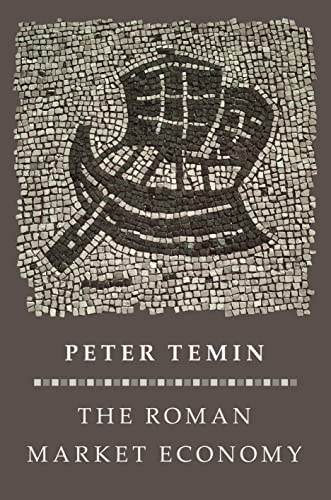
What modern economics can tell us about ancient RomeThe quality of life for ordinary Roman citizens at the height of the Roman Empire probably was better than that of any other large group of people living before the Industrial Revolution. The Roman Market Economy uses the tools of modern economics to show how trade, markets, and the Pax Romana were critical to ancient Rome’s prosperity.Peter Temin, one of the world’s foremost economic historians, argues that markets dominated the Roman economy. He traces how the Pax Romana encouraged trade around the Mediterranean, and how Roman law promoted commerce and banking. Temin shows that a reasonably vibrant market for wheat extended throughout the empire, and suggests that the Antonine Plague may have been responsible for turning the stable prices of the early empire into the persistent inflation of the late. He vividly describes how various markets operated in Roman times, from commodities and slaves to the buying and selling of land. Applying modern methods for evaluating economic growth to data culled from historical sources, Temin argues that Roman Italy in the second century was as prosperous as the Dutch Republic in its golden age of the seventeenth century.The Roman Market Economy reveals how economics can help us understand how the Roman Empire could have ruled seventy million people and endured for centuries.
User’s Reviews
Editorial Reviews: Review “Temin is a professional economist, and his book glows with the fervour of the true believer.”—Peter Thonemann, Times Literary Supplement”[T]his important book should be a challenge to ancient economic historians of all persuasions to engage seriously with both economic theory and comparative history, as well as with its specific claims about the development and performance of the Roman Empire.”—Neville Morley, Sehepunkte”In The Roman Market Economy Peter Temin accomplishes the quintessential task of the economic historian: to take shards of pottery, folios of brittle parchment, and patinated tools and fashion from them a credible, comprehensive and vivid picture of a society long gone.”—Plamen Ivanov, LSE Review of Books”The Roman Market Economy effectively demonstrates the elegance and simplicity of economic demonstration. But Temin’s methodological point would have been more persuasive had it shown that an economic methodology can lead to new, or challenge old, understandings of the ancient economy.”—Sitta von Reden, Journal of Interdisciplinary History Review “The study of ancient economies has for many generations been a fiercely debated field. Peter Temin has produced a book that will in many ways foster renewed energy in this great debate. What is of special value here is his economic analysis, including the use of regressions to show that price movements in the Roman provinces must be linked to those in Rome itself, and that the Roman economy, therefore, was a market economy. Whether one agrees or not with this basic conclusion, the framing of the evidence will alter the terms of the debate, and not just for the Roman economy but for Hellenistic economies as well. The book is a must-read for all economic historians and will surely become one of the most widely read books on the ancient economy.”―J. G. Manning, Yale University”Peter Temin’s fascinating book deploys the techniques of economic analysis to understand the nature of Roman trade, markets, and transactions, and definitively challenges the view of the Roman Empire as a ‘primitive’ economy. Stressing the importance of markets, trade, commerce, and banking, and emphasizing their prominence in the evidence from ancient texts and archaeology, Temin offers a sophisticated account of Rome’s economic institutions and practices that fundamentally revises and enriches our understanding of the prosperity and the decline of this major imperial power.”―Alan K. Bowman, University of Oxford”This is a very important book, and I know of no other quite like it. Temin’s scholarship promotes and illustrates the relevance of economic theory to the study of Roman history. The Roman Market Economy contains plenty of claims that are controversial, but that’s what will energize the debate.”―Walter Scheidel, coeditor of The Oxford Handbook of Roman Studies”Economic historians have actively studied medieval and early modern Europe for decades, but few have ventured back as far as Peter Temin does here. He demonstrates that economic arguments apply just as well to the ancient world, and that even quite general propositions can be tested against evidence from antiquity.”―François R. Velde, coauthor of The Big Problem of Small Change From the Back Cover “The study of ancient economies has for many generations been a fiercely debated field. Peter Temin has produced a book that will in many ways foster renewed energy in this great debate. What is of special value here is his economic analysis, including the use of regressions to show that price movements in the Roman provinces must be linked to those in Rome itself, and that the Roman economy, therefore, was a market economy. Whether one agrees or not with this basic conclusion, the framing of the evidence will alter the terms of the debate, and not just for the Roman economy but for Hellenistic economies as well. The book is a must-read for all economic historians and will surely become one of the most widely read books on the ancient economy.”–J. G. Manning, Yale University”Peter Temin’s fascinating book deploys the techniques of economic analysis to understand the nature of Roman trade, markets, and transactions, and definitively challenges the view of the Roman Empire as a ‘primitive’ economy. Stressing the importance of markets, trade, commerce, and banking, and emphasizing their prominence in the evidence from ancient texts and archaeology, Temin offers a sophisticated account of Rome’s economic institutions and practices that fundamentally revises and enriches our understanding of the prosperity and the decline of this major imperial power.”–Alan K. Bowman, University of Oxford”This is a very important book, and I know of no other quite like it. Temin’s scholarship promotes and illustrates the relevance of economic theory to the study of Roman history. The Roman Market Economy contains plenty of claims that are controversial, but that’s what will energize the debate.”–Walter Scheidel, coeditor of The Oxford Handbook of Roman Studies”Economic historians have actively studied medieval and early modern Europe for decades, but few have ventured back as far as Peter Temin does here. He demonstrates that economic arguments apply just as well to the ancient world, and that even quite general propositions can be tested against evidence from antiquity.”–François R. Velde, coauthor of The Big Problem of Small Change About the Author Peter Temin is the Gray Professor Emeritus of Economics at the Massachusetts Institute of Technology. His books include The World Economy between the World Wars. Read more
Reviews from Amazon users which were colected at the time this book was published on the website:
⭐Were the Romans, and the people in Egypt and Palestine and its other provinces, like us? Obviously, not exactly. We are separated by some 80 generations of history and innovation. Their economy, however, may have resembled ours more than you would think. After Pompey tamed the pirates of Crete and elsewhere in 67 BC, the Mediterranean became a Roman lake. For several centuries afterward, the Pax Romana boosted trade throughout the region, not just in luxury goods but in staples as well. Peter Temin, in his 2012 book The Roman Market Economy, estimates that at the beginning of the current era supplying Rome with wheat, wine, and olive oil required four thousand ship voyages a year. Those voyages took longer than today. The web site orbis.stanford.edu enables you to calculate the time and cost of travel between the major cities of the empire by season. The fastest summer route from Jerusalem to Rome, for example, required 28 days. Temin says that the entire Mediterranean became a unified market economy. Prices of wheat and other staples were flexible rather than set by law. As you would expect in a market economy, prices were higher the closer you got to Rome, the largest city in history until London in the 18th century. Because of the cost of shipping, wheat was cheaper in Palestine and Egypt than in the capital. Feeding Rome through a market system would have been impossible without a legal system and ways to finance and insure commercial voyages. Courts existed to resolve business disputes. Loans to finance voyages often included insurance. They were not to be repaid if the ship sank. With a unified coinage, the early empire largely avoided inflation, even as conquering areas with mines added to the supply of silver and bronze. With the defeat of the pirates and the growth of trade, regions specialized in what they did best. Palestine shipped glass ingots to Gaul, where it was blown into vases. More generally, regions specialized in wheat, or olive oil, or wine as conditions favored them. Providing an additional boost to output, a climate warming period started in the 2nd century BC and lasted through the 2nd century AD. Commerce brought urbanization, which led people into skilled jobs such as tent-making and other skills. Training for these jobs—the most common crafts were carpentry and other building trades—came from fathers and from guilds. Cities aided the creation and spread of ideas in civil engineering and architecture. Literacy, though far below that of England at the beginning of the industrial revolution, was higher than at any time until after the middle ages. Often workers were paid market wages. Though slavery existed throughout the empire, it was concentrated in and near Rome. Commerce and cities had a downside as well. They spread infectious diseases. For the average person, life was shorter in the cities than in the countryside. The urban death rate may have been 60 per thousand, compared to 40 per thousand overall. Characterizing the early Roman empire as a market economy arouses protests from a number of scholars who emphasize the army, the exaction of tribute, the seizure of mines and lands from conquered territories, and the forcing over the centuries of millions of non-Romans into slavery. The 2012 Cambridge Companion to the Roman Economy presents many of their views. Nearly all scholars agree that had the empire lasted through the first millennium, it would not have brought an earlier industrial revolution. That would have required a combination of widespread literacy and numeracy, cheap fuel, and high wages that it never enjoyed.
⭐This book is for readers who have at least a basic knowledge of the Roman Empire and a basic understanding of economics. I would suggest that if you have not read Gibbon and did not stay awake during Econ 201-203, you will miss much of what is being said. I use Gibbon only as a benchmark of knowledge, since one who has read enough on the subject to appreciate this book will almost certainly have read the Decline and Fall. The book discusses several controversies which are still going on about the reasons for the decline of the empire. It does not take sides, except that quite reasonably, since it is a study of free markets in the Roman economy, it does imply that Marxist nonsense was not involved. The comments on the nature of Roman slavery might serve as an antidote to those who have been misled by “Spartacus”. The book focuses on the economics of the late republic and early empire. Warning. Math is used. 🙂 I would have liked it better if it had backgrounded a little more for the general reader. It would then have been a good introductory book to an expanding area of historical research.
⭐I should start by stating that I am not an academic. And this is clearly an academic book. I have always been interested in reading about the Roman Republic and Roman Empire. After reading numerous histories and novels of this period I always came away disappointed. Most books focus on the military battles and the political battles, but never address what really made Rome so prosperous. In order to keep the republic and empire so strong for numerous centuries, there also had to be an incredibly efficient economy in place. How did the Romans become proficient in building large cement structures and roads across the empire? How did they feed 1 million residents in the main city of Rome? This could not just be a result of the spoils of war. There also had to be a thriving economy. Was this the first example of large scale capitalism at work? Did the Senators and Emperors understand and encourage a free market economy?I could never find a book that addressed these questions until I found this book. It kind of attempts to answer those questions. However it is very long on academic analysis (including innumerable economic/mathematical equations) and very lacking in either conclusions or thoughtful hypothesis. Hopefully somebody will expand the research on this subject.
⭐It is hard to imagine a more tedious and irritating book. The basic thesis, that Rome was a highly progressive market economy is presented, Supported by minor evidence and then belabored for countless pages. I will grant that Temin has shown that it is highly likely that the Roman Republic and the early Empire did hae extensive functioning markets that set prices for private transactions. I am, at the same time deeply disappointed that Temin has entirely failed to account for the role of conquest, looting, kidnapping and extortion in the flows of goods and services through the Roman world.The fact that Rome was more or less constantly at war until Augustus, the importance of slaves in the Roman economy and the role of Egyptian tribute in the feeding of Rome have more or less vanished. If markets set the price at the margin then these all become “distributional” questions of no interest to the economist. Except we might consider the marginal choice ot the Roman general between taking labor as slaves or burdening a province with tribute. it is all cool.At one point Temin excuses the treatment of slaves because “Romans were just cruel”. But this is the question that really needs to be asked. Was Roman economic stability built on conquest and, if it was, how did this contribute to the ruthless and violent culture that we have used as a model for our own.
⭐Very good
⭐This book is brilliant and well-written; Temin shows how, even with sparse data, we can make a few tentative observations about the Economy of the Roman Empire. His prose is mostly pleasant to read, and he does an excellent job of analyzing different facets of the Roman economy. This is a classic that must be read by classical scholars.Temin starts the book by framing the debate as being between ‘modernists’ and ‘primitivists.’ The former believe that the Roman economy was largely market-driven, and can be analyzed using tools of modern economics: comparative advantage, supply and demand, etc. Primitivists, on the other hand, would demur, and instead conceive of the Roman economy as primitive: dominated by local patronage networks, slavery, and military expansionism. Temin tries to argue in favour of the modernists — in this, I do not believe he succeeds.A full review is too exhaustive for Amazon, but I shall provide a single example. In Chapter 2, Temin uses six noisy observations of wheat prices to argue that the Roman Mediterranean economy was interconnected. This may be the case, but there are a few problems with this argument:1) A sample size of 6 is too small to make definitive conclusions.2) An interconnected regional economy does not suggest that the Roman Empire in general was interconnected; what about outlying regions in Gaul and Germania?3) Even if the entire empire was economically interconnected, much of this might have been state-driven via patronage networks; higher prices could reflect compensation for travel across longer distances. This would simply be a primitivist spin.I might be nit-picking, but I do not believe, as one academic claims, that Temin has nailed the coffin of the primitivists. However, for those scholars who are seeking a path into study of the Roman economy, this is an excellent place to start. The perennial debate between the primitivists and modernists is ongoing, and both sides have valuable contributions to the discussion.
⭐Il semble que la vieille querelle entre primitivistes et modernistes soit désormais révolue.Ce livre montre que les théories actuelles sur l’économie peuvent être appliquées avec succèsau monde antique. Je ne pense pas trop m’avancer si je dis que ce travail resteraune référence incontournable pour les années à venir.
⭐
Keywords
Free Download The Roman Market Economy (The Princeton Economic History of the Western World, 44) in PDF format
The Roman Market Economy (The Princeton Economic History of the Western World, 44) PDF Free Download
Download The Roman Market Economy (The Princeton Economic History of the Western World, 44) 2017 PDF Free
The Roman Market Economy (The Princeton Economic History of the Western World, 44) 2017 PDF Free Download
Download The Roman Market Economy (The Princeton Economic History of the Western World, 44) PDF
Free Download Ebook The Roman Market Economy (The Princeton Economic History of the Western World, 44)