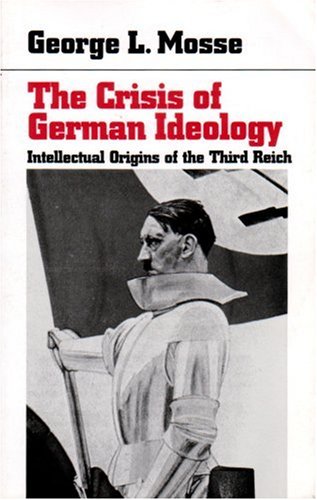
Ebook Info
- Published: 1999
- Number of pages: 373 pages
- Format: PDF
- File Size: 32.99 MB
- Authors: George L. Mosse
Description
Excellent Book
User’s Reviews
Reviews from Amazon users which were colected at the time this book was published on the website:
⭐This book is a fascinating account of the various threads of the early stages of modern Germany which led to the fallacy of ‘The Aryan Myth’ and its amorality which contradicts every notion of “The Oneness of Humanity”. A reality all the Messengers knew of, yet were moot about expressing it in such a manner as how Baha’u’llah was mandated to clearly articulate, and which refutes emphatically what the confusion of the early German Volk proponents vainly imputed to having evolved white skin, blue eyes, and blond hair. A great deal of the ‘Volk Mystique’ is laid bare to witness how early Germans went about disputing the ‘Semitic’ elements in the Bible, and rewriting it as a “German Bible’ in order that it conform to the perceptions Germans had of themselves, and the subsequent weaving of the myth of Aryan superiority.
⭐An excellent review but fails to confront many basic issues. Perhaps they would have interrupted the conclusion whichwas foregone. Eg. Was Europe—all of it—becoming more industrialized? (Volkisch: “modernity”) Was it becoming moreurgan. (Volisch: == Jewish??) Were they many wealthy Jews, say dept store owners vs. small retail (anti-Semitic)stores? Why were there many Jewish bankers? Why did Jews control half of wealth of Frankfurt? Two ways ofdefeating a depression are collective hate of a minority (pick one) and war. How did these function? Factsfigures and analyses are needed. And in this book are absent.Book does provide perceptive analysis of background of anti-Semitism Author.confesses that Hitler “probably” neverread these “thinkers” himself. Did Jews and Zionism battle anti-Semitism,Hitler or appropriate its tactics.
⭐How could the horrors of Nazi Germany happen? The focus in this book is on the intellectual and philosophical ideals that helped enable Nazism, ideas about the “volk,” racial purity, the importance of rural life, and the best way to educate the young. It’s an interesting read.
⭐Exactly as described. Arrived quickly.
⭐Don’t read this book unless you absolutely have to. I had to read it for school & almost paid somebody to read it for me. I wouldn’t make my worst enemy read something this boring.
⭐Essential, very readable book on the psychology and sociology leading up to the Nazi takeover of German politics.
⭐This outstanding book is basic to understanding Nazism and the Third Reich. Without indulging in any historical determinism, Mosse exposes and analyzes the intellectual background of Nazism in this very well written and documented book. The Volkish ideologies that formed the seedbed of Nazism were the products of several major developments in 19th century Germany. Deeply rooted in Romanticism and Idealism, the Volkish ideology emerged towards the end of the 19th century as a reaction to the disappointments of Imperial Germany. Many Germans, who had grown up with a highly romanticized idea of what unification would bring, found the prosaic reality of Imperial Germany profoundly disappointing. The belated unification of Germany under the Prussian Crown, accompanied by the stresses of rapid industrialization, disappointed many who found that the Wilhelmine state did not produce the expected social solidarity. At the same time, rapid industrialization with the emergence of a self-conscious and politically active working class and powerful business interests was deeply threatening to many, particularly traditional the traditional middle classes and craftsmen.Mosse lays out very well how a group of now largely unknown and third rate intellectuals developed an increasingly popular ideology consisting of mystic and anti-rational identification of the German Volk with civilized values. These values were opposed to liberal capitalism, democratic politics, the idea of universal human values, the rationality underlying the natural sciences, and socialist ideas. Added to these ideas were a sense of living is a period of social degeneration, racism, powerful anti-semitism, social darwinism, an exaltation of emotion and action over thought, and longing for a fictious past based on a highly romanticized view of medieval Germany. The Volkish solution was a social regeneration that would sweep away both capitalism and socialism, abolition of democratic forms of government, with simultaneous personal and social transformation led by a charismatic leader.Mosse shows well how these ideas were spread throughout German society by a variety of intellectuals, journalists, publishers, and particularly through the excellent German educational system. German schools incorporated Volkish ideas into their standard curricula and Volkish intellectuals were tremendously influential in German universities. Mosse takes pains to emphasize the strongly middle-class nature of this ideology and its adherents, and the way it captured a very large segment of German youth before, during, and after WWI. The catastrophe of WWI and its aftermath was an enormous boost to Volkish ideologies. The sense of social decline and degeneration received apparent validation from the events of the war and the instability of the Weimar Republic.The great achievement of Hitler and his lieutenants was to develop a popular movement, an idea resisted by the generally elitist Volkish intellectuals, based on Volkish ideas. Anti-semitism, in particular, was crucial as it identified Jewry as the cause of German decline. Social regeneration then, could be accomplished by removal of Jews and institutions supposedly associated with Jews – democracy, socialism – without any real assault on the existing social or economic order. Hitler’s German revolution was consequently a necessarily anti-Semitic revolution. That Volkish ideas constituted a remarkable flight from reality was both practically and theoretically irrelevant.Beyond its great value in illuminating a crucial chapter of modern history, The Crisis… also has some interesting contemporary relevance. There have been some recent charges from a variety of right wing sources that Darwin’s evolutionary biology led to Nazism. Similarly, there has been some not very well substantiated efforts to associate socialism and liberalism with Nazism. In his discussion of the impact of social darwinist, Mosse points out that while social darwinism was an important component of Volkish ideologies, the Volkish ideologues and the Nazis were suspicious of Darwin per se. The idea of evolution, properly understood, contradicted the essential Idealism that was at the heart of Volkish ideologies. Mosse takes pains to emphasize that one of the great appeals of Volkish ideologies and Nazism in particular was the promise of revolution and personal transformation without real alterations of the social and economic fabric of German society.
⭐I had to read Mosse’s book for a graduate seminar on the Holocaust and found this to be absolutely fascinating. Not only does it show the progression of philosophies withing Germany from its roots in Romanticism to Volkish to what would ultimately become Nazi ideologies, but it presents the material in such a way that it becomes understandable exactly how this transition in thought could happen. Though the book is written as a scholarly history for scholars, it is fairly easy to understand, especially in the format in which it is presented. The first section focuses on the roots of Volkish thought and how they progressed from Romanticism in the late nineteenth century to Volkish in the early twentieth century which in turn lead to the Nazi ideals presented by Hitler to the German masses in the 1930s, a perversion of the Volkish. His second section examines how Volkish spread from small groups of idealists into the University system through literature and art, and through this infiltration of the Universities, as well as the German Youth Movement, expose its philosophies to a wider German audience than it had enjoyed before the first world war. The final section addresses Hitler’s rise to power and the ways in which Hitler was able to manipulate Volkish and its intrinsic anti-Semitism to a radical degree to serve his purposes. Highly recommended for those interested in the Holocaust and/or Philosophy.
Keywords
Free Download The Crisis of German Ideology : Intellectual Origins of the Third Reich in PDF format
The Crisis of German Ideology : Intellectual Origins of the Third Reich PDF Free Download
Download The Crisis of German Ideology : Intellectual Origins of the Third Reich 1999 PDF Free
The Crisis of German Ideology : Intellectual Origins of the Third Reich 1999 PDF Free Download
Download The Crisis of German Ideology : Intellectual Origins of the Third Reich PDF
Free Download Ebook The Crisis of German Ideology : Intellectual Origins of the Third Reich