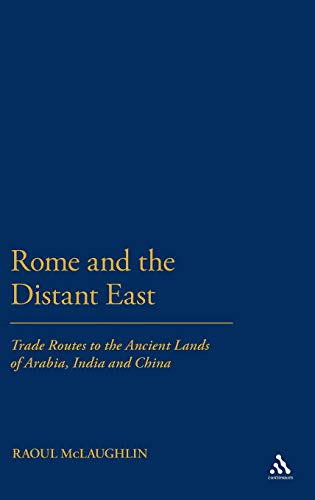
Ebook Info
- Published: 2010
- Number of pages: 256 pages
- Format: PDF
- File Size: 2.24 MB
- Authors: Raoul McLaughlin
Description
In ancient times there were several major trade routes that connected the Roman Empire to exotic lands in the distant East. Ancient sources reveal that after the Augustan conquest of Egypt, valued commodities from India, Arabia and China became increasingly available to Roman society. These sources describe how Roman traders went far beyond the frontiers of their Empire, travelling on overland journeys and maritime voyages to acquire the silk, spices and aromatics of the remote East. Records from ancient China, early India and a range of significant archaeological discoveries provide further evidence for these commercial contacts. Truly global in its scope, this study is the first comprehensive enquiry into the extent of this trade and its wider significance to the Roman world. It investigates the origins and development of Roman trade voyages across the Indian Ocean, considers the role of distant diplomacy and studies the organization of the overland trade networks that crossed the inner deserts of Arabia through the Incense Routes between the Yemeni Coast and ancient Palestine. It also considers the Silk Road that extended from Roman Syria across Iraq, through the Persian Empire into inner Asia and, ultimately, China.In ancient times there were several major trade routes that connected the Roman Empire to exotic lands in the distant East. Ancient sources reveal that after the Augustan conquest of Egypt, valued commodities from India, Arabia and China became increasingly available to Roman society. These sources describe how Roman traders went far beyond the frontiers of their Empire, travelling on overland journeys and maritime voyages to acquire the silk, spices and aromatics of the remote East. Records from ancient China, early India and a range of significant archaeological discoveries provide further evidence for these commercial contacts. Truly global in its scope, this study is the first comprehensive enquiry into the extent of this trade and its wider significance to the Roman world. It investigates the origins and development of Roman trade voyages across the Indian Ocean, considers the role of distant diplomacy and studies the organization of the overland trade networks that crossed the inner deserts of Arabia through the Incense Routes between the Yemeni Coast and ancient Palestine. It also considers the Silk Road that extended from Roman Syria across Iraq, through the Persian Empire into inner Asia and, ultimately, China.
User’s Reviews
Editorial Reviews: Review In the half century since Mortimer Wheeler’s pioneering Rome Beyond the Imperial Frontiers appeared, the archaeological and scholarly inquiry of the Far East has expanded dramatically. A synthetic up-to-date account of the progress of this inquiry has been a desideratum. Raoul McLaughlin’s Rome and the Distant East has heroically tackled this important task, assembling the exotic and esoteric literature, and with penetrating insight analyzed the extensive trade that characterized the international world of the early Roman imperium. The study is comprehensive, involving both the aromatics trade with Arabia and India, and the fabled Silk Road that connected China with the distant Da Qin—as the Chinese called Rome—in the west, and exploring the commercial arteries, both the overland caravan routes and sea routes, and including a discussion of the impact of the luxury trade on the Roman economy. There is much to glean from this stimulating and interesting study that should attract historians, economists, and a variety of other scholars (Professor David Graf, University of Miami, US)’In the half century since Mortimer Wheeler’s pioneering Rome beyond the imperial frontier appeared, the archaeological and scholarly inquiry of the Far East has expanded dramatically. A synthetic up-to-date account of the progress of this inquiry has been a desideratum. Raoul McLaughlin’s Rome and the Distant East has heroically tacked this important task, assembling the exotic and esoteric literature, and with penetrating insight analyzed the extensive trade that characterized the international world of the early Roman imperium. The study is comprehensive, involving both the aromatics trade with Arabia and India, and the fabled Silk Road that connected China with the distant Da Qin—as the Chinese called Rome—in the west, and exploring the commercial arteries, both the overland caravan routes and sea routes, and including a discussion of the impact of the luxury trade on the Roman economy. There is much to glean from this stimulating and interesting study that should attract historians, economists, and a variety of other scholars.’ – Professor David Graf, University of Miami, USAThis is the first comprehensive, reliable account of the extensive overland and maritime trade between the Roman Empire and the “Distant East” in the early centuries CE. It is well-researched, well-written, and well-supported with liberal quotes, useful maps, and an excellent bibliography. It clearly describes how important these early contacts were, both economically and for the exchange of ideas, across Eurasia – contacts that continue to influence our world today and our understanding of it. His vivid descriptions of the difficulties faced and overcome in establishing these intercontinental and trans-oceanic trade routes are particularly fascinating. This work already has a permanent place among the few treasured references I always keep to hand while writing. I heartily recommend it as essential reading for anyone with an interest in the ancient history of the Silk Routes, the Roman or Chinese Empires, India, Persia, or the lands between. It is certain to open new vistas, and deepen appreciation of both ancient and modern societies. (John E. Hill, author of Through the Jade Gate to Rome)In the half century since Mortimer Wheeler’s pioneering Rome Beyond the Imperial Frontiers appeared, the archaeological and scholarly inquiry of the Far East has expanded dramatically. A synthetic up-to-date account of the progress of this inquiry has been a desideratum. Raoul McLaughlin’s Rome and the Distant East has heroically tackled this important task, assembling the exotic and esoteric literature, and with penetrating insight analyzed the extensive trade that characterized the international world of the early Roman imperium. The study is comprehensive, involving both the aromatics trade with Arabia and India, and the fabled Silk Road that connected China with the distant Da Qin—as the Chinese called Rome—in the west, and exploring the commercial arteries, both the overland caravan routes and sea routes, and including a discussion of the impact of the luxury trade on the Roman economy. There is much to glean from this stimulating and interesting study that should attract historians, economists, and a variety of other scholars (Sanford Lakoff)This is the first comprehensive, reliable account of the extensive overland and maritime trade between the Roman Empire and the “Distant East” in the early centuries CE. It is well-researched, well-written, and well-supported with liberal quotes, useful maps, and an excellent bibliography. It clearly describes how important these early contacts were, both economically and for the exchange of ideas, across Eurasia – contacts that continue to influence our world today and our understanding of it. His vivid descriptions of the difficulties faced and overcome in establishing these intercontinental and trans-oceanic trade routes are particularly fascinating. This work already has a permanent place among the few treasured references I always keep to hand while writing. I heartily recommend it as essential reading for anyone with an interest in the ancient history of the Silk Routes, the Roman or Chinese Empires, India, Persia, or the lands between. It is certain to open new vistas, and deepen appreciation of both ancient and modern societies. (Sanford Lakoff)Featured on further reading list in History Today article. About the Author Dr Raoul McLaughlin is a Tutor at Queen’s University Belfast. His research interests include Roman commerce and the ancient economy.
Reviews from Amazon users which were colected at the time this book was published on the website:
⭐This is a study of “globalisation” in the antique world , or “archaic globalisation” as it is sometimes called. Specifically, this is a study of the links of the Roman world with other antique societies, notably, Persia, Arabia and further east, India and China. It covers trade, diplomatic relations and most importantly, the economic impact on the Roman Empire of its relations with the East, particularly India.McLaughlin makes a compelling case for the importance and indeed in many respects transformative effect on the Roman Empire of its relations with distant societies to its East. His narrative uses evidence from Greek, Latin, Chinese, Persian, Prakrit, Tamil and Sinhalese sources as well as archaeological evidence.India was probably the most significant of Rome’s overseas trading partners. The sources reveal a vibrant trade between Rome and India. Romans largely exported bullion so that to this day, archaeological digs in India reveal large numbers of Roman coins. Exports however also included glass, Italian wine for which Indian elites appear to have acquired a taste. Indian exports to Rome included cotton, pepper and various luxury goods. What was cheap and mundane in Rome, such as the common wine drunk by legionaries was a prized luxury in India. Conversely, the plentifully available pepper in India, was a valuable commodity in Rome. Goods acquired by Romans in India included goods sourced from other more distant places such as China, Sri Lanka and Malaysia. By the time of Pliny, it appears that Roman ships were visiting Sri Lanka and going around the island to visit ports in eastern India. A Roman ship appears to have reached China about 166 ACE but this was a one off contact.The reach of Rome into Arabia and East Africa is also discussed. Arabian trade may have equalled Indian trade in its magnitude. Roman traders sourced frankincense and myrrh from Arabia and from east Africa various items of primary produce. In return, their brought manufactured goods such as textiles. Roman traders also acted as middlemen supplying to Africans, goods from India such as steel. They also brought rice from India for sale in East Africa so that the commodities in which they traded did not just include luxuries but also staples.Rome due to its proximity to these areas also at times exercised political power over some regions such as Nabataea and also launched military expeditions into Arabia. While both Pompey (emulating Alexander) and the Emperor Trajan both gave thought to an expedition to India, neither was able to proceed with their plans. India appears to have been a centre of economic gravity for Rome’s external trade so that considering conquest of Indian markets was perhaps not surprising. It is also not surprising that neither Pompey nor Trajan in the end decided to take their legions to India, given the difficulty Alexander himself faced in India (he was fought to a standstill in the Punjab) and the formidable Persian state lying between Rome and India.A chapter on the “silk road” to China looks at the overland trading links between Rome, Persia, Central Asia and eventually China. Chinese silks passed down these trading routes through middlemen ultimately making their way to wealthy Roman consumers. The Han policy was to allow hostile foreigners “to develop a craving for our products and this will be their fatal weakness”. Romans did not have direct access to China on account of Persian resistance to such contacts, no doubt in order to protect their own business interests as middle men. A separate trade route ran down to southern Iraq which joined a maritime route to India’s west coast. Palmyra in Syria was a centre of these trading networks and became so rich and powerful that it was able for a short time to overthrow Roman rule and establish its own alterative imperium in the Eastern Mediterranean during the third century.The most original and arguably ground breaking part of McLaughlin’s study is his assessment of the overall impact of external trade on the Roman economy. He refers to Pliny’s complaint that “India drains more than 50 million sesterces a year from our empire”. This was more than the annual tribute Caesar levied on Gaul. McLaughlin estimates the Indian trade to have been worth about 100 million sesterces per year. Trajan adjusted the gold silver value ratio of Roman currency to more closely resemble Indian standards. Indian produce such as pepper, despite its cost, was widely available in the Empire and affordable in small quantities for ordinary people.A sophisticated banking and commercial system developed to finance this trade. Trade was commonly conducted by partnerships not dissimilar to the kinds of institutions that gave rise to the joint stock company in early modern times. Partners commonly invested in more than one venture to spread risk, in the same way that share portfolios today are structured to spread risk. Ship owners would rent space to merchants for their cargo although larger enterprises may have owned their own ships. This development of a commercial system was in part made possible by Rome’s external trade.During the early Empire, a new class of super rich emerged due to their lucrative trading ventures to the consternation of the old landed aristocracy. The new class was satirised for example by Petronius in his character Trimalchio. Agents of one such family from Italy, the Anni, reached the Sri Lankan capital Anuradhapura during the Julio-Claudian era, resulting in the Sinhalese king Bhatikabhaya sending an embassy to the Emperor Claudius. Another member of a merchant family involved in the Indian trade and based in Alexandria, backed Vespasian and “was instrumental in the Flavian victory” over its rivals to establish the imperial dynasty that succeeded the Julio-Claudians.The state taxed goods entering the Empire at 25%. McLaughlin considers that while provincial revenues often just about covered costs of running the province with a small surplus, the wealth and revenue from the eastern trade saved the Empire from “financial crisis”, drawing a link between the access to eastern trade that occurred after the Augustan era and the prosperity of the Empire during the era until the end of the Antonine period. He estimates that about a third of imperial revenues came from taxing the eastern trade.A chapter is devoted to diplomatic relations between Rome and its eastern neighbours. Rome’s engagement with Arabian states was deep and intense, and included the annexation of parts of greater Arabia eg Nabataea. Despite the long distances, embassies also arrived in Rome from Tamil Nadu and Sri Lanka in South India and from the Kushan state in North Western India. The Kushans representing perhaps the easternmost extent of the Hellenistic world shared in common with the Romans Greek culture. One king from North-eastern India even described himself as the new “Porus”, offering an alliance with Rome against Persia. Augustus, Claudius, Trajan and other Antonine rulers all received embassies from India and for them this was an effective way of demonstrating to their subjects the prestige Rome enjoyed at the ends of the earth. When China and Rome got to know of the existence of the other, each attempted to make contact with the other but with limited success on account of the distance and hostile powers between them. To the Romans, the Chinese were the “Seres” or “silk people”. The Chinese called Rome “Da Qin” meaning the “Other China” – literally “Great China”. The term was used until as late as the fifteenth century to refer to Byzantium.McLaughlin’s study contains a description of the ocean going vessels used in the trade between the Red Sea and the Indian Ocean. Roman freighters were solid and capable vessels that were admired by Indians. Indian ships which travelled largely between India and South East Asia (but also to the Red Sea) appear to have been smaller but better adapted to more difficult waters in and around India. These vessels appear to have included double hulled catamaran type vessels that made the crossing from India to Malaysia and Indonesia.Rome’s commercial relations with the East suffered a decline following the Antonine era. A global pandemic during at the time appears to have wrought devastation throughout the antique world from China to Rome. The time of troubles in Rome after the Antonine era also contributed to the dislocation of its trade. Notably, the debasement of Roman currency impacted badly on the ability of Rome to trade with the East. The revival of Persia under the Sassanids and a period of military conflict between the two empires also contributed to the disruption. Even though trade with the East did not cease, it operated on a reduced scale. The loss of revenue from the eastern trade in McLaughlin’s view after these crises was a critical event in the eventual decline of Rome as it was never able to “restore its vital commercial contacts with the distant east”. The disruption of trade relations no doubts also affected India. It is suggested that it was the loss of Roman trade that encouraged Indians to “look East” with the resulting process of the “Indianisation” of South East Asia.McLaughlin’s study focuses on trading and diplomatic relations, and importantly, the impact of trading relations on the Roman economy. It does not address in detail cultural exchange along the trade routes. To be clear, this is not a weakness but merely reflects the choice of focus and subject matter. The author does cover these matters in other writings and offers glimpses of these cultural exchanges in the narrative.It should not be surprising that cultural relations should develop on the back of the extensive trading networks that bound Rome and its neighbours. Importantly, both Buddhism (originating in India) and Christianity (originating in the Roman Empire) travelled along the routes that carried trade and in time established strong presences outside their places of origin. The journey of Buddhism to China perhaps represents the strongest and most enduring legacy of the period and is well studied; especially the link between trade and the spread of the religion along trade routes (eg see Xinru Liu, Ancient India, Ancient China).Christianity however also established itself outside the place of its origin, the Roman Empire, notably in East Africa (in the Axumite Kingdom) and Southern India where it still has millions of followers. Indian Christianity arguably represents an enduring legacy of Roman influence outside the Empire that originally had been carried along antique trade routes. The Apostle Thomas himself according to local Christian tradition is said to have founded the Church in India arriving there along these trade routes. The New Testament refers to the missionary journeys of Paul in freighters travelling along trade routes in the Mediterranean, Christianity also established itself in Persia and along the silk road (although not Orthodox Christianity supported by the Roman state) where to this day, Christians are found, such as the Chaldeans in Iraq.Most intriguing, perhaps, is the reverse impact on the Mediterranean of Indian culture, travelling along the trade routes in the opposite direction from Christianity. Indian sources refer to Buddhist missions going as far West as Egypt and Macedonia during the reign of Asoka in the third century BCE. McLaughlin refers to the Indian presence in Egypt and the city of Rome during the later era he studies and also of Roman converts returning from India bringing with them Buddhism. The author refers to surviving classical busts from Rome of prominent individuals “with the composure of philosophers and their hair styled in the manner of Buddhist holy men” with the suggestion that these were Romans who had “adopted the Buddhist beliefs in India before returning to live in the Empire where they continued to practice their Eastern faith” One could add that the parallels drawn between Neo-Platonic thought and Indian philosophy may also represent part of the legacy of Indian influence in Rome – finding its way eventually into Gnostic Christianity (see Paulos Mar Gergorios, Neoplatonism and Indian Philosophy). Plotinus for example is said to have been influenced by both Persian and Indian philosophy. Clement of Alexandria clearly had knowledge of Indian philosophy and knew in particular the distinction between orthodox and non-orthodox Indian thought, distinguishing between sramanas and Brahmins. However, whatever the Eastern influence on Roman culture, it did not survive the later dominance of Christianity and then Islam, just as the Hellenistic presence in north Western India eventually became subsumed within Buddhism and Hinduism.The subject of McLaughlin’s work is Rome and its eastern counterparts. The deep links that the Romans forged with their eastern neighbours were also mirrored by the perhaps even deeper and more enduring links that these societies made during the era with each other. The Chinese and Indians for example had developed deep trading and cultural ties by the time of the late Han, studied by Xinru Liu in “Ancient India and Ancient China” as had the Iranians with both China and India. Unlike relations with Rome which declined after the 2nd century ACE, these other antique connections linking China, India and Iran evolved pretty continuously through to the Middle Ages although with some bumps on the road. It was not until the High Middle Ages that Western ties with the East resumed in a significant way through Venetian and Egyptian intermediaries until the journey of Vasco da Gama at the end of the fifteenth century that saw a resumption of direct contact between the West and India.One might wonder why there has been relatively limited interest by classicists in these ancient linkages. McLaughlin proffers the explanation that in the nineteenth century, Rome came to be viewed as a European achievement with little recognition of the contribution of other societies to its achievements. This places the omission of classicists in this regard within the context of Western imperialism. However, there may be more to it than this. For the modern descendants of antique societies, they represent our classical antecedents and as such, the foundations of our own societies and civilisations. For the West, these classical roots lie in Greece and Rome, for Indians, during the period between the Maurya and Gupta empires, for the Chinese , the Han and the Tang and for Iran, the Achaemenids and the Sassanids. The suggestion that the classical achievement involved not just the efforts of our own ancestors but also borrowings from outside, proves to be a sensitive and difficult proposition. Those sensitivities were brought into the open for example by the reaction among many Western Classicists to Martin Bernal’s “Black Athena, the Afro-Asiatic Roots of Classical Civilisation”. The brittle reaction of some Indian scholars to discussion of the important influence of Greek works on Indian scientific achievement during the Gupta era is also comparable. Chinese scholars too sometimes have difficulty with dealing the undeniable impact of Indian culture on China after the late Han era. History it is said is about both remembering and forgetting the past. The ground covered by scholars such as McLaughlin might represent some of the bits we have preferred to forget.McLaughlin’s study looks to a global canvass for the classics rather than one confined to a particular part of the world, turning to diverse sources such as Pliny, Strabo, the New Testament, Sangam era literature of South India, Han history and the correspondence of Persian merchants. These sources are convincingly used by the author to show how the various segments of the antique world could and did comprise the outlines of an entire system held together by trade, religious and cultural exchange and the movement of people.The foundation of what one might call antique globalisation was laid not by the political elites and intellectuals – but by the merchants whom they usually disdained. Seneca however understood the value of what merchants accomplished with long distance trade when he wrote “we have been given the winds so that the wealth of each region might become common, and not carry legions and cavalry, or bring harmful intent to other peoples”. McLaughlin’s study is a reminder of a forgotten aspect of the Roman achievement – and also that of their Eastern neighbours. In reminding us of the ancient links between classical civilisations, scholars such as McLaughlin hold up a distant mirror to our own highly globalised world.
⭐I am writing an historical fiction novel set in this era, dealing with the adventures of a Roman diplomatic mission to China, hence my interest in this book.Although my first draft is complete, and I had identified many of the historical elements through other research, I nevertheless found this book to be an amazing, single source reference which confirmed much of what I had collected piecemeal: the scope of trade, which was positively modern in scale, the size and construction of the ships, and their forays through the Straits of Malacca into the S. China Sea. The fact that oared tugboats were used to get the big freighters into the treacherous harbor of Barygaza in India (where some of my ships stopped), and the city of Rinan (Hanoi, I had the province Jiaozhi, but not the city) as one of the immediate checkpoints entering Chinese waters, will be added to give more life to my story.This book also deals with the Roman economy, which was built on reasonably modest taxes on provinces, which usually did not pay the bill for the legions posted there, an inter-provincial sales tax of 2.5% and goods exchanged, and an international tariff of 25%. Since the scope of Indian Ocean trade was about 100M sesterces, or about $400M per year, the revenues from eastern trade alone financed about 1/3 of their army.I highly recommend this book for anyone who wants some insights into the early Empire not based on the myths of “constant expansion” or “a cruel slave-based economy.” In fact the book reveals that entire Eurasian world was “globalized” to an extent not matched again until modern time. And when the Imperial economy collapsed in the wake of a devastating plague (itself spread by global trade) in the last half of the second century, the empires of China, Bactria, India and Parthia collapsed, all within a few decades as the cash from Roman purchases dried up.The writing is clear, easy to read and of interest to the historian and non-historian alike.
⭐This is the first comprehensive, reliable account I have found of the extensive overland and maritime trade between the Roman Empire and the “Distant East” in the early centuries CE. It is well-researched, well-written, and well-supported with liberal quotes, useful maps, and an excellent bibliography. It clearly describes how important these early contacts were, both economically and for the exchange of ideas, across Eurasia – contacts that continue to influence our world today and our understanding of it. His vivid descriptions of the difficulties faced and overcome in establishing these intercontinental and trans-oceanic trade routes are particularly fascinating. This work already has a permanent place among the few treasured references I always keep to hand while writing. I heartily recommend it as essential reading for anyone with an interest in the ancient history of the Silk Routes, the Roman or Chinese Empires, India, Persia, or the lands between. It is certain to open new vistas, and deepen appreciation of both ancient and modern societies.
⭐Very well written. It brings up very interesting thoughts. A brand new and documented way of showing how the eastern trade was so important to the Roman Empire.
Keywords
Free Download Rome and the Distant East: Trade Routes to the ancient lands of Arabia, India and China in PDF format
Rome and the Distant East: Trade Routes to the ancient lands of Arabia, India and China PDF Free Download
Download Rome and the Distant East: Trade Routes to the ancient lands of Arabia, India and China 2010 PDF Free
Rome and the Distant East: Trade Routes to the ancient lands of Arabia, India and China 2010 PDF Free Download
Download Rome and the Distant East: Trade Routes to the ancient lands of Arabia, India and China PDF
Free Download Ebook Rome and the Distant East: Trade Routes to the ancient lands of Arabia, India and China