

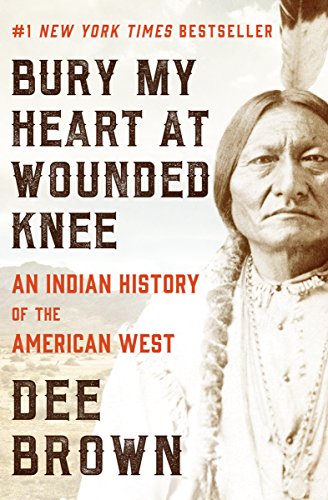
Ebook Info
- Published: 2012
- Number of pages: 482 pages
- Format: PDF
- File Size: 5.78 MB
- Authors: Dee Brown
Description
The “fascinating” #1 New York Times bestseller that awakened the world to the destruction of American Indians in the nineteenth-century West (The Wall Street Journal). First published in 1970, Bury My Heart at Wounded Knee generated shockwaves with its frank and heartbreaking depiction of the systematic annihilation of American Indian tribes across the western frontier. In this nonfiction account, Dee Brown focuses on the betrayals, battles, and massacres suffered by American Indians between 1860 and 1890. He tells of the many tribes and their renowned chiefs—from Geronimo to Red Cloud, Sitting Bull to Crazy Horse—who struggled to combat the destruction of their people and culture. Forcefully written and meticulously researched, Bury My Heart at Wounded Knee inspired a generation to take a second look at how the West was won. This ebook features an illustrated biography of Dee Brown including rare photos from the author’s personal collection.
User’s Reviews
Reviews from Amazon users which were colected at the time this book was published on the website:
⭐”Bury My Heart At Wounded Knee” picks up where “The Trail of Tears” by Gloria Jahoda ends, for a continued look into a history where the home of the Brave was taken as the land for free after Columbus “discovered” the already inhabited land and named her America.Dee Brown has done a brilliant job compiling and writing “Bury My Heart At Wounded Knee: An Indian History of The American West” almost as if this book were a first-eye report during the 1860-1890 era, a time when the growing crowd of white settlers moved westward in search of more land and after the eastern Native American tribes had already been systematically removed from the east toward the west. The work includes photographs of chiefs and people of prominence within each respective chapter of time. At the back of the book, there is an index for reference. The beginning of each chapter is prefaced with a time-line of other world events for perspective as well as the obviously well-thought-out quotes of important Native American Indians. Legendary Native American Indian tribes, chiefs and warriors included in this book are: Navaho, Modoc, the many branches of Dakota (Sioux), Nez Perces, Apache, Ute, Cheyenne, Arapaho, Crow, Comanche, Ponca, Sitting Bull, Geronimo, Ouray, Crazy Horse, Chief Joseph, Captain Jack, Cochise, Manuelito, Little Crow, Roman Nose, Dull Knife, Little Wolf and many others.The Long Walk of the Navajo – a people once very rich but left destitute and dying on a parceled out prison-land reservation of unimaginable, horrid conditions – is a familiar walk of the fates of other Nation tribes before and after themselves. Although different in their own ways, each tribe’s fate was related in their suffering the same resounding theme of systematic destruction due to the greed of the white settlers.Anything not of the white way was considered barbaric. Instead of assimilating into their host country, the white people bullied and deceived Indians into meek submission to adopt their way and live on unwanted reservation lands or face death. When America had an interest in Indian land, they found ways, generally by brute force, to remove the Indians from their land. Unprovoked attacks, false arrests and killing and rounding-up survivors to take them to a worthless piece of land so settlers could stake land claims were part of the tactics used when the west was lost to white invaders. If land was not handed over promptly, entire villages were massacred, burned and destroyed, the survivors taken and labeled prisoners of war. Tribes of gentle, non-resistant Indians were conquered and exterminated. Cries of “Exterminate or banish!” were common among the settlers as was the seizure of land without pretense of payment. Gold seekers and settlers encroaching on land constantly provoked and stole from the Indians and then reversed the truth. The building of forts and the Union Pacific Railroad system in the middle of their hunting grounds and scaring the buffalo also heavily infringed upon terms of the treaties. Places that were sacred and holy to the Indian people, were mined by gold-crazed whites and trespassed upon although words of the treaties specifically said that no white man could pass over, settle upon or reside in the territory set forth. Those who fought too hard to keep their land or freedom were automatically marked for extinction. Any white who defended the rights of the Indian people were ridiculed, ostracized and worse.Even if attacked first, the Indians were considered murderers in their defense, yet for the whites, a killing was considered an “act of war” and punishment was never administered. The soldiers routinely “acted with crazy minds,” brutally massacring indiscriminately, sometimes leaving 2/3 of the dead as mutilated women and children. The Indian people only fought trespassing soldiers who were on their land and did so with brilliant war strategies. There were never fair trials because it was the white man’s law and under that law Indians were “not persons within the meaning of the law.” They were considered aliens at birth.”Let us own the country together,” proposed Buffalo Chief, who along with all Native Americans, desperately wanted peace and tried at all costs to find it. “Peace” almost always meant life on a reservation of the white man’s choosing, never being able to leave the military, political operations without written permission. A promise of peace in the government’s treaty would always say the Indians would no more be relocated yet they would continue to be relocated, sometimes four and five times. The “People of the horse,” accustomed to traveling where they pleased in the land “where everything drew a free breath,” were constantly sent to poor and barren “Indian territories” or reservations where the people became very sick or died while imprisoned. Tribes had to share the reservations with other tribes not to their liking and were punished severely if they left. Promises of annuities and peace in exchange for their land were continually broken and to the reservations was funneled bad food and sub-standard supplies at best. Still, the Indians were not allowed to travel in order to hunt their own food as they once did. The buffalo were nearly extinct due to the sport hunting of the whites who left them to rot. General Sheridan was one of many who condoned the hunting/extermination “to allow civilization to advance.” Between 1872 – 1874, 3,700,000 buffalo were destroyed. Of those, only 150,000 were taken by the Native Americans who utilized every part of the buffalo for survival.Long-time Indian adversary, George Crook, who was experienced in the dealings of treachery, later concluded, “It is too often the case that border newspapers…disseminate all sorts of exaggerations and falsehoods about the Indians, which are copied in papers of high character and wide circulation, in other parts of the country, while the Indians’ side of the case is rarely ever heard. In this way, the people at large get false ideas with reference to the matter. Then when the outbreak does come, public attention is turned to the Indians, their crimes and atrocities are alone condemned, while the persons whose injustice has driven them to this course, escape scot-free and are the loudest in the denunciations. No one knows this fact better than the Indian, therefore he is excusable in seeing no justice in a government which only punishes him, while it allows the white man to plunder him as he pleases.” Or as Yellow Wolf explained it, the unjust whites told “only his own best deeds, only the worst deeds of the Indians.”In death, the Indian people were also dishonored with no proper burial given. Captain Jack’s (Kintpuash) body, for instance, was taken away after his hanging, to be embalmed, appearing in eastern cities as a carnival attraction.Even if the rightful Native American land owners had ceded their land under proper and understandable terms instead of under dubious means and sometimes faulty translations, it can be said that they were never given full disclosure as to the havoc and destruction that was to follow as the result from the change of hands in the ownership and more importantly to them, the stewardship of that land. Also logical is the fact that the Native Americans would not have willingly moved from their beloved ancestral homes so connected to their own lives to a foreign imprisonment unless threatened, coerced or tricked.History may have turned out quite differently had the Native American Indians consolidated forces and known their foreign adversary better. Instead of fighting against warriors in the manner they were accustomed to however, their enemy first appeared in disguise as a friend who took the extended hand offered in friendship and then chopped it off after the treaties were signed.I highly recommend “Bury My Heart At Wounded Knee” as an important, must-read for every American, especially those interested in a fuller disclosure of the truth as well as a case study into the manifestation of human greed, acceptable crimes possible through mob mentality, dehumanization, intolerance, misunderstanding and other hideous examples of depravity. Whose heart would feel no outrage or pain has no heart left to bury.~ ~ ~ ~ ~ ~ ~ ~White Woman Speaks:We called them “savages”When we were the savages.We call ourselves “native-born”When they were the Native-born.We mislabeled them “Indian givers”When we were the givers of all deceit.We considered this life to be “progress”When we progress in the wrong direction.(Rachel Elaine ~ 9-4-06)
⭐I’m not sure how to put into words how important this book is. It took me almost a month to read it because I felt that I had to focus and try to retain everything on the page, it was that engrossing. The book has extensive research, endnotes, a bibliography, and index to make this one of, if not, the best books on the history of Native Americans during the time of the Civil War to about 1890.The chapters are all heartbreaking accounts of the atrocities that Indians were subjected to during the greedy expansion of the United States. I don’t need to list all of them, as it would give less weight to their magnitude, but the most horrific chapter for me was Chapter 4 (I think). It’s about the massacre at Sand Creek and the brutality of that battle is unreal. I got physically ill as I read each sentence with my heart pounding and breaking with each beat.I can’t give this book a thorough review because I think the Kindle version is cumbersome to “flip” around in and give specific examples, but I really recommend this book to everyone who is interested in history and who wants solid accounts of these moments in history. I can’t say it’s unbiased in the message the author is trying to deliver, but Brown seems to present honest and factual accounts to formulate this narrative.It’s a winding road of countless misunderstandings between nations that could have avoided conflict many times, but things like ego, pressure, the media, and public opinion really mucked up a lot of what could have been more peaceful resolutions (if there could be resolutions at all). Since it took me so long to read, I can really only relate a later story about Geronimo finally giving up and returning to a reservation, Standing Rock(?), but when he and his followers got drunk and heard whispers about being hanged or taken to Florida, he went back on his promise to a now-friendly official (Crook?). After a longer period of time, Geronimo finally returned, but brought the burden of transporting stolen livestock with him from Mexico. Like, seriously Geronimo? That’s how you’re going to return after making a serious mistake after worrying (justifiably though) that you were really going to be treated worse? That event made me disappointed because I can understand both sides, but (Crook?) was kind enough to sell the stolen livestock and return to the earnings to the Mexican government in hopes of them finding their owners. He really bailed Geronimo out of that one.But stories like how Sitting Bull, Crazy Horse, and Big Foot died are so sad because they could have been avoided. Not only were great leaders killed by white people, but mercenary and traitorous Indians also ratted out and killed them as well. But even traitors who helped the US were often later imprisoned, shipped off, and their families died en route to various reservations.There are so many swindling deals in land disputes and so many Indian Affairs agents had conned tribal leaders into signing bad deals. There was a lot of power in a treaty that stated any deal must have 3/4ths of adult Indian signatures, but the government knew how to take advantage of people. It seemed like the final deal in regards to Sitting Bull after his fame, was the one where tribal leaders “wised up” and told officials that they knew the US’ plan to meet from tribe to tribe instead of a big council, but in the end, John Grass had convinced people to sign away their land at Standing Rock.There are many stories that are unbelievable, yet you can believe them even in the context of today’s political situation. These things happened during a time of great consternation in America and every turn seemed to be a bad one. The quotes that Brown used throughout this book are so impactful and timeless that I’m really compelled to continue learning about the Native Americans. I’m so disheartened with the US’s bloody history, but I think it’s more important now than maybe it ever has been to study these things and try to make the world a better place, if we still can.Please read this book and let it engross you like it did me. There are many dates, names, and events that are very hard to keep track of, but the author recalls them briefly if someone or something is later mentioned.The only thing I wish was given a modern context with consistency is the naming of Moons, Months, and Seasons because the author will use the Indian name, but less than half the time include parentheses to tell the reader when that actually is. “Moon of the Big Leaves (April)” or “The Moon When Ducks Begin to Fly.” Like, when the heck is that? Brown will only sometimes tell you that that special time is August.
⭐I read this book when it was first published back in 1987 and it is one of those books that has stayed on my bookshelf that I refer to now and then. It’s a heartbreaking book, covering not just one but dozens and dozens of instances of genocide as they occurred across the United States of America. When one understands the lies, deception, treachery, greed and violence that underpinned the foundations of modern day America, one can begin to understand why that country is the rotten place it is and why the ‘American Dream’ has been pedalled so hard for so long. What would they think now, those Indians, if they could rise from the grave and see our great civilised consumer culture. Our wanton waste, our indifference for each other, our filty, polluted, crimed ridden cities, our utter disregard and violation of the natural world that provides our very existence and sanity. This book should be studied in history lessons far more than the Industrial Revolution that I was forced to cover several times at school. It was a critical turning point in human history; the caretakers of the earth versus those who would exploit it wherever and whenever they could in an eternal quest for money. Yes, a beauiful dream died there and an utter nightmare took its place. In 1912 White Horse of Omaha said “Now the face of all the land is changed and sad. The living creatures are gone. I see the land desolate and I suffer unspeakable sadness. Sometimes I wake in the night and feel as though I should suffocate from the pressure of this awful feeling of loneliness’.
⭐This is the saddest true story that I have ever read.. Told from the Native Americans perspective it is a very sad story of ‘man’s inhumanity to man’ and how they were systematically slaughtered, starved and displaced…they actually thought the white men were their friends. Unbelievable cruelty from the European settlers who managed very quickly to convince many people that the Native Americans needed to be eradicated. President Andrew Jackson signed the Indian Removal Act in 1830. This book will open your eyes to what really went on and how these people were lied to and tricked by so called agents who were just there to make sure that they were removed from the land. I cried many times reading this and some descriptions of the atrocities of the Army soldiers I just had to stop reading. In one way I am so glad I read this book and have taken a great interest in the history of the Native Americans and then on the other I wish I hadn’t because I cannot understand their reasons behind such evil behaviour.
⭐There’s no denying that the “New” American Colonists treated the Native Americans dreadfully, with generals deciding to wipe out whole villages and camps, men, woman and children alike, because they were perceived as a threat… a threat to the railways, trading and whatever they felt like killing them for. Nobody really cared.Reading about this today is shocking and appalling to say the least. It’s an important part of America’s history. It’s also interesting to learn about many of the Native Americans whose names still persist in our consciousness to this day: Geronimo, Sitting Bull, Crazy Horse and so on.However, history aside, I can’t lie and say this book is a riveting read – it’s not. Most chapters are a) Native American tribe is told to move to a new reservation b) They want to stay on their ancestors land c) General decides to fight them to get them to move d) Native Americans fight back e) Army is sent in to kill the Native Americans f) the survivors move to the reservations. This is pretty much the template for each chapter. Nothing diminishes the horror of it all, but chapter after chapter of the same thing, it’s just hard work getting through it.I’d say it’s worth reading, but be prepared to “speed read” through a lot of it.
⭐When I was a kid (and that’s a long time ago!) I used to look forward to going to the cinema on a Saturday morning to watch Westerns of various kinds wherein which the Indians were always the “baddies” and the cowboys (Lone Ranger / Roy Rogers et al) were always the “goodies” and when a wagon train was completely surrounded by “hostiles” the sound everyone was listening for was the bugle that announced the arrival of the cavalry………! But, in fact, it was the other way around..the good guys were the Indians and the bad guys were the Army and Settlers..yes, there were some tribes that were hostile to the white Americans but in the main, most tribes started out wanting to befriend the white man believing that he would “civilise” them and give them all the advantages that the whites had – but in the fullness of time the government and settlers set out to marginalise them, following the “only good Indian is a dead Indian” philosophy including the extermination of women and children too!How could this be that history has been washed of all this fact? Can it be possible that the Land Of The Free could actually commit genocide on it’s own doorstep on this scale and get away with it….sadly, the answer is a resounding YES and it is with total admiration for the spirit of the First Nation Indians that I would recommend this book to all those, who like me, were completely taken in by the whitewashing of the facts, so that never again when you are listening to modern day American politicians banging on about human rights that you will ever again take them seriously!This book is a sad indictment of the times but moreover is a testament to spirit of the human who, under extreme duress, can still hold noble virtues!Written in very simple language, Dee Brown sets out the plight of each and every tribe including the so called infamous Indian Chiefs (Sitting Bull, Geronimo, Crazy Horse, Red Cloud etc) from the perspective of the Indian and at the same time details what was going on in Washington and elsewhere in the world, in the same years, to make you realise that this is very contemporary history indeed!
⭐A great read but so frustrating, white americans should hang their head in shame at the way the native american was treated, this was a pogrom by anyone’s definition and a number of people should have been tried for war crimes. Not a lot of difference between the actions of Grant and Sheridan compared to Karadzic and Milosevic during the Bosnian war. Although it’s no consolation to the native americans, the same process was carried out by ‘enlightened’ Europeans in every other country to be ‘discovered’, Cortez in Mexico, the British in Africa/Asia/Australia, Leopold in the Congo etcBack to the book, the frustration arises from the repetition in every chapter, one for each tribe or tribal grouping, in the way each tribe was destroyed by the lies and impositions of the american government. A great read in that one can only feel pride in the attitude and leadership of the tribal chiefs as they tried to abide by these government requirements at the same time as only wanting the best for their own people.
Keywords
Free Download Bury My Heart at Wounded Knee: An Indian History of the American West in PDF format
Bury My Heart at Wounded Knee: An Indian History of the American West PDF Free Download
Download Bury My Heart at Wounded Knee: An Indian History of the American West 2012 PDF Free
Bury My Heart at Wounded Knee: An Indian History of the American West 2012 PDF Free Download
Download Bury My Heart at Wounded Knee: An Indian History of the American West PDF
Free Download Ebook Bury My Heart at Wounded Knee: An Indian History of the American West