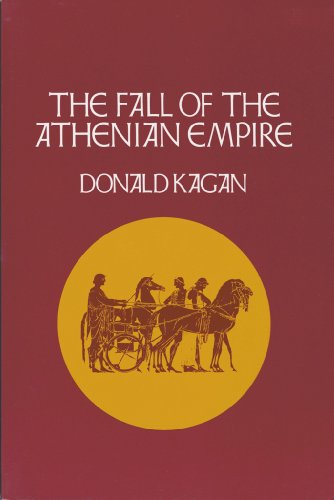
Ebook Info
- Published: 2013
- Number of pages: 476 pages
- Format: PDF
- File Size: 17.05 MB
- Authors: Donald Kagan
Description
In the fourth and final volume of his magisterial history of the Peloponnesian War, Donald Kagan examines the period from the destruction of Athens’ Sicilian expedition in September of 413 B.C. to the Athenian surrender to Sparta in the spring of 404 B.C. Through his study of this last decade of the war, Kagan evaluates the performance of the Athenian democracy as it faced its most serious challenge. At the same time, Kagan assesses Thucydides’ interpretation of the reasons for Athens’ defeat and the destruction of the Athenian Empire.
User’s Reviews
Reviews from Amazon users which were colected at the time this book was published on the website:
⭐Donald kagan, with his 4 volume history of the Peloponnesian war has opened up the clouds of my ignorance of these important events of so long ago that can teach us so much about are own current situation. In the last 3/5 months I’ve dedicated to reading his work couldn’t have been better spent. Thank you so much and that god may bless you.
⭐I owned all 4 volumes, but my wife lost this 4th somehow, so I recently replaced it.Thucydides Peloponnesian War should be required reading in public school, as its lessons for any democracy that would go to war or claim any sort of empire are still instructive today. For any student of philosophy, it provides the context in which Socrates taught, and the aftermath that so influenced Plato and Aristotle.Kagan’s 4 volumes, which should really only be read after Thucydides, go deeper than Thucydides, synthesizing all ancient sources on the war analyzed by a military mind at both the strategic and tactical level. Kagan had produced the definitive modern account of the war, from which any analysis that disagrees with him must start.
⭐Complete, captivating, thoughtful review addressing all aspects of this historic 30 year war. A must / good read for history buffs.
⭐Great book, all the detail (and more) about a crazy war that might have been (spoiler alert) avoided if cooler heads could have prevailed.
⭐Great read! Lessons to be learned for modern citizens!
⭐The Fall of the Athenian Empire is the fourth and last tome of Donald Kagan’s excellent history of the Peloponnesian War between Athens and Sparta and its allies. This volume covers the events that took place from the destruction of the Athenian expedition to Sicily, in mid-September 413, to the surrender of Athens in Spring 404.This volume is as good as the others, if not better. For all students in the period, and for anyone wanting to learn what happened and how and why Athens lost, this is the reference. It is to be preferred to Kagan’s one volume book covering the whole of the war and which is essentially a condensed version directed to the general reader who may have only a passing interest in the subject.The skills of Kagan are multifold. They are on display yet again and they may be even more apparent here than in some of the previous volumes. One reason is that, contrary to some of the earlier periods, there is no longer a single or a dominant source (Thucydides) but 5 sources, of which Thucydides is only one, and an incmplete one at that (he breaks of about 6 years before the end of the war. Two of the other sources (Diodoros and Plutarch) wrote several centuries after the events, although they based their narratives on earlier sources. As Kagan mentions, when some of these sources contradict each other, it is at best difficult to determine which one is correct.In addition to Kagan’s masterful grasp of the sources and of the secondary litterature, his ability to write in a clear style about a complicated set of diplomatic, political and military events is also quite exceptional. He also manages to present each side’s situation, reconstructs in a convincing way what may have been their respective objectives and show how important Persian policies (and their changes) became by the end of the war. Last, but nost least, the book includes a complete set of maps and diagrams illustrating the main campaigns and describing the main battles.Perhaps the most interesting part of the book is Kagan’s analysis of Thucydides judgements and the extent to which these were true or reflected his preconceptions. This is certainly one of the most valuable parts of the book (similar pieces can be found in the other three tomes) because, thanks to careful and dispassionate analysis, Kagan shows to what extent some of our views are preconceived and influenced by our sources and mainly by Thucydides himself whose wonderful story telling was tainted by his political biases. Here are some of the main points he makes:- the strategy of Pericles was in fact flawed, as opposed to the winning strategy that Thucydides has managed to make us think it was- the Athenian defensive strategy had major weaknesses: it concentrated on not losing the war by avoiding land battles, as opposed to concentrating on winning it- despite Thucydides allegations that civil strife in general, and the ultra-democratic faction (to which he was bitterly opposed and which had exiled him) was respoponsible for losing the war, the democrats in fact prosecuted the war far more actively and more successfully after 410 BC than had the oligarchs just before- nevertheless, and even after the disastrous Sicilian expedition (and contrary to what I always used to believe, for instance), Athens was not doomed and could have won the war, so it was not doomed from the beginning and its surrender was not pre-determined.I will NOT, however, discuss the core point of the book (why did Athens lose?) to avoid any spoilers. There is no single and simple explanation (there are several, in fact) and the answers are discussed in-depth throughout the book.Anyway, to cut a long review short, this is an example of history telling at its very best. Although perhaps not “the gold-standard in Ancient Greek History”, as another put it, it is certainly among – say – the top 10 books in this field. It has, however, remained the “gold standard” on the Peloponnisian War, although this volume is now a quarter of a century old and the previous ones are even older. This is not to say that no other volume on the same topic is good. At least some of them are. However, these four tomes, and this one in particular, are still unmatched in terms of scholarship, comprehensiveness and clarity of the narrative and discussions.I found it so good and so convincing that it took me a while to realize that the points that the author was making should be viewed as his thesis, rather than “the truth”.
⭐This forth book of the series on the Peloponnesian War brings to a culmination Kagan’s detailed scholarship and compelling narrative writing on the subject. The period it covers, from the aftermath of the disastrous Athenian Expedition to Sicily in 413 up to the surrender of Athens to the Peloponnesian league in 404, is probably the most complex and difficult to deal with of the whole conflict, but Kagan analyses it with masterly clarity, despite the eventual loss of his main source for earlier periods, Thucydides.In place of a fairly simple conflict between Sparta and its allies and the Athenians, this phase was a many-sided, with Persian satraps intervening on one side or the other, Persian money used to supply the side currently in favour and the complex machinations of Alcibiades, playing Spartans and Persians off against each other, at first an enemy of Athens, later one of its leaders and finally no-one’s friend. Athenian politics were also complex. The previous moves from limited democracy to a fuller version were reversed, and first a strict an pro-Spartan oligarchy was imposed at Athens. A milder oligarchy followed, but the Athenian fleet based at Samos remained democratic and eventually managed a restoration of democracy in Athens.On the military front, although weakened by the Sicilian debacle, Athens managed to recover and fight on. However, with less manpower and diminished financial resources and suffering from internal strife, Athens’ path was gradually downwards towards defeat. This defeat was not inevitable, but once the Peloponnesian league managed to build a credible fleet with Persian money, Athens could only survive if it remained united, mobilised its allies and kept on winning, whilst the Peloponnesians could fight a war of attrition despite defeats and losses of manpower on the way, as long as they remained determined to defeat Athens.Kagan’s conclusion makes it clear that Athens was not the only loser. Sparta suffered from the erosion of its conservative values though growing corruption and personal ambition once its leaders were exposed to money and power. The number of its full citizens declined sharply and it gained little gratitude from its allies. Many Peloponnesian cities lost population and wealth and some places like Platea and Melos were devastated by the war. The only real winners were Persia and, ultimately, Macedon.Throughout his four books, Kagan subjects Thucydides to detailed scrutiny, and in his conclusion gives his considered judgement. Thucydides was a political writer with an agenda that was against more the extreme forms of democracy and in favour of a broad oligarchy, as shown by his support for Pericles and loathing of Cleon. His analyses of the causes of the war, its inevitability and support for Pericles’ strategy are all questioned by Kagan and found wanting.All four books of the series are excellent, and this maintains the standard.
⭐This is the first book in the tetralogy which, after the first few chapters, is not an extended commentary on Thucydides. Well-written, clear, and well-paced.
⭐Like Peace of Niceas (eg) not for the beginner. But very readable and an interesting analysis and interpretation of the evidence. Should be read critically for maximum value
⭐As usual, well written with a fair and comprehensive arguments for his version of events. The whole series is a must for all classical history lovers.
⭐L’histoire de la guerre du Péloponnèse publiée en 4 volumes par Donald Kagan est ce qui existe aujourd’hui de mieux sur le conflit majeur de l’histoire de la Grèce Classique. Ce travail monumental n’a malheureusement pas été traduit en français. Notons qu’il en existe en anglais un « abrégé », au sens noble du terme, et en un seul volume, dans lequel Donald Kagan propose une vision plus synthétique de son travail sur la cette guerre, dont la source principale demeure l’œuvre de Thucydide.Dans ce quatrième et dernier volume intitulé « The Fall of The Athenian Empire », Donald Kagan met en lumière les capacités insoupçonnées d’Athènes pour résister encore dix années, malgré son terrible désastre en Sicile. Les campagnes navales dominent un tome plus épais que les autres (450 pages). Alcibiade, déjà présenté dans le tome 3, joue également un rôle déterminant sur les derniers soubresauts de cette guerre à mort entre les deux cités de Sparte et Athènes. Prête de l’emporter, après sa victoire aux îles Arginuses, Athènes succombe finalement autant à ses divisions internes (procès des généraux) qu’à la montée en puissance de la coalition navale rassemblée autour de Sparte et de son génial amiral Lysandre.Aussi inspiré qu’a pu l’être Thucydide en son temps, intégrant toutes les recherches modernes effectuées sur la Guerre du Péloponnèse, Kagan nous offre ici une analyse monumentale, pleine d’érudition et d’intelligence.Book is extensively covered in green highlighter throughout and many pages are written on in biro – item was incorrectly described as “used and acceptable” and “US paperback reprint in Good overall condition. Light creasing to a few bottom page edges and some blue surface marks to rear cover. Cornell University Press 1991.”
Keywords
Free Download The Fall of the Athenian Empire (New History of the Peloponnesian War) in PDF format
The Fall of the Athenian Empire (New History of the Peloponnesian War) PDF Free Download
Download The Fall of the Athenian Empire (New History of the Peloponnesian War) 2013 PDF Free
The Fall of the Athenian Empire (New History of the Peloponnesian War) 2013 PDF Free Download
Download The Fall of the Athenian Empire (New History of the Peloponnesian War) PDF
Free Download Ebook The Fall of the Athenian Empire (New History of the Peloponnesian War)