

Ebook Info
- Published: 2005
- Number of pages: 220 pages
- Format: PDF
- File Size: 2.06 MB
- Authors: Grant R. Hardy
Description
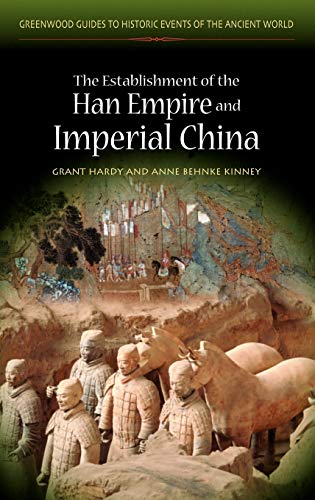
The Han Dynasty created an enduring Chinese empire comparable to the Roman Empire. In this book, narrative chapters, biographical sketches, and translated primary documents give readers a unique overview of this important founding dynasty.The Han Dynasty (206 B.C.E. to C.E. 221) ruled a large prosperous Chinese empire that was roughly contemporary with the Roman Empire and comparable in size. The Han was founded by Liu Bang who ruled as Emperor Gaozu. The Han emperors turned away from the harsh rule of their Qin predecessors and promoted Confucianism and other schools of thought while retaining some of the useful autocratic features of Legalism. Under Wudi (140-87 B.C.E.) the empire expanded to include parts of Central Asia, Korea and Vietnam. Under the Han dynasty the Chinese developed steel, the water mill, high quality stoneware (china), and paper.Designed as an introduction to the founding and consolidation of the Han Empire, this work offers information on the founding of the Han Empire; conflict between town and countryside and the empire and barbarians; technological innovations like steel and papermaking; social changes and the lives of women and children; and a comparative look at Imperial China in world history. Excerpts from Confucius on government, recently found Qin laws written on bamboo strips, and contemporary historical accounts lend depth and immediacy to the work. Brief biographies of key rulers, rebels, and philosophers give readers a look at events through the eyes of participants. An annotated bibliography, index, chronology, glossary, and 26 illustrations and maps round out the book.
User’s Reviews
Editorial Reviews: From School Library Journal Adult/High School-The establishment of the Han Empire, solidifying the Qin unification of the warring states, is of paramount importance in the history of China, and arguably, in world history. This excellent introduction to that dynastic period devotes separate chapters to the political, institutional, technological, and social ramifications of the era. The final chapter is one of the most interesting and important: in an interpretive essay the writers consider the cultural and political consequences of the Han Empire in East Asia, make comparisons (especially to Rome and Persia), and look ahead to post-Han China. A few pages suggest a reevaluation of the First Emperor, arguing that he might have been unfairly vilified by Han apologists. There are 20 biographies, 14 primary-source documents, several time lines, a brief glossary, a bibliography (including film, Internet, and curriculum guides), and a mere 16 black-and-white artifact photos or line drawings. Some information is repeated, but given the complexity of the material, this is rather a bonus. The writing is engaging and not pedantic. This volume, very much focused on the Western or Former Han (the Xin and later Han are dealt with in two sentences only), is a promising eastward expansion of this series on the ancient world.-Patricia D. Lothrop, St. George’s School, Newport, RI Copyright © Reed Business Information, a division of Reed Elsevier Inc. All rights reserved. Review “China’s Han Dynasty created a prosperous empire from 206 BCE to CE 221, promoting a less harsh society than that of their Quin predecessors and developing technological advancements from the water mill to stoneware and paper. From elements of social change in Han times to kingdom problems and issues, its role in world society and politics, and its importance in establishing centralized control in Asia, ^IThe Establishment of the Han Empire and Imperial China^R is essential reading for any college-level scholar who would understand the importance of this developmental period.” ― MBR Bookwatch”The establishment of the Han Empire, solidifying the Qin unification of the warring states, is of paramount importance in the history of China, and arguably, in world history. This excellent introduction to that dynastic period devotes separate chapters to the political, institutional, technological, and social ramifications of the era….The writing is engaging and not pedantic. This volume, very much focused on the Western or Former Han (the Xin and later Han are dealt with in two sentences only), is a promising eastward expansion of this series on the ancient world.” ― School Library Journal About the Author Grant Hardy is Associate Professor of History at the University of North Carolina, Asheville.Anne Behnke Kinney is Professor of Chinese, and Director of the East Asia Center at the University of Virginia. As a graduate student she spent two years in the department of History and Archaeology at Peking University. She is the author of Representations of Childhood and Youth in Early China (2003), and has published numerous articles and scholarly publications. Read more
Reviews from Amazon users which were colected at the time this book was published on the website:
⭐This book really has little to recommend it. Judging from the title you’d be forgiven for thinking that it was an analysis of the changes that China went through in the transition from the Qin Empire and into the Han. That is nominally what it attempts to do. But it also tries to be a beginner book in Chinese history. And an introduction to Chinese philosophy. And a listing of the significant figures from the period. And in covering all this it misses what seems like its main goal. What exactly changed when the Han came in? I left the book wondering that and I realized that I would have to search elsewhere. Certainly it covers what changed under the Qin, at least in very basic terms. But since it doesn’t bother to explain what came before it’s hard to recognize which elements were changed and which were always there. The Warring States period is barely covered, which should be essential in an introductory text. It covers the events of the period in 26 pages. The first emperor of Han takes up six of them. The Warring States takes up two. The rest is all Qin.To show how uninformative this book is I’m going to describe the organization and contents in some detail. As I said previously the narrative of events takes up only 26 pages and while easy to follow it is very vague. There are 21 pages on the government of China during the Han, a period which I must mention, was not covered in the narrative. Next up are 14 pages on technological innovation. This would be better termed philosophies or world views because most of the technical innovation under the Han came later. It’s basically a brief overview of the five elements and how people farmed. The final relevant chapter has 19 pages on the social system. This brings the book up to a total of 90 pages dealing with such a massive topic as the founding of an entire empire. Two empires really. The final chapter has 15 pages on the rest of Chinese history. There are also 16 pages worth of brief biographies of key players (most of whom come from before or after this period) and 26 pages of primary source excerpts. On top of this limited space the font is quite big and takes up too much room.Now I know that this is meant as an introductory text and cannot possibly provide as much information as I would like, but there is a point beyond which too little information is useless. This failed to give more than the vaguest idea of how the Han came to power or established such a long lasting empire and it managed to be boring on top of it. If I had been forced to read this for school I would have felt no compulsion to seek out more information. As it was I read this book to learn more about this period and I feel I learned nothing. I got better and more detailed information from a general Chinese history book covering 3,000 years. As an introductory book it tries to do much but fails even to explore its main focus. If you’re looking for an introduction to Chinese history I’d try
⭐. It might be outdated but it’s infinitely more informative and satisfying than this one. The only reason I give this book the second star is because it does contain some useful information in a reasonably accessible format.
⭐great condition and very cheap price
⭐This is a very nice summary of materials on Han China. My only concern is that it is too brief.The first section is an excellent, but brief (50 page), recap of Chinese history from Shang to foundation of the Han dynasty. The material takes something of a western narrative form. Some might argue that pre-Han China history cannot be understood in terms of European feudalism, but I think it will interest most western readers and that is the point of an introductory work.The next section tries to cover an even grander topic: Han political science. Again, it is nothing if not brief, but does an excellent job of hitting the main points. The chapter makes the point that Han China represented a balance of 3 major philosophic trends: Confucianism, Taoism, and legalism. Though the material on each is entirely too brief, the reader will find the narrative easy to read. One of the interesting themes is a description of the Han government in terms of 3 branches: military, bureaucracy and ‘censorate’ (a spy agency that watched both for the emperor). A parallel power structure existed in the emperor’s harem (inner-court). At times the eunuchs and women there could control the emperor enough to be effective masters of the government. The bibliography has many suggestions for additional reading.The third section on Chinese industry and technology, with an emphasis comparing the relative states of European and Chinese arts during the Han era.The rest of the book covers a broad set of topics which I would summarize as an extended and illustrated notes/bibliography. For example, one section is a set of about 50 extended quotes from Han and pre-Han documents.
Keywords
Free Download The Establishment of the Han Empire and Imperial China (Greenwood Guides to Historic Events of the Ancient World) in PDF format
The Establishment of the Han Empire and Imperial China (Greenwood Guides to Historic Events of the Ancient World) PDF Free Download
Download The Establishment of the Han Empire and Imperial China (Greenwood Guides to Historic Events of the Ancient World) 2005 PDF Free
The Establishment of the Han Empire and Imperial China (Greenwood Guides to Historic Events of the Ancient World) 2005 PDF Free Download
Download The Establishment of the Han Empire and Imperial China (Greenwood Guides to Historic Events of the Ancient World) PDF
Free Download Ebook The Establishment of the Han Empire and Imperial China (Greenwood Guides to Historic Events of the Ancient World)