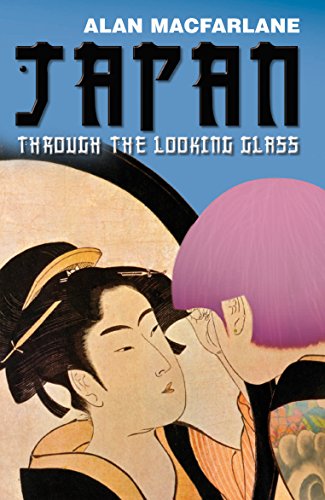
Ebook Info
- Published: 2009
- Number of pages: 288 pages
- Format: PDF
- File Size: 1.52 MB
- Authors: Alan Macfarlane
Description
This entertaining and endlessly surprising book takes us on an exploration into every aspect of Japanese society from the most public to the most intimate. A series of meticulous investigations gradually uncovers the multi-faceted nature of a country and people who are even more extraordinary than they seem. Our journey encompasses religion, ritual, martial arts, manners, eating, drinking, hot baths, geishas, family, home, singing, wrestling, dancing, performing, clans, education, aspiration, sexes, generations, race, crime, gangs, terror, war, kindness, cruelty, money, art, imperialism, emperor, countryside, city, politics, government, law and a language that varies according to whom you are speaking. Clear-sighted, persistent, affectionate, unsentimental and honest – Alan Macfarlane shows us Japan as it has never been seen before.
User’s Reviews
Editorial Reviews: Review “A well-informed analysis of Japanese culture and society.”—The Independent“A disarming, engaging, and provocative book.”—Andrew Barshay, University of California, Berkeley“A well-informed analysis of Japanese culture and society.”―The Independent“A disarming, engaging, and provocative book.”―Andrew Barshay, University of California, Berkeley About the Author Alan Macfarlane is Professor of Anthropology at Cambridge. He has often visited and taught in Japan. He is the author of The Glass Bathyscaphe and Japan Through the Looking Glass.
Reviews from Amazon users which were colected at the time this book was published on the website:
⭐In anticipation of an upcoming trip to Japan, I read Cambridge anthropologist Alan Macfarlane’s Japan Through the Looking Glass. Macfarlane is a relatively a relative latecomer to Japan, having arrived there for the first time only in 1990, although he’s been back several times, in addition to reflecting upon what he saw and learned there. Macfarlane completed his anthropological fieldwork in Nepal and he’s written a great deal about early modern England. He’s a keen student of the transition to modernity and the early theorists who dealt with that change from Montesquieu to Maitland, including Adam Smith, Tocqueville, Malthus, Marx, and others who have attempted to explain the advent of modernity. It was with this background that Macfarlane approached Japan, and he found that Japan confounded many of the characteristic dichotomies that classical theorists had developed about modern versus traditional societies.The main theme of Japan Through the Looking Glass is that nothing seems quite as it first appears in Japanese culture; indeed, even upon closer examination, paradoxes and uncertainties abound. As Macfarlane notes, many outward similarities exist with Great Britain. Both are island nations, both have a feudal history, both have a long history of a strong work ethic, and both were the first to industrialize in their regions. But as Macfarlane points out, despite the similarities, westerners have a continuing challenge in understanding how Japan works.For instance, Japan has a mix of individualism and status relationships. It is a modern (often hyper-modern) capitalist society, yet the profit motive is not glorified. Individuals in the sense of Western individualism don’t exist. Instead, people are defined by relationships. People think in terms of relationships and emotions rather than in terms of logic whenever dealing with other people. Thus, while the Japanese can be quite reticent in speech and seemingly cold, in their observation of the subtlest behaviors and assessments of responses they’re finely nuanced and responsive. As to religion, in a land filled with temples and shrines, the Japanese are, according to Macfarlane, some of the least religious people in the world. If we measure religiosity by belief in a soul, the afterlife, or belief in God, we find few Japanese adhere to these beliefs. The Japanese perceive little difference between nature and culture, and none between the natural and the supernatural. This does not mean that the native Shinto religion, Confucianism, and Buddhism have not had an effect, but rather than suffer a transformation by any one religion, Japanese culture has transformed the religions to fit Japan. Thus, Zen Buddhism lies a far distance from the more traditional Buddhism of South Asia. This lack of distinction between nature and culture also helps us appreciate Japanese attitudes towards nature and the beauty of ephemeral things like cherry blossoms and the phases of the moon. Macfarlane even ventures into the difficult question of why, when Japanese became a conquering military power in the 1930s, there were so many instances of the Japanese atrocities. How did such an otherwise docile people, who have an extremely low crime rate and few incidents of criminal violence, turn into war criminals? Macfarlane, adopting the opinions of some others who have considered this paradox, suggests that the perception of extreme differences between native Japanese and others accounts for this stark dichotomy. But it remains in some sense another one of the enigmas of Japan.Macfarlane has an open, inquisitive mind that is well trained in attempting to understand how societies work. He readily admits that Japan has confounded his preconceived notions about the transformation to modernity and the role of the Axial religions in modern cultures. In this way, he serves as an outstanding guide him for a venture into understanding Japan and the Japanese. If you’re looking for us a sink, a well constructed and broad ranging work on the enigma of Japan, I highly recommend this book to you.
⭐From the people, perspectives, culture, beliefs, religion, similarities and differences… this book does a great job of really making Japan come alive and peel back the top layer to go deeper inside the people. Wow, what an unusual place!! So different that the West. I really enjoyed this depth of perspective. Especially on the socially and mental differences. I started reading it before going to Japan myself and read it along my 18 day trip, which provided such a rich depth to the experience. And opened my eyes to see a lot more going on than I would’ve otherwise.
⭐Okay, admittedly I have not read the entire book yet, for I was most interested in the “Beliefs” section. I know some Japanese mythology, but I wanted to learn more about the “real-life” Shinto and Japanese religion. Of course beliefs will vary from person to person, but his claim that the Japanese do not believe in a soul or an afterlife contradicts other things I’ve read about the religion. Buddhism believes in an afterlife, and while some myths suggest the afterlife, Yomi, is somewhat like Hades, but there is also the idea of returning to nature, becoming a spirit, and so one and so forth, which this book did briefly touch on. I could be wrong, but this book goes against other things I’ve read, so it was a bit of a disappointment.
⭐A little too superficial. I would have much preferred a clearer discussion of actual beliefs, rather than what I got.
⭐My title says it all. This book contains interesting ideas. The author occasionally whips up sentences like “As I came to learn a little more about Japan, I began to have the sense that if the economy dominates America, law dominates England, religion India, culture China, then one of the central threads of Japan is aesthetics.” Such statements, though impressionistic and hardly empirical, provide interesting prompts for further reflection on the topic at hand. This may be taken to be a good thing.However, one gets the impression that the author is romanticising Japan. The overall impression of Japan that he conveys is positive at best and neutral at worst. He often gives a general statement or observation about the country, which is fine. The problem I have with his approach is two-fold: firstly, the way in which he depicts this observation is frequently one-sided; secondly, his observations do not always strike me as painting the full picture of Japan. For the first point, I cannot say for sure whether it is because the author is consciously romanticising Japan, or whether he is just being generous by trying to find explanations for why the Japanese have such-and-such a characteristic. With regards to the second point, I personally feel that it is as though his materials were deliberately selected to portray the Japanese in a sympathetic light. However, as this book appears to be, simply, an account of his experiences, perhaps it was just the result of the way his personal journey played out for him. That I do not know.Another criticism I have about this book is that the author makes certain claims based on wrong assumptions. For example, he says, “In so far as there were any kinds of ‘rank’ groupings in the past, they (the Japanese, we assume) were original and unparalleled in other civilisations.” He then goes on to give this “‘rank’ grouping” as “lords, peasants, merchants and craftsmen”. Two factual errors here: firstly, the hierarchy is wrong. It should be: lords, peasants, craftsmen, then merchants. He got the last two mixed up. Secondly, this was hardly “original and unparalleled”. It was copied from the Chinese structure. The only way to exculpate the author is to say that we really cannot tell for sure where his original topic sentence (“original and unparalleled”) is supposed to extend to. Maybe we are meant to take into account his subsequent additions, like “The differentiations were porous, allowing people to move between strata on the basis of talent and good fortune.” But then we have to question his clarity of expression. Besides, this second assertion is also factually wrong because social distinctions were also porous in China thanks to the imperial examination system. Finally, he also mixes up the different Indo-european classes when he uses them as a comparison.Then, his book is also full of contradictions. He likes to say something about the Japanese, and then turn it over by asserting that the opposite can be said to be true too. Maybe he’s trying to demonstrate that the Japanese are not one-dimensional, or trying to show us that there are multiple perspectives to things, but the final effect is that he sounds muddled.Finally, the overall sense that one gets from the way the author writes is that he is sloppy. At one point he starts out by saying, “From one perspective it appears that there are no individuals in Japan”, and then proceeds to give an “example of the lack of any fixed concept of the individual” by using the fact that the Japanese in the past had different names at different stages of their lives. He also mentions, in parentheses, that people in Vietnam and Thailand had this practice as well. Two problems arise from here: 1) there is a slide in core idea: from there being “no individuals in Japan”, it becomes “a lack of any fixed concept of the individual” 2) although he qualifies himself, saying that this practice is not unique to Japan, this then leads us to wonder why he started making this point in the first place (since this question then seems to be more of a say, Asian vs. Western paradigm rather than a Japanese vs. non-Japanese one). Thus, one feels that he is rather messy in the way he expresses himself, and does not always get a crystal-clear idea of what exactly he is trying to get at.To end off, I feel that this book may be an interesting skim. The author scatters interesting conclusions here and there, and often includes observations from other writers on Japan. However, it does not warrant a closer read because of the not-always-reliable claims, and the less-than-rigorous manner in which the author structures his arguments and makes his points. (Oh, and I cannot resist pointing out one last inaccuracy: the Japanese personal name is not necessarily “tucked away unobtrusively at the end”–on the contrary, in Japanese, the most important piece of information is more often than not found at the… end.)
⭐I lived in Japan for 3 years and read this after that period. Backwards I guess. Its not a bad book if you are interested about Japan and what makes it tick. For me its a bit of a boring read but I guess thats too be expected with non-fiction books.
⭐Arrived very quickly and in mint condition. Very pleased.
⭐As described and fast delivery
⭐nice one.
⭐Bien qu’ayant vécu au Japon et heureusement marié avec une japonaise depuis 30 ans j’ai réalisé à la lecture de ce livre que je n’avais que très peu compris le Japon et ses ressorts (que les japonais eux mêmes d’ailleurs ne comprennent que superficiellement). Il fallait un sociologue extérieur comme MacFarlane pour nous ouvrir les yeux. Lecture indispensable pour ceux qui souhaitent comprendre le Japon en profondeur. Je pense ceci dit qu’on n’en tire tout le bénéfice que si on y a vécu aussi soi même.2007年出版の、比較的、新しい、専門書とは言えないのでしょうが、日本についての、文化人類学者の著作です。権威主義の人間の意見と、とられるでしょうが、さすが、ケンブリッジ大学の教授と思います。日本を研究した、他の優れた学者達の著作を引用して、日本全体を、説明しようと、しています。amae 甘えの概念の説明は、不十分と思います。私は、私の持つ他の大半の英語の本と同様、一気に通読できる程、英語が出来ないので、章毎にインデックス・ラベルを貼って、興味のある箇所を繰り返し、読んでいます。
⭐
Keywords
Free Download Japan Through the Looking Glass in PDF format
Japan Through the Looking Glass PDF Free Download
Download Japan Through the Looking Glass 2009 PDF Free
Japan Through the Looking Glass 2009 PDF Free Download
Download Japan Through the Looking Glass PDF
Free Download Ebook Japan Through the Looking Glass