Ebook Info
- Published: 1991
- Number of pages: 232 pages
- Format: PDF
- File Size: 23.59 MB
- Authors: Alan Macfarlane
Description
The Origins of English Individualism is about the nature of English society during the five centuries leading up to the Industrial Revolution, and the crucial differences between England and other European nations. Drawing upon detailed studies of English parishes and a growing number of other intensive local studies, as well as diaries, legal treatises and contemporary foreign sources, the author examines the framework of change in England. He suggests that there has been a basic misrepresentation of English history and that this has considerable implications both for our understanding of modern British and American society, and for current theories concerning the preconditions of industrialization.
User’s Reviews
Editorial Reviews: Review “Historians are said to be moving back towards the idea of an enduring national identity. Alan Macfarlane wrote a paradigm-busting book back in the late 1970s, The Origins of English Individualism. That must have taken courage considering the sort of a decade it was … A brilliant analysis.” The Independent From the Inside Flap The Origins of English Individualism is about the nature of English society during the five centuries leading up to the Industrial Revolution, and the crucial differences between England and other European nations. Drawing upon detailed studies of English parishes and a growing number of other intensive local studies, as well as diaries, legal treatises and contemporary foreign sources, the author examines the framework of change in England. He suggests that there has been a basic misinterpretation of English history and that this has considerable implications both for our understanding of modern British and American society, and for current theories concerning the preconditions of industrialization. From the Back Cover The Origins of English Individualism is about the nature of English society during the five centuries leading up to the Industrial Revolution, and the crucial differences between England and other European nations. Drawing upon detailed studies of English parishes and a growing number of other intensive local studies, as well as diaries, legal treatises and contemporary foreign sources, the author examines the framework of change in England. He suggests that there has been a basic misinterpretation of English history and that this has considerable implications both for our understanding of modern British and American society, and for current theories concerning the preconditions of industrialization. About the Author Alan Macfarlane is Reader in Social Anthropology at the University of Cambridge, and Fellow of King’s College. Read more
Reviews from Amazon users which were colected at the time this book was published on the website:
⭐In the current discussions about the “stagnation” or “decline” of our Western cultures and their related economies, this work is one of the few that provide some clues to the “missing link” in the role of individuality in the incredible advances and modernization of Western civilization, stemming from the Industrial Revolution, its origins in England and its ultimate spread to America and to other parts of Continental Europe.The inferences from the scholarship in this work fit into the more recent studies of those historic phenomena: “Bourgeois Virtues” and “Bourgeois Dignity” by Deirdre McCloskey (which are available on Kindle).The recent works: “The Great Stagnation” and “Average is Over” by Tyler Cowan and the even more recent contrary views of Edmund Phelps in his “Mass Flourishing” will lead to a discerning reader to think about the role of individuality, the decline or recession of that role in our society today (as noted by Michael Oakeshott’s essay “The Masses in Representative Democracy” contained in his “Rationalism in Politics”).Those with a serious interest in understanding the broad cultural shifts over extensive historical periods, and the effects now being noted in our own times, may also note a link of understanding individuality with the work of Emmanuel Todd, particularly “Causes of Progress,” which is currently out of print and probably difficult to find.This is a work of a scholar of history and a great deal of the detail in the text concerns the nature of the scholarship and investigations supporting conclusions that are at odds with what were broad spread assumptions of the similarities of the social groupings in England to those on the continent and to those encountered in later periods in less developed areas of the world. However, one can read through that detailed material rather rapidly and recognize that it does support the conclusions of the distinctions and differences in English social order during the periods under study, which preceded the Industrial Revolution, but were undoubtedly the groundwork for its establishment in England.
⭐Book as described, fast shipping
⭐Good quality!
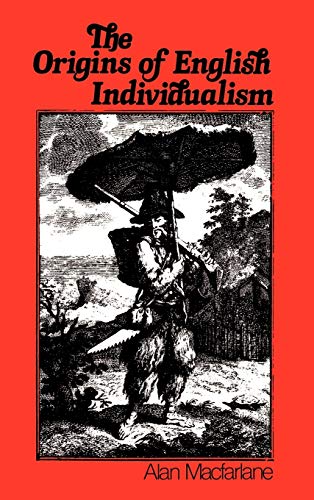
⭐In this book, the author examines the nature of English society during the five centuries prior to the Industrial Revolution, emphasizing the key differences between England and other nations. Citing numerous studies of medieval English life, he challenges the now entrenched theoretical framework (i.e. the “Whig” interpretation of history) originally promoted chiefly by Macaulay, Marx and Weber in which all societies are placed at various points along an inevitable development path, beginning with primitive feudalism and ending with modern capitalism. In place of this theory, he posits a theory of English exceptionalism, the idea that there has indeed been something special about England. He shows at length how medieval England fails to fit standard definitions of “peasant” society and in fact displayed the distinctive marks of individualism as early as the 13th century. Macfarlane doesn’t claim to trace individualism to its roots (admitting that requires further study, although he suspects Montesquieu was right in assuming the English adopted it from Germanic roots, citing Tacitus’ On the Manners of the Germans, which describes this “beautiful system [that] was invented first in the woods” based on absolute individual property), only that it predates (and in fact influenced) the Renaissance, Reformation and Enlightenment, events which are typically called upon to explain its emergence (he notes that some recent scholarship concedes some roots lie deep in biblical and classical times). The English tale of Robinson Crusoe (drawing on cover) embodies this seemingly uniquely English (in medieval times) tradition.The author acknowledges that the established view is especially appealing to our modern hope for development in the third world (improving life from harsh, “nasty, brutish and short” to humane, mobile and affluent with loving, nuclear families) and also offers the attractive notion of “progress” from “lower” to “higher” forms of societal organization.The primary implication of his thesis is that there is no necessary set of evolutionary stages from feudalism to individualism, from hierarchy to equality. Rather, these are alternative systems, which may coexist in time. Further, the nuclear family system, far from being a recent and transient development (as many have claimed), is ancient, durable and flexible, its simple molecular structure very likely allowing societal change to proceed rapidly in areas such as industrialization and urbanization. The theory sheds light on why market liberalism has failed to take root in the third world.While Macfarlane traces the roots of Western individualism and capitalism to the early 13th century and suspects Germanic roots before that, his thesis ties nicely into the notion of the Great Tradition, defended by Lord Acton and others (see M. Stanton Evans’ The Theme is Freedom for a modern defense), which asserts that these traits, along with libery, progress, popular sovereignty, science, the rule of law and many other Western values are actually God-given fruits of the Judeo-Christian tradition, beginning with the ancient Israelies and tracing through classical times and are definitely not recent inventions of modern rationalist man.I give it four stars for fascinating conclusions and implications, although the extensive discussion of source evidence, while necessary, may be tedious at times for some readers.
⭐looks like a great book, as advertised, on time, looking forward to reading it. Well satisfied.
⭐Excellent value!
⭐very interesting book
⭐Great.
⭐Condition as described and expected, good value
Keywords
Free Download The Origins of English Individualism: The Family Property and Social Transition 1st Edition in PDF format
The Origins of English Individualism: The Family Property and Social Transition 1st Edition PDF Free Download
Download The Origins of English Individualism: The Family Property and Social Transition 1st Edition 1991 PDF Free
The Origins of English Individualism: The Family Property and Social Transition 1st Edition 1991 PDF Free Download
Download The Origins of English Individualism: The Family Property and Social Transition 1st Edition PDF
Free Download Ebook The Origins of English Individualism: The Family Property and Social Transition 1st Edition