

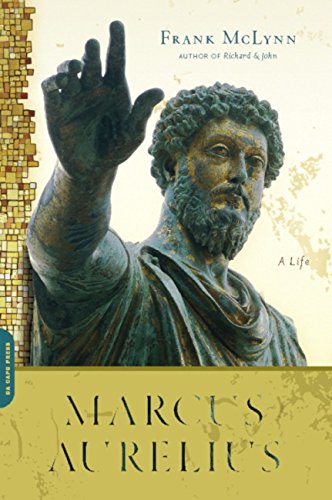
Ebook Info
- Published: 2009
- Number of pages: 722 pages
- Format: PDF
- File Size: 5.34 MB
- Authors: Frank McLynn
Description
Marcus Aurelius (121-180 AD) is one of the great figures of antiquity who still speaks to us today, more than two thousand years after his death. His Meditations has been compared by John Stuart Mill to the Sermon on the Mount. A guide to how we should live, it remains one of the most widely read books from the classical world. But Marcus Aurelius was much more than a philosopher. As emperor he stabilized the empire, issued numerous reform edicts, and defended the borders with success. His life itself represented the fulfillment of Plato’s famous dictum that mankind will prosper only when philosophers are rulers and rulers philosophers. Frank McLynn’s Marcus Aurelius, based on all available original sources, is the definitive and most vivid biography to date of this monumental historical figure.
User’s Reviews
Reviews from Amazon users which were colected at the time this book was published on the website:
⭐Plato, in his “Republic,” spoke of the value of the philosopher-king, arguing that that government would be best which was headed by philosophers, who understood “truth.” If so, then Marcus Aurelius should have been one of the great rulers of his era. This book explores, in considerable detail and with a broad scope, his philosophy, his life, and his rule.He was designated as a future ruler by Hadrian, to follow what was expected to be a short reign by Antoninus Pius (who was rather elderly when he took the throne)–who, however, lived quite some time. Thus, Marcus Aurelius became emperor (actually, co-emperor) at an age older than otherwise expected.The book is good at providing context. At the outset, McLynn notes the importance of this work (Page xi): “. . .the only voice that still seems to have contemporary relevance is that of the man who ruled the Roman empire from 161-180 AD.” He also observes that (Page 9): “We continue to use the tag ‘Marcus Aurelius’ for a ruler who is wise.” Then, he discusses the Roman economy (including the role of slaves, which was not altogether positive in its impact on the economy) and government. Given the importance of the emperor Hadrian, the book spends some time discussing his rule and the effects of his exercise of power. Hadrian was a hard person, willing to “take out” those whom he thought might endanger his rule. McLynn refers to him as a “very dark character.” Indeed, one characteristic of this volume, and one that sometimes becomes obtrusive, is his running commentary and highly judgmental comments in the middle of his narrative. Personally, I would have preferred his analysis to come at the end. On the other hand, the reader as always aware of the author’s perspective, and that has its own merit.The childhood and early adulthood of Marcus Aurelius is well described, including his education, his belief in Stoicism, and his experience with the world of Roman politics. Hadrian designated Marcus to become emperor, and the volume describes the logic nicely. Under the emperorship of Antoninus, Marcus was kept in Rome, involved in administrative tasks. He was never really trained or developed any experience with respect to war and command of the Roman legions. Thus, he had to learn while doing later on (although he did reasonably well in command of his forces, generally good generals to assist him. We learn of his family life and of his son, the horrific Commodus, one of the most wretched of emperors (well described in the text). Indeed, some judge Marcus Aurelius negatively for having such faith in a son who turned out so vilely.Upon his accession (with a mediocrity as co-emperor), Marcus set about the task of keeping the empire on solid footing. There were many challenges. The economy was beginning to creak, and this he stage for future deterioration. His effort to link philosophy with rule is touched on, showing the great challenges facing a philosopher who would be king. He did not like the spectacles of Rome, but had to fund them to keep the people happy, for instance. War fi8nally broke out to the north and east, and he performed pretty well as commander-in-chief–against the Germans and others who wished to break free from Roman rule.McLynn sometimes seems to wander back and forth in judgment of Marcus’ rule. Sometimes, he seems to note that he never lived up to his promise; at other times he observes that he did about as well as anyone could, given the emerging problems of the empire. The last chapter does a very solid job of putting Marcus Aurelius in a larger context.All in all, if one be interested in Marcus Aurelius the person, the philosopher, and the emperor, this book would be well worth reading. . . .
⭐Just imagine you are at a family dinner and your brilliant but very opinionated Uncle Frank McLynn had a few glasses of wine and decided to tell you all about Marcus Aurelius. He starts out telling you how much he thinks Stoic philosophy is self absorption and denial of emotions and how he can’t stand stoicism. Well, you know how it is when uncle Frank gets going and how you feel like disagreeing with him, but he talks too loud and he is very interesting, so you just sit and listen. Before you know it, he is describing the very interesting early life of Marcus and how he was educated by Greek philosophers and was being groomed to someday be the emperor of Rome. On and on Uncle Frank goes narrating the life of Marcus and various other main characters of the time, but then after a sip of wine, Uncle Frank curses that darn stoicism that Marcus has taken to be his core way of viewing the world. Why that fool Marcus uses his stoic philosophy to rationalize away the possible death of his child rather then emote like normal people do. Uncle Frank gets into almost raging on that one. Well, Uncle Frank calms down a bit and takes us through Marcus’s military campaigns against those German barbarians where stoic philosophy doesn’t stop Marcus from chasing down and beheading thousands of the Teutons. Uncle Frank likes this part of Marcus’s story until he admits that this was the time Marcus wrote his “Meditations” which was a summation of that darn stoic thinking which Uncle Frank finds so terrible. Well, Marcus, the stoic, had been writing about accepting death and he finally accepts it for himself but Uncle Frank won’t let him go as he complains about how many modern writers and thinkers have been adversely affected by that darn stoicism promoted by Marcus. By this time, you are ready to go home as you have had your fill of Uncle Frank’s intense opinions but you have to admit he really knows his history and tells a compelling story. Time to go home and nurse your hangover, in a stoic manner of course.
⭐This book is comprehensive and detailed. I am new to ancient history but not ancient philosophy so, in choosing this book, I was looking for historical, cultural, and economic context for the ancient philosophy I’ve been reading. Indeed, I found context and I now better understand the complexity of the Roman Empire of the first two centuries. I got what I was looking for in buying this book. There are some problems, though. McLynn needs a better editor because his writing is often inelegant. At least he should read “The Elements of Style,” by Strunk and White. He uses words that no one else knows or uses (or should use) such as “valetudinarian.” “Invalid” or “hypochondriac” are better words. He even uses words that are archaic. Another problem is that McLynn regularly demonstrates bias. Instead of neutrally disagreeing with the views of other writers and historians, he disparages with emotion and invective. Regarding Marcus Aurelius’s importance as a Stoic, McLynn has nothing but disdain. He doesn’t understand how or why Stoicism developed as an important philosophical defense against the horrors of the ancient world of war, famine, plague, slavery, torture, and terrible infant mortality. Rather, he labels Stoicism as inhumane. So, McLynn has written a book about one of the great emperors of Rome, yet clearly misunderstands and misrepresents the philosophy that was at the core of Aurelius’s being. This book is a valuable source of information but it would have been better with less opinion and more clarity.
⭐When buying this book, I wanted to read about Marcus Aurelius, the man. What I did not want to read were long, drawn out chapters about the Parthian war and critical reviews of stoicism.I understand that context is important, but the author spent way too long talking about these subjects and ended up boring me to tears.Difficult read and skipped large portions of dry text.
⭐This book is painstakingly researched and throws up an amazing volume of background facts so as book about life in Rome of the period it is very interesting. As a book on Marcus Aurelius the ‘person’, it is a rather remote read that doesn’t deliver a rounded portrait, as a narrative never quite seems to “get started” and can be a bit turgid at times.The word “scholarly” comes to mind rather than “a good read”.
⭐Great book. Very informative but I found that there were just a few too many graphic sex scenes – particularly the chariot threesome. My eight year old got his hands on it and won’t stop saying “toga-licious body”. Was not expecting it to be quite so raunchy but other than that it’s a great read.
⭐This is excellent, covering his philosophy as well as the history.
⭐Great book.good condiction.
Keywords
Free Download Marcus Aurelius: A Life in PDF format
Marcus Aurelius: A Life PDF Free Download
Download Marcus Aurelius: A Life 2009 PDF Free
Marcus Aurelius: A Life 2009 PDF Free Download
Download Marcus Aurelius: A Life PDF
Free Download Ebook Marcus Aurelius: A Life