

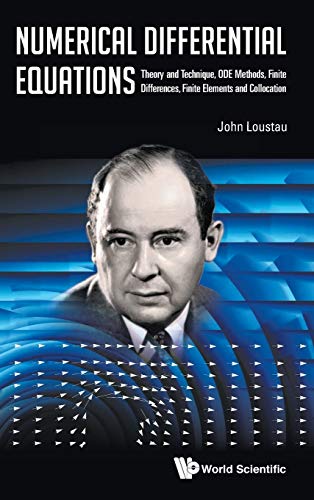
Ebook Info
- Published: 2016
- Number of pages: 384 pages
- Format: PDF
- File Size: 93.60 MB
- Authors: JOHN LOUSTAU
Description
This text presents numerical differential equations to graduate (doctoral) students. It includes the three standard approaches to numerical PDE, FDM, FEM and CM, and the two most common time stepping techniques, FDM and Runge-Kutta. We present both the numerical technique and the supporting theory.The applied techniques include those that arise in the present literature. The supporting mathematical theory includes the general convergence theory. This material should be readily accessible to students with basic knowledge of mathematical analysis, Lebesgue measure and the basics of Hilbert spaces and Banach spaces. Nevertheless, we have made the book free standing in most respects. Most importantly, the terminology is introduced, explained and developed as needed.The examples presented are taken from multiple vital application areas including finance, aerospace, mathematical biology and fluid mechanics. The text may be used as the basis for several distinct lecture courses or as a reference. For instance, this text will support a general applications course or an FEM course with theory and applications. The presentation of material is empirically-based as more and more is demanded of the reader as we progress through the material. By the end of the text, the level of detail is reminiscent of journal articles. Indeed, it is our intention that this material be used to launch a research career in numerical PDE.
User’s Reviews
Editorial Reviews: From the Back Cover The book presents numerical differential equations to graduate (doctoral) students. It includes the three standard approaches to numerical PDE, FDM, FEM and CM, and the two most common time stepping techniques, FDM and Runge-Kutta. We present both the numerical technique and the supporting mathematical theory. The applied techniques include those that arise in the present literature. The supporting mathematical theory includes the general convergence theory. This material is easily accessible to students with basic knowledge of mathematical analysis, Lebesgue measure and the basics of Hilbert spaces and Banach spaces. Nevertheless, we have made the book free standing in most respects. Most importantly, the terminology is developed within the text. The material is developed in the context of several interesting application areas such as finance, aerospace, mathematical biology, fluid mechanics.
Reviews from Amazon users which were colected at the time this book was published on the website:
⭐Great Book & Quick Delivery. However, the Delivery Man didn’t seem to Care Enough cause he Just left it on my Door-Front with “No Plastic Cover”,on a Rainy Day. So I found the Package Wet, But Thank God that the Content {the Book wasn’t Badly Affected)..Maybe if you Can Work on that, that’ll Make a Difference.. Thanks Again!
⭐
Keywords
Free Download Numerical Differential Equations: Theory and Technique, ODE Methods, Finite Differences, Finite Elements and Collocation in PDF format
Numerical Differential Equations: Theory and Technique, ODE Methods, Finite Differences, Finite Elements and Collocation PDF Free Download
Download Numerical Differential Equations: Theory and Technique, ODE Methods, Finite Differences, Finite Elements and Collocation 2016 PDF Free
Numerical Differential Equations: Theory and Technique, ODE Methods, Finite Differences, Finite Elements and Collocation 2016 PDF Free Download
Download Numerical Differential Equations: Theory and Technique, ODE Methods, Finite Differences, Finite Elements and Collocation PDF
Free Download Ebook Numerical Differential Equations: Theory and Technique, ODE Methods, Finite Differences, Finite Elements and Collocation