

Ebook Info
- Published: 2014
- Number of pages: 201 pages
- Format: PDF
- File Size: 7.22 MB
- Authors: Stephen Leon Lipscomb
Description
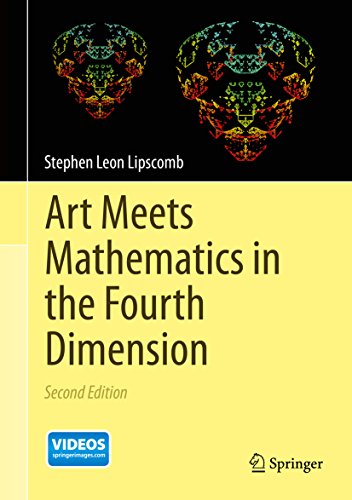
To see objects that live in the fourth dimension we humans would need to add a fourth dimension to our three-dimensional vision. An example of such an object that lives in the fourth dimension is a hyper-sphere or “3-sphere.” The quest to imagine the elusive 3-sphere has deep historical roots: medieval poet Dante Alighieri used a 3-sphere to convey his allegorical vision of the Christian afterlife in his Divine Comedy. In 1917, Albert Einstein visualized the universe as a 3-sphere, describing this imagery as “the place where the reader’s imagination boggles. Nobody can imagine this thing.” Over time, however, understanding of the concept of a dimension evolved. By 2003, a researcher had successfully rendered into human vision the structure of a 4-web (think of an ever increasingly-dense spider’s web). In this text, Stephen Lipscomb takes his innovative dimension theory research a step further, using the 4-web to reveal a new partial image of a 3-sphere. Illustrations support the reader’s understanding of the mathematics behind this process. Lipscomb describes a computer program that can produce partial images of a 3-sphere and suggests methods of discerning other fourth-dimensional objects that may serve as the basis for future artwork.
User’s Reviews
Reviews from Amazon users which were colected at the time this book was published on the website:
⭐I read this book mostly with the purpose to learn about the 3-sphere. I’ve managed to collect useful information about disc gluing, sphere slicing, basic elements of the 3-sphere and piercing the 3-sphere with a straight line. These were good, intuitive concepts where one starts with lower-dimensional spheres (eg. the circle, the 2-sphere) and applies the concept to 4-dimensional space and the 3-sphere. Often it was hard to follow what the text was advancing, as this general-audence kind of approach is not simple, it requires the author to be someone who has really struggled with the concept and is now able to explain it in layman’s terms. The author of this book is a mathematician, it seems he grasps concepts through mathematical intuition and his thoughts are hard to follow by someone who is not at this level of math.Because the concept of “perspective”, so important in art, is missing here, it may be difficult to understand how objects are meant to look. Freddy, the penguin who is said to see only in 2-dimensions, can actually see a circle. One would expect the penguin can see only an interval which may have an appearance of depth due to shadows. Only a 3-dimesnional being can see the circle in its entirety. Such details are important for the reader to be properly guided into the concepts.Apart from learning the basic concepts about 3-spheres, there are many other chapters of the book, dealing with various subjects related to the 3-sphere. There is an entire chapter, trying to prove that Dante Alighieri described an universe shaped as a 3-sphere. You might as well believe it. Another spacious section is devoted to Michelangelo’s “Creation of Adam”, where we supposedly find a cross-sectional image of a human brain. Parts of it actually come from the contours of the feet of some naked figures and such science found in the art of the middle ages is highly stretchy. There is an entire chapter where we learn that Einstein believed the universe is a 3-sphere, but it is unclear what the purpose of the chapter may be. A number of chapters are dedicated to geometries, called “webs”, which can be built in 4-space and then projected onto 3-space and thus utilized to show 3-dimensional “shadows” of a 3-sphere. The “web” is introduced, then mathematical and computational operations are appliedto it briefly and then there is a spacious explanation of what the images resemble (eg a human face). Then there is a detailed mathematical treatment – these chapters require knowledge of calculus and linear algebra.In summary, I have learned a few good concepts about the 3-sphere. The book has potential, if it is to show a clear flow of thoughts and concepts, where they have a beginning, steps where the reader gradually advances in knowledge and then reaches to a logical end. The pace could be much more uniform – it is perhaps too fast in places. Artistic “perspective” seems needed to explain many concepts better. The 4-web can be very useful in depicting a 3-sphere, as long as many more steps are included to guide the reader logically, at a slower pace, from one statement to the next.The book has definite potential, it would be interesting to read its next and expanded editions.
⭐
Keywords
Free Download Art Meets Mathematics in the Fourth Dimension 2nd Edition in PDF format
Art Meets Mathematics in the Fourth Dimension 2nd Edition PDF Free Download
Download Art Meets Mathematics in the Fourth Dimension 2nd Edition 2014 PDF Free
Art Meets Mathematics in the Fourth Dimension 2nd Edition 2014 PDF Free Download
Download Art Meets Mathematics in the Fourth Dimension 2nd Edition PDF
Free Download Ebook Art Meets Mathematics in the Fourth Dimension 2nd Edition