

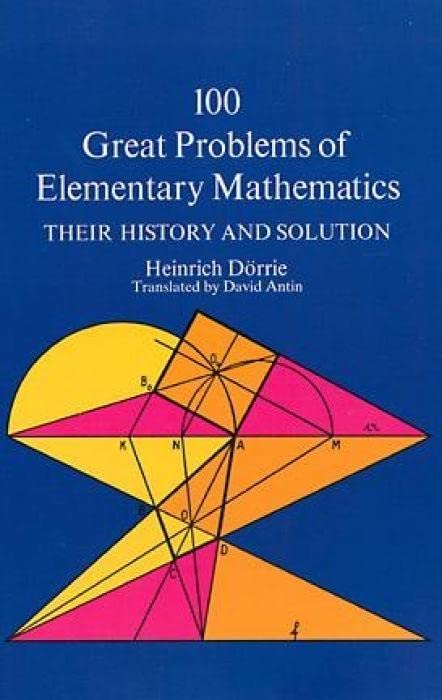
Ebook Info
- Published: 1965
- Number of pages: 416 pages
- Format: PDF
- File Size: 10.65 MB
- Authors: Heinrich Dorrie
Description
“The collection, drawn from arithmetic, algebra, pure and algebraic geometry and astronomy, is extraordinarily interesting and attractive.” — Mathematical GazetteThis uncommonly interesting volume covers 100 of the most famous historical problems of elementary mathematics. Not only does the book bear witness to the extraordinary ingenuity of some of the greatest mathematical minds of history — Archimedes, Isaac Newton, Leonhard Euler, Augustin Cauchy, Pierre Fermat, Carl Friedrich Gauss, Gaspard Monge, Jakob Steiner, and many others — but it provides rare insight and inspiration to any reader, from high school math student to professional mathematician. This is indeed an unusual and uniquely valuable book.The one hundred problems are presented in six categories: 26 arithmetical problems, 15 planimetric problems, 25 classic problems concerning conic sections and cycloids, 10 stereometric problems, 12 nautical and astronomical problems, and 12 maxima and minima problems. In addition to defining the problems and giving full solutions and proofs, the author recounts their origins and history and discusses personalities associated with them. Often he gives not the original solution, but one or two simpler or more interesting demonstrations. In only two or three instances does the solution assume anything more than a knowledge of theorems of elementary mathematics; hence, this is a book with an extremely wide appeal.Some of the most celebrated and intriguing items are: Archimedes’ “Problema Bovinum,” Euler’s problem of polygon division, Omar Khayyam’s binomial expansion, the Euler number, Newton’s exponential series, the sine and cosine series, Mercator’s logarithmic series, the Fermat-Euler prime number theorem, the Feuerbach circle, the tangency problem of Apollonius, Archimedes’ determination of pi, Pascal’s hexagon theorem, Desargues’ involution theorem, the five regular solids, the Mercator projection, the Kepler equation, determination of the position of a ship at sea, Lambert’s comet problem, and Steiner’s ellipse, circle, and sphere problems.This translation, prepared especially for Dover by David Antin, brings Dörrie’s “Triumph der Mathematik” to the English-language audience for the first time.
User’s Reviews
Reviews from Amazon users which were colected at the time this book was published on the website:
⭐“100 Great Problems of Elementary Mathematics” is translated from “Triumph der Mathematik,” originally published in German. The title describes the book well enough. Its articles describe not only the mathematics behind the solution of each well-known problem, but also the identities of the innovators and the time frame in which each labored.Although no fault of the author or the translator, I do think that some of the notation and also the labeling in its diagrams should be more “au courant:” Some of its diagrams actually use Roman numerals! One annoying thing I found was that in three related sections — 68. (Euler’s Tetrahedron Problem), 69. (The Shortest Distance Between Skew Lines), and 70. (The Sphere Circumscribing a Tetrahedron) — the translator seemed not to know the difference between “area” and “volume.” I also found typos elsewhere in the book. (In other settings a typo might not be serious; in a mathematics book, well …)Despite these slight deficiencies, I consider the book quite worthwhile. In fact, I have worn out five copies in my decades-long acquaintance with it.
⭐The objective of the book is great and the problem collection is amazing. I so want to love it. However, it is so much like a text book with very terse steps. Also the author uses some weird symbols which I am not able to read. They are neither greek or latin but look more like fancy drawings. As I am not able to read them I am not able to read the equations in my mind making it a tough read.
⭐squeezing 100 problems into less than 400 pages is not an easy task. There seems to be consistent tradeoff for brevity at the expense of readability. But if you are fairly experienced in elementary mathematics, most of the stuff can be followed. The degree of difficulty in following problems covered in this book varies greatly. Some can be appreciated by people with middle/high school math backgrounds. Others are very challenging to me (4th undergrad in engineering with good math background relative to undergrad math students). The big advantage of this book is that it deals with widely applicable, and historically significant, and applied math problems. This is in contrast to the bulk of math problem books out there that just deal with recreational problems (puzzle for example. but math olympic problems are recreational too, since the best high school students have to be able to solve them in around an hour). Look at the table of content and you will see. Highly stimulating.
⭐Wonderful book for anyone who is A) a genius, B) truly loves mathematics and C) doesn’t mind discovering that there are things that can be done with algebra that they never dreamed of! :)The rest has already been well said by the other reviewers.I will mention there is another book with a very similar title by Hugo Steinhaus (with an intro by Martin Gardener). “One Hundred Problems in Elementary Mathematics”. The two books are NOT the same. If you enjoy Dorrie’s book, you should check out Steinhaus’ book as well. Similar subject matter, but the problems aren’t the same 100 problems. Although some are duplicated, most are different, and some of the duplicates are done with a different approach.
⭐Fine.
⭐Good !
⭐GOOD THOUGHT PROVOKING BOOKJ.
⭐100 Great Problems of Elementary Mathematics is such a goldmine of ingenuity that it is hard to comprehend how it could be sold for so low a price. Ten dollars is practically a steal.This publication, which was translated into English back in 1965, is a concise summary of some of the greatest works of mathematics throughout mankind’s history. The problems contained are quite challenging. Many are such that if you understood any one of them, then you would probably know something that even the best math professor nearest you would not. This may sound like an overstatement, but in a day and age where some PhD’s in math have either forgotten or never really learned how to determine so little as the square root of a number by just pencil and paper, it is probably not.It is from analyzing the book’s passages of Bernoulli’s Power Sum Problem that I was able to achieve a great mathematical triumph after discovering the following challenge found in William Dunham’s The Mathematical Universe: determining a precise mathematical formula to figure out how Jakob Bernoulli could take all the positive integers from 1 to 1000, raise each of them to the tenth power, and then add them up to where the sum came up to over 30 digits! I tried to develop algorithms that would work but failed each time, until I, once again, read this volume.The situations presented are quite difficult to grasp, but once you get to where you know how to apply any one of them in solving mathematical puzzles, you feel elated. I know I did.For the individual who enjoys looking at mathematics in a historical context and who wants to approach problems that are perhaps not entirely solvable with the use of the calculator and/or the computer, I recommend this book.
⭐Absolutely brilliant book to dip into and to see recited some of the most seductively brilliant arguments from some of the most brilliant minds in history.
⭐excellent
⭐This is a book I dip into from time to time. It is a great collection, but the word elementary should certainly not be applied. I was a head of maths at a secondary school for many years, and I know that just about all of the teachers in my department would have had great difficulty in understanding much of what is in this book.So I think it’s a book for ‘gifted and talented’. Like me!
⭐Sono problemi antichi risolti in maniera elegante senza ricorrere a formalismi estremi; a volte senza il ricorso al calcolo differenziale. Dalla teoria dei numeri alla meccanica celeste. Ad esempio dalla soluzione dell’equazione di Keplero al punto di massima brillantezza di Venere osservato dalla TerraThe one hundred problems cover number theory, analysis, analytical, projection geometry etc.The solutions are usually illustrative and requires little background to be understood.when ordering this book, I initially wanted to read some topics on conic curves, but I got more interesting subjects now.I hope the author would have added more figures to it, as the average number of figures per problem is probably less than one.
Keywords
Free Download 100 Great Problems of Elementary Mathematics (Dover Books on Mathematics) in PDF format
100 Great Problems of Elementary Mathematics (Dover Books on Mathematics) PDF Free Download
Download 100 Great Problems of Elementary Mathematics (Dover Books on Mathematics) 1965 PDF Free
100 Great Problems of Elementary Mathematics (Dover Books on Mathematics) 1965 PDF Free Download
Download 100 Great Problems of Elementary Mathematics (Dover Books on Mathematics) PDF
Free Download Ebook 100 Great Problems of Elementary Mathematics (Dover Books on Mathematics)