

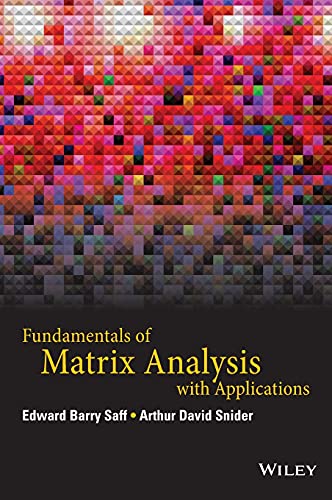
Ebook Info
- Published: 2015
- Number of pages: 408 pages
- Format: PDF
- File Size: 5.20 MB
- Authors: Edward Barry Saff
Description
An accessible and clear introduction to linear algebra with a focus on matrices and engineering applicationsProviding comprehensive coverage of matrix theory from a geometric and physical perspective, Fundamentals of Matrix Analysis with Applications describes the functionality of matrices and their ability to quantify and analyze many practical applications. Written by a highly qualified author team, the book presents tools for matrix analysis and is illustrated with extensive examples and software implementations.Beginning with a detailed exposition and review of the Gauss elimination method, the authors maintain readers’ interest with refreshing discussions regarding the issues of operation counts, computer speed and precision, complex arithmetic formulations, parameterization of solutions, and the logical traps that dictate strict adherence to Gauss’s instructions. The book heralds matrix formulation both as notational shorthand and as a quantifier of physical operations such as rotations, projections, reflections, and the Gauss reductions. Inverses and eigenvectors are visualized first in an operator context before being addressed computationally. Least squares theory is expounded in all its manifestations including optimization, orthogonality, computational accuracy, and even function theory. Fundamentals of Matrix Analysis with Applications also features:Novel approaches employed to explicate the QR, singular value, Schur, and Jordan decompositions and their applicationsCoverage of the role of the matrix exponential in the solution of linear systems of differential equations with constant coefficientsChapter-by-chapter summaries, review problems, technical writing exercises, select solutions, and group projects to aid comprehension of the presented conceptsFundamentals of Matrix Analysis with Applications is an excellent textbook for undergraduate courses in linear algebra and matrix theory for students majoring in mathematics, engineering, and science. The book is also an accessible go-to reference for readers seeking clarification of the fine points of kinematics, circuit theory, control theory, computational statistics, and numerical algorithms.
User’s Reviews
Editorial Reviews: Review “Providing comprehensive coverage of matrix theory from a geometric and physical perspective, the book describes the functionality of matrices and their ability to quantify and analyze many practical applications. Written by a highly qualified author team, the book presents tools for matrix analysis and is illustrated with extensive examples and software implementations.” (Zentralblatt MATH 2016).”This is a straightforward modern introduction to matrices….. a very well done text, probably most suitable for engineering students.” (Mathematical Association of America 2016). From the Inside Flap An accessible and clear introduction to linear algebra with a focus on matrices and engineering applicationsProviding comprehensive coverage of matrix theory from a geometric and physical perspective, Fundamentals of Matrix Analysis with Applications describes the functionality of matrices and their ability to quantify and analyze many practical applications. Written by a highly qualified author team, the book presents tools for matrix analysis and is illustrated with extensive examples and software implementations. Beginning with a detailed exposition and review of the Gauss elimination method, the authors maintain readers’ interest with refreshing discussions regarding the issues of operation counts, computer speed and precision, complex arithmetic formulations, parameterization of solutions, and the logical traps that dictate strict adherence to Gauss’s instructions. The book heralds matrix formulation both as notational shorthand and as a quantifier of physical operations such as rotations, projections, reflections, and the Gauss reductions. Inverses and eigenvectors are visualized first in an operator context before being addressed computationally. Least squares theory is expounded in all its manifestations including optimization, orthogonality, computational accuracy, and even function theory. Fundamentals of Matrix Analysis with Applications also features: Novel approaches employed to explicate the QR, singular value, Schur, and Jordan decompositions and their applicationsCoverage of the role of the matrix exponential in the solution of linear systems of differential equations with constant coefficientsChapter-by-chapter summaries, review problems, technical writing exercises, select solutions, and group projects to aid comprehension of the presented conceptsFundamentals of Matrix Analysis with Applications is an excellent textbook for undergraduate courses in linear algebra and matrix theory for students majoring in mathematics, engineering, and science. The book is also an accessible go-to reference for readers seeking clarification of the fine points of kinematics, circuit theory, control theory, computational statistics, and numerical algorithms. From the Back Cover An accessible and clear introduction to linear algebra with a focus on matrices and engineering applicationsProviding comprehensive coverage of matrix theory from a geometric and physical perspective, Fundamentals of Matrix Analysis with Applications describes the functionality of matrices and their ability to quantify and analyze many practical applications. Written by a highly qualified author team, the book presents tools for matrix analysis and is illustrated with extensive examples and software implementations. Beginning with a detailed exposition and review of the Gauss elimination method, the authors maintain readers’ interest with refreshing discussions regarding the issues of operation counts, computer speed and precision, complex arithmetic formulations, parameterization of solutions, and the logical traps that dictate strict adherence to Gauss’s instructions. The book heralds matrix formulation both as notational shorthand and as a quantifier of physical operations such as rotations, projections, reflections, and the Gauss reductions. Inverses and eigenvectors are visualized first in an operator context before being addressed computationally. Least squares theory is expounded in all its manifestations including optimization, orthogonality, computational accuracy, and even function theory. Fundamentals of Matrix Analysis with Applications also features: Novel approaches employed to explicate the QR, singular value, Schur, and Jordan decompositions and their applicationsCoverage of the role of the matrix exponential in the solution of linear systems of differential equations with constant coefficientsChapter-by-chapter summaries, review problems, technical writing exercises, select solutions, and group projects to aid comprehension of the presented conceptsFundamentals of Matrix Analysis with Applications is an excellent textbook for undergraduate courses in linear algebra and matrix theory for students majoring in mathematics, engineering, and science. The book is also an accessible go-to reference for readers seeking clarification of the fine points of kinematics, circuit theory, control theory, computational statistics, and numerical algorithms. About the Author EDWARD BARRY SAFF, PhD, is Professor of Mathematics and Director of the Center for Constructive Approximation at Vanderbilt University. Dr. Saff is an Inaugural Fellow of the American Mathematical Society, Foreign Member of the Bulgarian Academy of Science, and the recipient of both a Guggenheim and Fulbright Fellowship. He is Editor-in-Chief of two research journals, Constructive Approximation and Computational Methods and Function Theory, and has authored or coauthored over 250 journal articles and eight books. Dr. Saff also serves as an organizer for a sequence of international research conferences that help to foster the careers of mathematicians from developing countries. ARTHUR DAVID SNIDER, PhD, PE, is Professor Emeritus at the University of South Florida, where he served on the faculties of the Departments of Mathematics, Physics, and Electrical Engineering. Previously an analyst at the Massachusetts Institute of Technology’s Draper Lab and recipient of the USF Krivanek Distinguished Teacher Award, he consults in industry and has authored or coauthored over 100 journal articles and eight books. With the support of the National Science Foundation, Dr. Snider also pioneered a course in fine art appreciation for engineers. Read more
Reviews from Amazon users which were colected at the time this book was published on the website:
⭐I have long been fascinated with matrix operations in computing. So I thought this book would help me better understand matrix operations. This book, however, is far more than expected. It isn’t the namby-pamby kind of matrix operations I’ve been doing. This is serious mathematics. From the back cover: “Providing comprehensive coverage of matrix theory from a geometric and physical perspective, Fundamentals of Matrix Analysis with Applications describes the functionality of matrices and their ability to quantify and analyze many practical applications..” Frankly, it is beyond my skill level unless I put very serious effort into it. I can see that it is a thorough treatment of matrix analysis, but beyond my ability to comprehend from a simple reading. The book is described as an “accessible and clear introduction to linear algebra with a focus on matrices and engineering applications. The authors are clearly masters of the subject, but it is not something that has a place in my life.Jerry
⭐Professors seeking a new text for their class will want to consider Saff and Snider’s Fundamentals of Matrix Analysis. While the text (and material itself) is fairly dense, there are glittering bits of playfulness that make the subject tolerable (and this is especially important to your students). For instance, the authors point out that the first part of this text may prove to be a review … and refer to this material as potentially tedious and point out that your students may be falling asleep. Cute. But, professors should know that this text does take its time to re-familiarize students with the overall material. (That alone is valuable!)Of note:-There are review problems-There are technical writing exercises-And (of interest to many professors), there are group projectsThe answers to odd-numbered exercises are supplied by the authors. (This, too, will be seen as a boon by those who teach this course).Wiley provides a student companion site for this text. Professors should inform students of this supplement since it will (undoubtedly) prove helpful.Professors seeking a new text for their class should give this a look. It may prove a truly valuable resource.
⭐I enjoy this book, as it is well structured, and illustrates its topic clearly. Matrices are a lot of drudgery, but with the help of this book, at least the subject is comprehendible. I like it.
Keywords
Free Download Fundamentals of Matrix Analysis with Applications 1st Edition in PDF format
Fundamentals of Matrix Analysis with Applications 1st Edition PDF Free Download
Download Fundamentals of Matrix Analysis with Applications 1st Edition 2015 PDF Free
Fundamentals of Matrix Analysis with Applications 1st Edition 2015 PDF Free Download
Download Fundamentals of Matrix Analysis with Applications 1st Edition PDF
Free Download Ebook Fundamentals of Matrix Analysis with Applications 1st Edition