

Ebook Info
- Published: 2008
- Number of pages: 400 pages
- Format: PDF
- File Size: 5.74 MB
- Authors: O. Ya. Viro
Description
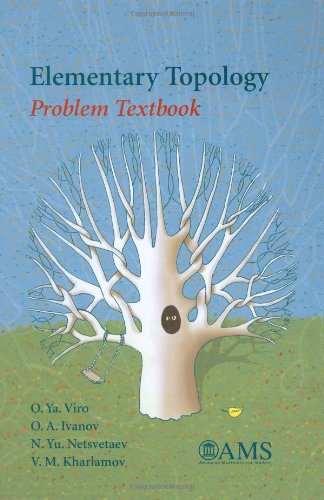
This textbook on elementary topology contains a detailed introduction to general topology and an introduction to algebraic topology via its most classical and elementary segment centered at the notions of fundamental group and covering space. The book is tailored for the reader who is determined to work actively. The proofs of theorems are separated from their formulations and are gathered at the end of each chapter. This makes the book look like a pure problem book and encourages the reader to think through each formulation. A reader who prefers a more traditional style can either find the proofs at the end of the chapter or skip them altogether. This style also caters to the expert who needs a handbook and prefers formulations not overshadowed by proofs. Most of the proofs are simple and easy to discover. The book can be useful and enjoyable for readers with quite different backgrounds and interests. The text is structured in such a way that it is easy to determine what to expect from each piece and how to use it. There is core material, which makes up a relatively small part of the book. The core material is interspersed with examples, illustrative and training problems, and relevant discussions. The reader who has mastered the core material acquires a strong background in elementary topology and will feel at home in the environment of abstract mathematics. With almost no prerequisites (except real numbers), the book can serve as a text for a course on general and beginning algebraic topology.
User’s Reviews
Editorial Reviews: Review “With its selection of topics and its interesting, unique format, this book could be very useful as a graduate text for a first course in topology.” —- Mathematical Reviews
Reviews from Amazon users which were colected at the time this book was published on the website:
⭐I should preface this review by noting that I actually used this book in a course taught by one of the authours (Prof. Viro). Having said that, I will try to make the review as unbiased as possible for people who may not have the good fortune of using the book in a course taught by someone who wrote the book.The set up of the book is unique, and it took a while to get used to it. I’ve honestly never read a textbook set up this way before, so when I say “unique”, I mean it in the strictest definition of the word.I recommend this book for two types of people:1) Those who want to really understand the “nitty-gritty” of basic, grad-level topology and who want to work everything out from the ground up. As the introduction states, this book is not written in the standard way, where proofs are given directly after the statement (ie; theorem/lemma/corollary/etc.) Proofs (or at least, sketches of proofs) are given at the end of each chapter, but the main burden of proving a statement lies on the reader. This is good and bad. It’s good because it does allow you to find your own “voice” in the material. It can be bad in the sense that you may not understand enough to even know how to begin finding your own voice. Personally, I felt somewhere in the middle of those two extremes. I did find it helpful to use other textbooks to help fill in some blanks in understanding.2) You want to use it as an activity book-type supplement to a different book.My only real complaint with the text was that the organization was a little rough for me, as someone with mild-to-moderate dyslexia. It was a little too easy for me to get confused by the letter-number combinations used to organize the material. Having said that, I don’t hold it against the authours. There’s no such thing as a “dyslexia resistant book”, so one shouldn’t expect that.All in all, I enjoyed using this book, and it’s one that I’ll keep in my personal library for years to come.
⭐I agree with everything reviewer maisonsuspendue has to say. I used this book for my first serious course in topology-we mainly used it as a guide for topics selection. I like how this book is not centered around the building of knowledge, but around the building of skills. The problems are laid out in a fashion that most problems are meant to be used to tackle their successor. We did not go through the proofs of Urysohn and Tietze in the course I took which is great since the authors of this book lay out a nice path for how to prove both of them. I feel like I really own many of the results of general topology because I have actually gone through them on my own-It is definitely worth a look at.
⭐good
⭐I am not normally moved to write reviews, but the two star rating (the only one currently posted) is in my view unjust. I can’t deny that the English is occasionally a little off, and there are some typos, but to suggest that these facts somehow render the book unusable is just not true.I bought this book after completing a first course in topology in order to have some more problems to work on and possibly to see some new topics. It has proven wonderful for this purpose. Really, I wish I had learned out of it in the first place. While it is true that it would probably not be suitable for standard classroom use (with all the answers and proofs provided it would require a genuinely motivated student to get the most out of it), it would surely be a great supplement the main class text. It would also clearly be great for learning from on one’s own.This is a “problem textbook” in two senses. First, in the obvious way, it is a textbook which contains many problems. But it also does the reader the favor of moving the proofs to the ends of each chapter. This has the effect, as the authors’ describe it, of making “the book inconvenient for careless skimming.” In other words, it encourages the reader to fill in the proofs as he or she goes along. So this adds a second layer of “problems” to work on.But this organizational strategy is more than a contrived inconvenience. It also has the advantage of making clear the shape of larger arguments and connections between sections. One can dip into the details as one sees fit, all while being able to place this detailed work in the context of a larger argument. So, in addition to being a book you can systematically work through, it also rewards conscientious skimming.(I should add that the placing of proofs at the end is not entirely without precedent. Think, for instance, of Courant’s calculus texts, with their appendices. It works quite well there as well.)Finally, the copy I received is beautifully printed and nicely bound. I was almost shocked, especially when compared to the overpriced volumes put out by Springer these days, which look like they’ve been run through a photocopier and assembled by a four-year-old with a glue gun. This, by contrast, is a book you will physically want to spend time with.
⭐I like the concept of a problem textbook and this one has a great deal of good stuff.Unfortunately the editing is too poor to give a correct rate. I urge the authors to rewrite the part on covering spaces which should not have been published with so many mistakes and to improve the solutions given to the problems at the back of the book. Also serious work is needed in reducing the number of typos. With these improvements I would be willing to consider a different rate.
⭐Love the book, but the print is on cheap material for Bangladeshi market. Not approved for EMEA.
⭐Thorough coverage of topology
Keywords
Free Download Elementary Topology in PDF format
Elementary Topology PDF Free Download
Download Elementary Topology 2008 PDF Free
Elementary Topology 2008 PDF Free Download
Download Elementary Topology PDF
Free Download Ebook Elementary Topology