

Ebook Info
- Published: 1998
- Number of pages: 172 pages
- Format: PDF
- File Size: 8.31 MB
- Authors: David A. Singer
Description
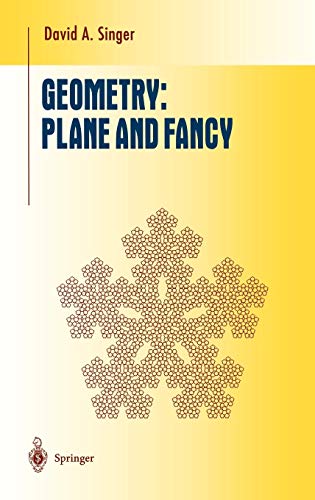
A fascinating tour through parts of geometry students are unlikely to see in the rest of their studies while, at the same time, anchoring their excursions to the well known parallel postulate of Euclid. The author shows how alternatives to Euclids fifth postulate lead to interesting and different patterns and symmetries, and, in the process of examining geometric objects, the author incorporates the algebra of complex and hypercomplex numbers, some graph theory, and some topology. Interesting problems are scattered throughout the text. Nevertheless, the book merely assumes a course in Euclidean geometry at high school level. While many concepts introduced are advanced, the mathematical techniques are not. Singers lively exposition and off-beat approach will greatly appeal both to students and mathematicians, and the contents of the book can be covered in a one-semester course, perhaps as a sequel to a Euclidean geometry course.
User’s Reviews
Reviews from Amazon users which were colected at the time this book was published on the website:
⭐a good value for this book…hubby was happy to add it to his collection.
⭐We found this book rather dull and also annoying in that it leaves out many proofs (“it turns out that…”, “Gauss showed that…”, etc.). We would not have bothered writing a review had we not been provoked by a sweeping statement regarding the history of mathematics on page 127: “if we assume Descartes’s theorem [on exterior solid angles of polyhedra], we can prove that for any convex polyhedron V-E+F=2. As Malkevich points out in his article [in Shaping Space: A Polyhedral Approach, Senechal & Fleck (eds.)], this has led to the erroneous impression that Descartes could easily have discovered Euler’s formula. But that would have required Descartes to think of a polyhedron as a combinatorial object, rather than a geometric object, a major intellectual leap at the time.” This is complete nonsense. In fact, Descartes did think of polyhedra as combinatorial objects but choose not to publish since he did not get very far. A surviving manuscript has now been published: Descartes on Polyhedra: A Study of the “De solidorum elementis”, Federico, Springer, 1982. Here Descartes gives several Euler-style identities, but none involving edges. Clearly, then, there was no “major intellectual leap” required to discover Euler’s formula, just luck and persistence. The reason why Descartes and his contemporaries did not develop the combinatorial approach further was not some mysterious conceptual wall but simply the fact that this approach did not seem very fruitful.
⭐While some of these complaints may be due to the course that used this book, I do believe that this is one of the worst math books I’ve ever read.The book has several problems. The most glaring problem is its vagueness. None of the (117) figures are labeled. None of the questions are numbered, or given any other identifying mark. Some questions refer to figures on different pages, but simply say “look at [the figure],” only to leave the reader with the thought “what figure.” Or to suggest one figure, though to use a different figure all together. Coupled with the fact that many theorems are not stated, or are not identified and are rarely proven. Stylistically, this book is just a mess.If that weren’t bad enough, many of the figures look like clipart images from 1991. The book is copyright 1998, suggesting to me that if he spent 7 (or more) years writing this book, maybe he should have redone some of the figures so they’re not such an eyesore. Maybe this is a minor point, but if you’re going to advertise the fact that you have 117 images, maybe you should make those images look nice.As for the books good points, the information presented is in a logical fashion, and is correct. The text is easy to read (in that the font is not too small, or strange), and the pages are sturdy enough to write on them if you need to play with the figures.For any teachers/professors reading this, I would not recommend using this book as a primary source for your course. Maybe it would be ok as a supplementary source.Finally, if you were considering using this book for the topic on graph theory, then I would suggest instead using “Introduction to Graph Theory” by Robin J. Wilson (ISBN: 0-582-24993-7)
Keywords
Free Download Geometry: Plane and Fancy (Undergraduate Texts in Mathematics) 1998th Edition in PDF format
Geometry: Plane and Fancy (Undergraduate Texts in Mathematics) 1998th Edition PDF Free Download
Download Geometry: Plane and Fancy (Undergraduate Texts in Mathematics) 1998th Edition 1998 PDF Free
Geometry: Plane and Fancy (Undergraduate Texts in Mathematics) 1998th Edition 1998 PDF Free Download
Download Geometry: Plane and Fancy (Undergraduate Texts in Mathematics) 1998th Edition PDF
Free Download Ebook Geometry: Plane and Fancy (Undergraduate Texts in Mathematics) 1998th Edition