

Ebook Info
- Published: 2006
- Number of pages: 184 pages
- Format: PDF
- File Size: 2.16 MB
- Authors: Chuanming Zong
Description
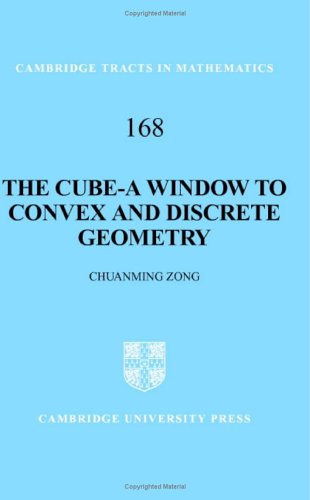
This tract has two purposes: to show what is known about the n-dimensional unit cubes and to demonstrate how Analysis, Algebra, Combinatorics, Graph Theory, Hyperbolic Geometry, Number Theory, can be applied to the study of them. The unit cubes, from any point of view, are among the most important and fascinating objects in an n-dimensional Euclidean space. However, our knowledge about them is still quite limited and many basic problems remain unsolved. In this Tract eight topics about the unit cubes are introduced: cross sections, projections, inscribed simplices, triangulations, 0/1 polytopes, Minkowski’s conjecture, Furtwangler’s conjecture, and Keller’s conjecture. In particular the author demonstrates how deep analysis like log concave measure and the Brascamp-Lieb inequality can deal with the cross section problem, how Hyperbolic Geometry helps with the triangulation problem, how group rings can deal with Minkowski’s conjecture and Furtwangler’s conjecture, and how Graph Theory handles Keller’s conjecture.
User’s Reviews
Reviews from Amazon users which were colected at the time this book was published on the website:
⭐Easily one of my favourite mathematical texts. As someone who researches in geometry and is always looking for new ways to approach the subject, I found this book to be extremely enlightening.Though I wouldn’t classify the material as “simple” by any means, I do think there’s a certain amount of ease that comes with approaching the material from the vantage point of the geometry of the cube. Euclidean geometry is one of the first mathematical concepts we get introduced to in our education, and so there’s a certain amount of comfort that comes with that familiarity. But this is no high school text book. A familiarity with advanced undergraduate material is a must, and even that might not be enough depending on the readers confidence and breadth of knowledge.I’ve only (so far) read from the Preface up to Chapter 4 (Triangulations), and I can say that the material has helped me build off of previous materials I’ve been taught in classes and at conferences/symposia/lectures (as well as material I’ve taught myself).I’m fairly excited to dig in to the Chapter 5 material (0/1 polytopes) as it’s a subject I’ve not yet seen.As to Zong’s writing style: Though it can be occasionally dense (as most mathematics can be), it’s never inaccessible. One of the best features of the book is Zong’s table of basic notation that he uses at the beginning of the text. This is a feature I’ve adopted into my own mathematical writings. It makes reading the material that much easier, since you know exactly where to go (the front of the book) if you forget exactly what a certain symbol means. I find when I put a mathematical text down for a few days and then go back, I sometimes waste hours trying to find out what a symbol means because I forgot to make a note in the margins. The table of notations in this book virtually eliminates that problem.If you enjoy geometry, this is a good one to pick up.
⭐accurate careful speedy TOTALLY PROFESSIONAL
⭐
Keywords
Free Download The Cube-A Window to Convex and Discrete Geometry (Cambridge Tracts in Mathematics Book 168) 1st Edition in PDF format
The Cube-A Window to Convex and Discrete Geometry (Cambridge Tracts in Mathematics Book 168) 1st Edition PDF Free Download
Download The Cube-A Window to Convex and Discrete Geometry (Cambridge Tracts in Mathematics Book 168) 1st Edition 2006 PDF Free
The Cube-A Window to Convex and Discrete Geometry (Cambridge Tracts in Mathematics Book 168) 1st Edition 2006 PDF Free Download
Download The Cube-A Window to Convex and Discrete Geometry (Cambridge Tracts in Mathematics Book 168) 1st Edition PDF
Free Download Ebook The Cube-A Window to Convex and Discrete Geometry (Cambridge Tracts in Mathematics Book 168) 1st Edition