

Ebook Info
- Published: 2012
- Number of pages: 310 pages
- Format: PDF
- File Size: 2.18 MB
- Authors: Ernesto Girondo
Description
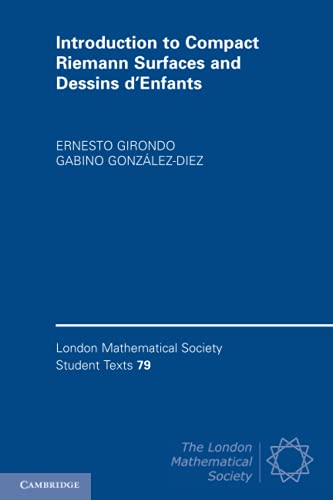
Few books on the subject of Riemann surfaces cover the relatively modern theory of dessins d’enfants (children’s drawings), which was launched by Grothendieck in the 1980s and is now an active field of research. In this book, the authors begin with an elementary account of the theory of compact Riemann surfaces viewed as algebraic curves and as quotients of the hyperbolic plane by the action of Fuchsian groups of finite type. They then use this knowledge to introduce the reader to the theory of dessins d’enfants and its connection with algebraic curves defined over number fields. A large number of worked examples are provided to aid understanding, so no experience beyond the undergraduate level is required. Readers without any previous knowledge of the field of dessins d’enfants are taken rapidly to the forefront of current research.
User’s Reviews
Editorial Reviews: Review “Overall the text is very well written and easy to follow, partly due to the abundance of good concrete examples in every single section illustrating concepts from the very basic to the very technical.” Aaron D. Wootton, Mathematical Reviews Book Description An elementary account of the theory of compact Riemann surfaces and an introduction to the Belyi–Grothendieck theory of dessins d’enfants. About the Author Ernesto Girondo is Profesor Titular de Geometría y Topología in the Department of Mathematics at Universidad Autónoma de Madrid.Gabino González-Diez is Catedrático de Geometría y Topología in the Department of Mathematics at Universidad Autónoma de Madrid. Read more
Reviews from Amazon users which were colected at the time this book was published on the website:
⭐This is quite an excellent book, and very much worth purchasing (if you are interested at all in this subject). Really, it is the only book of its kind, as all other books/papers that I know of, which are also valuable for different reasons, are either collections of more specialized articles (e.g. Schneps) or, at the other extreme, have very little technical depth. But even if there were other competing books, this would likely still be the best, since it is unbelievably engaging and easy-to-read. You really can start at page 1 and effortlessly read the whole book, acquiring a very firm understanding of the subject by the end. The subject is, by nature, very visual and the authors include a large number of clear pictures and diagrams to accompany the exposition.In case the authors are reading, here are a few things that I suggest for future printings/editions:(1) Include some basic treatment of the Grothendieck-Teichmuller group, which could be done in an elementary way as in Pierre Guillot’s preprint arXiv:1309.1968. This could maybe be merged with section 4.3.1, which comments on the monodromy action coming from a “de-ramified” Belyi map.(2) Before Proposition 3.3, it might be nice to mention that Belyi’s special polynomials are themselves Belyi maps whose dessins are “double stars” (read near Figure 4.21).(3) In section 3.1, in the middle of the proof: Is that equality involving B_1 really an equality?(4) In the proof of Proposition 4.13, it might be nice to make additional comments on what to do while “us[ing] sigma_0 to label the remaining edges” when the edge in question is fixed by sigma_0.(5) Before Example 4.14, there is a typo: the 2nd sigma_0 on the right-hand-side should be replaced with a sigma_1.(6) In Proposition 4.20, I think it is somewhat misleading to say that there is a function {Dessins} to {Belyi Pairs}. It seems to me that there is only a function at the level of equivalence classes. In the opposite direction, {Belyi Pairs} to {Dessins}, there really is a function: color the inverse image of [0,1].(7) Remark 4.26: It might be nice to expand this topic (weakening the definition of equivalence to allow transformation of the codomain) into a full subsection.(8) Example 4.58: For the convenience of the reader, it might be nice to include the field splitting the cubic and its galois group (which are, respectively, the field over Q generated by cubic root of 2 and the symmetric group S3).(9) Example 4.24: Maybe I misunderstand the meaning of the labels of Figure 4.7, but I think some of the numbers in the “sheets” are missing signs (e.g. the point marked “2” should be marked “-2”). This may happen in other example also.
Keywords
Free Download Introduction to Compact Riemann Surfaces and Dessins d’Enfants (London Mathematical Society Student Texts, Series Number 79) 1st Edition in PDF format
Introduction to Compact Riemann Surfaces and Dessins d’Enfants (London Mathematical Society Student Texts, Series Number 79) 1st Edition PDF Free Download
Download Introduction to Compact Riemann Surfaces and Dessins d’Enfants (London Mathematical Society Student Texts, Series Number 79) 1st Edition 2012 PDF Free
Introduction to Compact Riemann Surfaces and Dessins d’Enfants (London Mathematical Society Student Texts, Series Number 79) 1st Edition 2012 PDF Free Download
Download Introduction to Compact Riemann Surfaces and Dessins d’Enfants (London Mathematical Society Student Texts, Series Number 79) 1st Edition PDF
Free Download Ebook Introduction to Compact Riemann Surfaces and Dessins d’Enfants (London Mathematical Society Student Texts, Series Number 79) 1st Edition