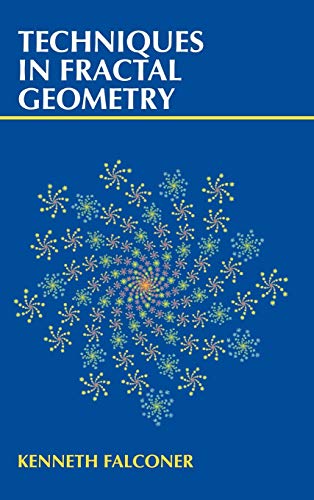
Ebook Info
- Published: 1997
- Number of pages:
- Format: PDF
- File Size: 8.35 MB
- Authors: Kenneth Falconer
Description
Following on from the success of Fractal Geometry: Mathematical Foundations and Applications, this new sequel presents a variety of techniques in current use for studying the mathematics of fractals. Much of the material presented in this book has come to the fore in recent years. This includes methods for studying dimensions and other parameters of fractal sets and measures, as well as more sophisticated techniques such as thermodynamic formalism and tangent measures. In addition to general theory, many examples and applications are described, in areas such as differential equations and harmonic analysis. This book is mathematically precise, but aims to give an intuitive feel for the subject, with underlying concepts described in a clear and accessible manner. The reader is assumed to be familiar with material from Fractal Geometry, but the main ideas and notation are reviewed in the first two chapters. Each chapter ends with brief notes on the development and current state of the subject. Exercises are included to reinforce the concepts. The author’s clear style and up-to-date coverage of the subject make this book essential reading for all those who with to develop their understanding of fractal geometry.
User’s Reviews
Opiniones editoriales From the Publisher This book addressees a variety of techniques and applications in fractal geometry. It examines such topics as implicit methods and the theory of dimensions of measures, the thermodynamic formalism, the tangent of space method and the ergodic theorem. Each chapter ends with brief notes on the development and current state of the subject. Provides a clear guide to applications and recent trends in fractal geometry. There are numerous diagrams and illustrative examples. From the Inside Flap Techniques in Fractal Geometry Kenneth Falconer, University of St Andrews, UK Following on from the success of Fractal Geometry: Mathematical Foundations and Applications, this new sequel presents a variety of techniques in current use for studying the mathematics of fractals. Much of the material presented in this book has come to the fore in recent years. This includes methods for studying dimensions and other parameters of fractal sets and measures, as well as more sophisticated techniques such as the thermodynamic formalism and tangent measures. In addition to general theory, many examples and applications are described, in areas such as differential equations and harmonic analysis. The book is mathematically precise, but aims to give an intuitive feel for the subject, with underlying concepts described in a clear and accessible manner. The reader is assumed to be familiar with material from Fractal Geometry, but the main ideas and notation are reviewed in the first two chapters. Each chapter ends with brief notes on the development and current state of the subject. Exercises are included to reinforce the concepts. The author’s clear style and the up-to-date coverage of the subject make this book essential reading for all those who wish to develop their understanding of fractal geometry. Also available: Fractal Geometry: Mathematical Foundations and Applications Hardback ISBN 0-471-92287-0 Paperback ISBN 0-471-96777-7 From the Back Cover Techniques in Fractal Geometry Kenneth Falconer, University of St Andrews, UK Following on from the success of Fractal Geometry: Mathematical Foundations and Applications, this new sequel presents a variety of techniques in current use for studying the mathematics of fractals. Much of the material presented in this book has come to the fore in recent years. This includes methods for studying dimensions and other parameters of fractal sets and measures, as well as more sophisticated techniques such as the thermodynamic formalism and tangent measures. In addition to general theory, many examples and applications are described, in areas such as differential equations and harmonic analysis. The book is mathematically precise, but aims to give an intuitive feel for the subject, with underlying concepts described in a clear and accessible manner. The reader is assumed to be familiar with material from Fractal Geometry, but the main ideas and notation are reviewed in the first two chapters. Each chapter ends with brief notes on the development and current state of the subject. Exercises are included to reinforce the concepts. The author’s clear style and the up-to-date coverage of the subject make this book essential reading for all those who wish to develop their understanding of fractal geometry. Also available: Fractal Geometry: Mathematical Foundations and Applications Hardback ISBN 0-471-92287-0 Paperback ISBN 0-471-96777-7 About the Author About the author Kenneth Falconer is Professor of Pure Mathematics at the University of St Andrews. He was an undergraduate, research student and Research Fellow at Corpus Christi College, Cambridge, and became a Lecturer and then a Reader at the University of Bristol before moving to St Andrews in 1993. He has written three other books and many research papers, largely on fractals, geometric measure theory and convexity. Leer más
Reviews from Amazon users which were colected at the time this book was published on the website:
⭐I had read “Fractal Geometry” in last year. Then I purchase this book. It seems advanced version of “Fractal Geometry”. In this book, some applications of fractal for science and engineering. For example, thermodynamic formalism, ergodic theorem, multifractal analysis, differential equations, and so on. I think that this book will become good textbook for scientist and engineer who apply fractal geometry for their field.A suitable book to remove any doubt about calculation of dimension of fractal objects. I enjoyed the chapter about ergodic theorem.
⭐
Keywords
Free Download Techniques in Fractal Geometry in PDF format
Techniques in Fractal Geometry PDF Free Download
Download Techniques in Fractal Geometry 1997 PDF Free
Techniques in Fractal Geometry 1997 PDF Free Download
Download Techniques in Fractal Geometry PDF
Free Download Ebook Techniques in Fractal Geometry