

Ebook Info
- Published: 2016
- Number of pages: 619 pages
- Format: PDF
- File Size: 5.63 MB
- Authors: William Paulsen
Description
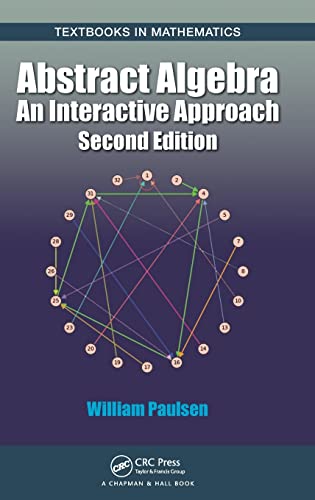
The new edition of Abstract Algebra: An Interactive Approach presents a hands-on and traditional approach to learning groups, rings, and fields. It then goes further to offer optional technology use to create opportunities for interactive learning and computer use. This new edition offers a more traditional approach offering additional topics to the primary syllabus placed after primary topics are covered. This creates a more natural flow to the order of the subjects presented. This edition is transformed by historical notes and better explanations of why topics are covered. This innovative textbook shows how students can better grasp difficult algebraic concepts through the use of computer programs. It encourages students to experiment with various applications of abstract algebra, thereby obtaining a real-world perspective of this area.Each chapter includes, corresponding Sage notebooks, traditional exercises, and several interactive computer problems that utilize Sage and Mathematica® to explore groups, rings, fields and additional topics.This text does not sacrifice mathematical rigor. It covers classical proofs, such as Abel’s theorem, as well as many topics not found in most standard introductory texts. The author explores semi-direct products, polycyclic groups, Rubik’s Cube®-like puzzles, and Wedderburn’s theorem. The author also incorporates problem sequences that allow students to delve into interesting topics, including Fermat’s two square theorem.
User’s Reviews
Editorial Reviews: Review Praise for previous editions:”The textbook gives an introduction to algebra. The course includes the explanation on how to use the computer algebra systems GAP and Mathematica …The book can be used for an undergraduate-level course (chapter 1-4 and 9-12) or a second semester graduate-level course.”―Gerhard Pfister, Zentralblatt MATH About the Author William Paulsen, PhD,professor of mathematics, Arkansas State University, USA
Reviews from Amazon users which were colected at the time this book was published on the website:
⭐A great book to learn from.
⭐The problem is that there is no cd or download information for the Sage and Mathematica scripts. The CRC website says:”Each chapter includes, corresponding Sage notebooks, traditional exercises, and several interactive computer problems that utilize Sage and Mathematica® to explore groups, rings, fields and additional topics.”The book says:”Simply put the CD provided into the computer …”No CD is provided. A lot of the examples use the Sage notebooks, which are not provided, and the value of the book is greatly diminished.I have contacted CRC press multiple times, with no resolution. I recently sent an email to the authorI will alter this review when the problem is resolved.*******************************************************************************update:The author of the book provided the files to me via email. As noted in the comments, the files are now available at the author’s site.
⭐
Keywords
Free Download Abstract Algebra: An Interactive Approach (Textbooks in Mathematics) 2nd Edition in PDF format
Abstract Algebra: An Interactive Approach (Textbooks in Mathematics) 2nd Edition PDF Free Download
Download Abstract Algebra: An Interactive Approach (Textbooks in Mathematics) 2nd Edition 2016 PDF Free
Abstract Algebra: An Interactive Approach (Textbooks in Mathematics) 2nd Edition 2016 PDF Free Download
Download Abstract Algebra: An Interactive Approach (Textbooks in Mathematics) 2nd Edition PDF
Free Download Ebook Abstract Algebra: An Interactive Approach (Textbooks in Mathematics) 2nd Edition