Ebook Info
- Published: 2008
- Number of pages: 260 pages
- Format: PDF
- File Size: 2.12 MB
- Authors: Marc Levine
Description
User’s Reviews
Reviews from Amazon users which were colected at the time this book was published on the website:
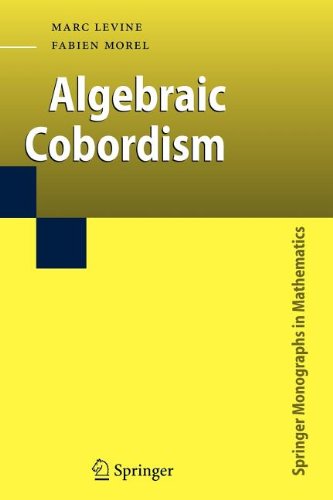
⭐This book is written in the Bourbaki style of modern mathematical exposition and so readers should not be expected to find fundamental insights or intuitive hints that will give them a better understanding of the origins and relevance of algebraic cobordism. Readers of this book will have to bring with them a solid understanding of algebraic geometry at the level of the theory of schemes, and an in-depth knowledge of classical cobordism theory as is found in the works of the mathematician Daniel Quillen or the book by Robert Stong.Therefore an understanding the theory of algebraic cobordism will be in the light of Daniel Quillen’s work on the complex oriented cobordism group MU, but generalized in the context of algebraic geometry. The paper by Quillen entitled “Elementary proofs of some results of cobordism theory using Steenrod operations” is widely quoted in the book and should be studied before tackling some of the difficult constructions in the book.Key to Quillen’s work was in the universality of the ‘formal group law’ and in the explicit use of a set of generators and relations for complex oriented cobordism. Complex cobordism is a universal contravariant functor on smooth manifolds and has a first Chern class for complex line bundles which satisfies the universal formal group law. Cobordism classes are generated by proper complex oriented maps, with two such maps giving the same cobordism class if they are fibers of a proper complex oriented map (the orientation coming from the virtual normal bundles of the smooth map). For smooth manifolds, pull-backs of generators are meaningful because of Thom’s tranversality theorem, and will be proper complex oriented maps between smooth manifolds. If f: W -> Y is such a smooth proper map between smooth manifolds, then f needs to factor through a closed immersion of W in C(N) X Y and there needs to be a complex structure on the normal bundle of W in C(N) X Y, where C(N) is complex N-space. Also, the codimension of f must be equal to dim Y – dim W.So what is different about algebraic cobordism and Quillen complex cobordism? One difference is that role of the formal group law and the first Chern classes. The other difference has its origins in the “rigid” nature of algebraic geometry, namely in the difficulty of constructing pull-backs along morphisms between smooth schemes, i.e. two such morphisms cannot be arranged to be transversal. If smooth schemes are taken to be representatives of classes in algebraic cobordism, the challenge then is to construct these pull-backs. Further, in ordinary complex cobordism, the unoriented cobordism ring has one generator for every degree not of the form 2^(k-1) and therefore is a “large” ring. The oriented complex cobordism ring is generated over the rational numbers by complex projective spaces. Cobordism rings are related to cohomology theories via the notion of a spectrum, and in particular the Thom spectra can be used to define cohomology theories. The fact that algebraic cobordism is a universal cohomology theory for algebraic varieties immediately implies a connection with the theory of motives, and the authors acknowledge this connection. Both the Chow ring and motivic cohomology should have some connection with the theory of algebraic cobordism in this regard.But it is cohomology theories that are oriented that are main focus of this book since an orientation on a ring cohomology theory gives rise to a “good” theory for projective push-forwards. One of the main points is to view the first Chern class of the tensor product of two line bundles not as the sum of the individual bundles but rather as a formal group law of the underlying oriented cohomology theory. The pull-backs, projective push-forwards, and the projective bundle formula will then determine the value of the first Chern class and the formal group law. Pull-back and push-forward morphisms are therefore needed to obtain first Chern classes, and how these different constructions are “entangled” with each other is modeled by the Borel-Moore functor, and these considerations are dealt with early on in the book.The (oriented) Borel-Moore functor is an additive functor that maps from an admissible subcategory of finite type k-schemes to graded Abelian groups that satisfies certain axioms that codify how smooth equi-dimensional morphisms (pull-backs), projective morphisms (push-forwards) and first Chern classes of line bundles are entangled with each other (the reviewer is using the word “entangled” to reflect the fact the properties of commutativity between the pull-backs and push-forwards, and how the first Chern classes behave with respect to these maps). Cobordism cycles for k-schemes X of finite type are then defined in terms of a projective morphism and a finite collection of line bundles. Isomorphism classes C(X) of cobordism cycles and the free abelian group Z(X) on these classes gives a graded abelian group, the group of cobordism cycles on X. Push-forward maps for projective morphisms and pull-backs for smooth equi-dimensional morphisms of relative dimension d are defined straightforward in terms of Z(X), as is a notion of a first Chern class homomorphism. These constructions are encapsulated into a functor Z* from any admissible subcategory of the k-schemes to the category of graded abelian groups which is shown to be a (universal) oriented Borel-Moore functor. All of this is done over an arbitrary field. The authors generalize this to the case where there is an external product on Z*, and define a set of ‘standard cycles’ on oriented Borel-Moore functors with products. They then show how to construct a new oriented Borel-Moore functor by “modding out” a set of homogeneous elements.By adding three additional axioms to the definition of an oriented Borel-Moore functor, the authors make another connection with the theory of motives by defining an oriented Borel-Moore functor of ‘geometric type’. The Chow group, asserted to be motivic in nature by some mathematicians is shown to be of geometric type. The authors also show, with some degree of clarity but a high degree of rigor that algebraic cobordism has connections to ordinary intersection theory via a formulation and proof of a moving lemma. This allows them to show that the algebraic cobordism is a universal Borel-Moore homology theory for k-schemes of finite type.
Keywords
Free Download Algebraic Cobordism in PDF format
Algebraic Cobordism PDF Free Download
Download Algebraic Cobordism 2008 PDF Free
Algebraic Cobordism 2008 PDF Free Download
Download Algebraic Cobordism PDF
Free Download Ebook Algebraic Cobordism