Ebook Info
- Published: 1986
- Number of pages: 187 pages
- Format: PDF
- File Size: 24.04 MB
- Authors: Plato
Description
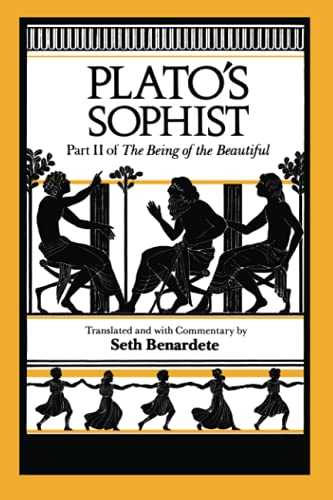
Theaetetus, the Sophist, and the Statesman are a trilogy of Platonic dialogues that show Socrates formulating his conception of philosophy as he prepares the defense for his trial. Originally published together as The Being of the Beautiful, these translations can be read separately or as a trilogy. Each includes an introduction, extensive notes, and comprehensive commentary that examines the trilogy’s motifs and relationships.”Seth Benardete is one of the very few contemporary classicists who combine the highest philological competence with a subtlety and taste that approximate that of the ancients. At the same time, he as set himself the entirely modern hermeneutical task of uncovering what the ancients preferred to keep veiled, of making explicit what they indicated, and hence…of showing the naked ugliness of artificial beauty.”—Stanley Rose, Graduate Faculty Philosophy JournalSeth Benardete (1930-2001) was professor of classics at New York University. He was the author or translator of many books, most recently The Argument of the Action, Plato’s “Laws,” and Plato’s “Symposium,” all published by the University of Chicago Press.
User’s Reviews
Editorial Reviews: About the Author Plato (c. 427-347 BC) was an Athenian philosopher during the Classical period of Greece and a student of Socrates. Thirty-five dialogues and thirteen letters have traditionally been ascribed to Plato. He founded the Academy in Athens, the first institution of higher learning in the Western world.
Reviews from Amazon users which were colected at the time this book was published on the website:
⭐First, the commentary of this work is superb, but, second, the translator made the translation unnecessarily complex and it makes this book hard to understand. I will comment on both.First, I was disappointed that the translation of this work is – I would say — unncessarily complex and it makes Sophist very convulated. The translator chose to use the term “what it is” and what it is not” to mean “being” and non-being”. Perhaps the earlier is closer to the original Greek term, but you can imagine that when you use “what it is” and “what it is not” in long sentences, they tend to get mixed up with the regular word “is”, and it renders the whole sentence unreadable. Here are 3 examples: I am comparing Benardete’s translation (this book), with Harold N. Fowler’s translation from 1921.Benardete:[257c]”So we’ll not concede the point, whenever it is said that a negative indicates a contrary, but only so much, that the prepositioning of “not”, general and particular, something of everything else than the names that come after it, or rather than the things, whatever they are, for which the names uttered after the negative are laid down.”Fowler:[257c]”Then when we are told that the negative signifies the opposite, we shall not admit it; we shall admit only that the particle “not” indicates something different from the words to which it is prefixed, or rather from the things denoted by the words that follow the negative.”–Benardete:[257b]”Whenever we say “that which is not”, we are not saying, it seems, something contrary to “that which is” but only other.”Fowler:[257b]”When we say not-being, we speak, I think, not of something that is the opposite of being, but only of something different.”–Benardete:[244b]”And what of this? Do you call “that which is” something?”Fowler:[244b]”Well then, do you give the name of being to anything?”—As you can see, Fowler’s translation is more straight forward, less ambiguous, and shorter. I have to read Benardete’s translation a few times to understand the meaning. Based on this, I will not recommend this translation to a beginner student of Plato.Now, on the commentary: the commentary is very extensive and full of insights. For example, his comment on the opening scene of the book is worth purchasing this book it self. Benardete went through a detail interpretation of why Socrates asks Theodorus if the Stranger might not very well have been God himself. Worth reading just for that.
⭐Benardete has either absorbed so much of the Platonic rhetorical structure that he has truly seduced Socrattic irony into an intelligible light , or is lost amongst the labyrinthine ways of post straussian scholars. Nobody, undergrad, or grad, knows for sure.
⭐
Keywords
Free Download Plato’s Sophist: Part II of The Being of the Beautiful in PDF format
Plato’s Sophist: Part II of The Being of the Beautiful PDF Free Download
Download Plato’s Sophist: Part II of The Being of the Beautiful 1986 PDF Free
Plato’s Sophist: Part II of The Being of the Beautiful 1986 PDF Free Download
Download Plato’s Sophist: Part II of The Being of the Beautiful PDF
Free Download Ebook Plato’s Sophist: Part II of The Being of the Beautiful