

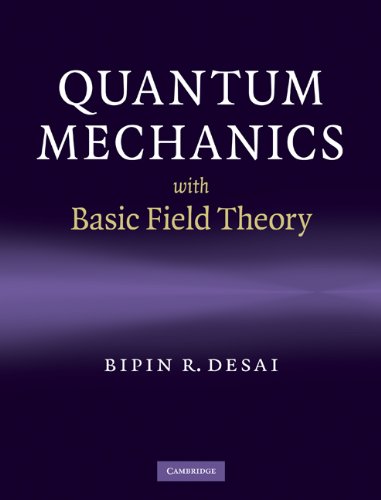
Ebook Info
- Published: 2009
- Number of pages: 1381 pages
- Format: PDF
- File Size: 2.66 MB
- Authors: Bipin R. Desai
Description
Students and instructors alike will find this organized and detailed approach to quantum mechanics ideal for a two-semester graduate course on the subject. This textbook covers, step-by-step, important topics in quantum mechanics, from traditional subjects like bound states, perturbation theory and scattering, to more current topics such as coherent states, quantum Hall effect, spontaneous symmetry breaking, superconductivity, and basic quantum electrodynamics with radiative corrections. The large number of diverse topics are covered in concise, highly focused chapters, and are explained in simple but mathematically rigorous ways. Derivations of results and formulae are carried out from beginning to end, without leaving students to complete them. With over 200 exercises to aid understanding of the subject, this textbook provides a thorough grounding for students planning to enter research in physics. Several exercises are solved in the text, and password-protected solutions for remaining exercises are available to instructors at www.cambridge.org/9780521877602.
User’s Reviews
Reviews from Amazon users which were colected at the time this book was published on the website:
⭐A pretty good QM textbook — it’s jam-packed with deeper topics in quantum theory too, breaking into QFT as the title would suggest. So, definitely get more content than you do in, say Sakurai. I think Desai also does a good job at explaining the steps taken during derivations, and made sure to reference earlier results (besides obvious ones like using [x,p], though of course). It’s very nice to not have to spend all of this time glancing back and forth between equations trying to figure out how the heck they got the latter from the former (that being said, I’ve still done that with this book! I would venture to say it’s more my fault in this case). Maybe my only complaint, and it’s one that a classmate raised, is that there aren’t that many in text / worked-through examples, though. An exception is in scattering theory, but some other topics leave you a little inexperienced by the time you reach the exercises. And my last complaint, which is a very common one, and definitely not unique to Desai, is that there _should_ be a few solutions in the back. Or, a hint as to the end result you should have at the end of an exercise, like you get in certain extra difficult exercises in Jackson (as strange as it is to compliment Jackson for showing mercy, haha!). Again, though, no solutions is often the norm–but what’s a self-studier to do??But, I gave Desai five stars for a reason. Would definitely, definitely recommend.
⭐As a student of Dr. Desai’s, I’ve had first-hand experience with working through this textbook, in the context of the author’s own lectures. This book is extremely good for working through derivations of various quantum mechanics concepts, and mathematically, is quite rigorous. I think this book would be most useful for the graduate student theorist, who is perhaps not as interested in experimental application of quantum mechanics as an experimentalist.The end of chapter problems are at times esoteric and mathematical, applying linear algebra to deconstruct an operator with no quantum mechanical context, however, often, the mathematics from these problems appear far ahead in the text. I would recommend the student also use another textbook to gain a more ‘experimentalist’ perspective on quantum mechanics.This book contains some errors (it is only in its first edition). At times the errors are minor, but other times they can be more significant. The most common error seems to be false equation references, or a missing ‘h-bar’ and factors of ‘c’. Very occasionally (I have seen one or two within the first 300 pages) there is a serious error, such as using an angular momentum vector instead of a magnetic field vector.I think this book is an excellent resource, and is almost completely self contained. It will teach you the tools and mathematical back-bone of quantum mechanics, but leaves rigorous applications of the subject to the student’s imagination.
⭐An excellent modern treatment of quantum mechanics at the graduate level, which can also be used as an introduction to field theory. This book should compete seriously with Shankar and Sakurai.
⭐B. Desai’s book on Quantum Mechanics is well-written, but the book lacks structure. Rather than introducing the necessity for a topic, and its physical motivations, the book leaps into derivations of various phenomena, without giving any attention to why the steps in the proof are being taken. Consequently, I think this book is not particularly well-suited to self-teaching; it simply doesn’t stand on its own. That being said, it makes an excellent supplement to another work. Whenever derivations or explanations have confused me in other books, Desai usually has a section dedicated to the topic at hand. If buying, I would recommend doing so in conjunction with R. Shankar’s Quantum Mechanics. My other minor problem with the text is that it’s very dry. Because there are so few explanations as to the motivation for the mathematics, the unending proofs quickly become tiresome.
⭐I used this textbook for a series of 3 graduate classes in Quantum Mechanics, in which we basically cover the first 26 chapters.I think the textbook is easy to follow, one can learn with it the mathematical tools of QM. The one thing I don’t like about the book is that is not a reliable reference book (in the sense that unless I went through the whole derivation of the equations I can’t be sure that the equation is not missing an h bar, c or a minus), however you must consider that this is the first edition of the book.Pros- Covers most of the topics relevant for a physics graduate student.- Step by Step mathematical derivationsCons- Lots of typos- No solutions to selected problems
⭐A very generous author sharing his knowledge and guiding you through a modern exposition of Quantum Mechanics.Great book!.Please keep on writing!The publisher should have used lighter weight paper. This book weighs a ton!Amazon should give this text greater visibility!
⭐I have been looking a book of this type for a long time and read reviews of this book after uploading a few beginning pages.I am glad to say that it meets my expectations. Although expensive but finally I took the plunge and bought it. It is needless to say that it is not a beginner’s book. One must know a little Quantum Mechanics and Electromagnetism to understand this book .One who has gone through Chester’s, Gasiorowicz’ and P.T.Mathews’ books on Quantum Mechanics will find this an excellent book to learn from with little effort. The concept of ‘gauge invariance’ , Green’s function and Lagrangian need to be known before going through this book.
⭐This is a remarquable book ; Very well written and it really leads the reader a long way BUT unfortunately it contains flaws ; the first example of that kind is described below ; but before some introductory words : the problem mentioned does NOT pertain that this is no book for mathematicians or at least the kind of who hate to make physics and are traumatized by “rigor” ; my feeling is that by learning physics THAT way ( the way the book does ) you get also a tremendous mathematical intuition so my criticism is not coming from that point of view ; but one has to be serious ; to give as a problem the following : show that a unitary operator can be written as the exponential of an Hermitian operator without any comment is a problem ; the reader MAY understand that the question is LINKED to former ones ( easy) but may also be lost ; this only the smallest criticism ; the author introduces operators on a Hilbert space but you will never know when the space is or not finite dimensional ; does this really matter here ? Well yes and no ; it might be unclear to the reader that finite dimensional results pass to infinite dimension ; this is fortunately the case when working in physics and the differences while important can be skipped at an introductory level ; anyhow , the result is true “in general” for unitaries that OPERATE on Hilbert spaces at least those for which a denumerable hilbertian basis exist which in the case of physics is the case ; I have no idea if the result is true in other cases which physicists just do not consider at all BUT the result is DEFINITELY FALSE for a unitary element of a C* Algebra …. so , at least some remark would have been in order ; the Author says in the Preface that the presented problems are “straightforward” and reminds of lessons by E Teller ending with so called exercises which required eventually the whole week-end to be solved ; well he did not realize that despite his will he is following his master ; for that reason only 4 stars and for another one ; the author says that he wants to drop rhetorics ; that’s fine but it makes the exposition very very very dry .
⭐The best book for beginners…better than griffiths…
Keywords
Free Download Quantum Mechanics with Basic Field Theory 1st Edition in PDF format
Quantum Mechanics with Basic Field Theory 1st Edition PDF Free Download
Download Quantum Mechanics with Basic Field Theory 1st Edition 2009 PDF Free
Quantum Mechanics with Basic Field Theory 1st Edition 2009 PDF Free Download
Download Quantum Mechanics with Basic Field Theory 1st Edition PDF
Free Download Ebook Quantum Mechanics with Basic Field Theory 1st Edition