

Ebook Info
- Published: 2013
- Number of pages: 787 pages
- Format: PDF
- File Size: 23.31 MB
- Authors: Volker Heine
Description
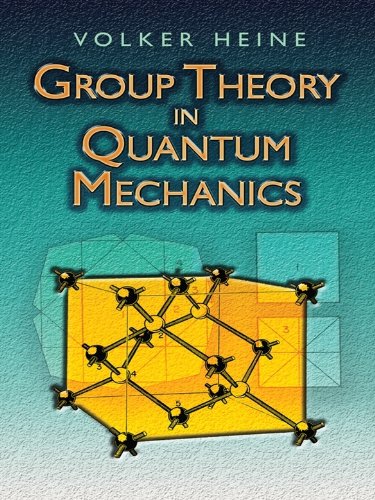
Geared toward research students in physics and chemistry, this text introduces the three main uses of group theory in quantum mechanics: (1) to label energy levels and the corresponding eigenstates; (2) to discuss qualitatively the splitting of energy levels, starting from an approximate Hamiltonian and adding correction terms; and (3) to aid in the evaluation of matrix elements of all kinds.”The theme,” states author Volker Heine, “is to show how all this is achieved by considering the symmetry properties of the Hamiltonian and the way in which these symmetries are reflected in the wave functions.” Early chapters cover symmetry transformations, the quantum theory of a free atom, and the representations of finite groups. Subsequent chapters address the structure and vibrations of molecules, solid state physics, nuclear physics, and relativistic quantum mechanics.A previous course in quantum theory is necessary, but the relevant matrix algebra appears in an appendix. A series of examples of varying levels of difficulty follows each chapter. They include simple drills related to preceding material as well as extensions of theory and further applications. The text is enhanced with 46 illustrations and 12 helpful appendixes.
User’s Reviews
Reviews from Amazon users which were colected at the time this book was published on the website:
⭐Heine’s book, although not as easy to understand as Tinkham’s book
⭐, addresses two topics that are not covered by Tinkham–in addition to covering the other topics covered by Tinkham (e.g. solid state physics; atomic physics). Like Tinkham, Heine begins his introduction to the basics of group theory, including the properties of character tables, with a simple example involving the symmetry of a figure from plane geometry. The two final chapters of Heine are “Nuclear Physics” and “Relativistic Quantum Mechanics”. The nuclear physics chapter includes a discussion of isotopic spin. The chapter on relativistic QM would seem to provide an introduction for quantum field theory (QFT), including a discussion of parity conservation.There are better books, however, that address topics that relate to QFT, especially Wu-Ki Tung’s book
⭐that addresses topics such as the Lorenz and Poincare transformations that are relevant for QTF. Indeed, Weinberg (in his book
⭐)recommends Tung for QTF–and with good reason. Heine’s book was published in 1965, while Tung’s was published in 1990, so naturally the later book in more current. So if you need some insight into group theory for QTF, go to Tung. For other topics, I prefer Tinkham. I was also not able to understand Heine’s proof of the Vector Addition Theorem for angular momentum. I found a version of the proof that I could understand, however, in Wigner’s book
⭐, and I display this proof along with my review of Wigner’s book.
⭐This is my first book on group theory and its applications to physics. I did take a one semester course on algebra in mathematics department when I was an undergraduate, so that I knew the basic properties of groups before reading this book. In my opinion, this is a very good introduction to teach physics students or physicists how to use the group theory in QM. Most of books with a similar title strat with the basic theory of groups and then its applications to physical problems. That is, mathematics first, then physics. This book, however, takes a different philosophy. It tightly binds the mathematics of the group theory with QM at the begining and Keeps the style at later chapters, so that a person who is familiar with QM at the level like “Principles of QM” by Shankar can absorb the materials which Dr. Heine tried to talk easily. Moreover, at the end of each section, there are a few problems to test your understanding. The proofs of the theorems are put at the appendix such that the main discussions will not be interrupted. The whole presentation is particluarly useful for a person who is not mathematically minded and has no ideas about this topic before. The prerequisites for understanding this book is the mathematics and physics contained in Shankar’s QM. After finishing this book, you may consult Cornwell or Gilmore for more complete mathematics and Georgi for the applications of Lie algebra to particle physics. I cannot recommend this book to beginners majoring in physics too highly.
⭐Excelente producto!!
Keywords
Free Download Group Theory in Quantum Mechanics: An Introduction to Its Present Usage (Dover Books on Physics) in PDF format
Group Theory in Quantum Mechanics: An Introduction to Its Present Usage (Dover Books on Physics) PDF Free Download
Download Group Theory in Quantum Mechanics: An Introduction to Its Present Usage (Dover Books on Physics) 2013 PDF Free
Group Theory in Quantum Mechanics: An Introduction to Its Present Usage (Dover Books on Physics) 2013 PDF Free Download
Download Group Theory in Quantum Mechanics: An Introduction to Its Present Usage (Dover Books on Physics) PDF
Free Download Ebook Group Theory in Quantum Mechanics: An Introduction to Its Present Usage (Dover Books on Physics)