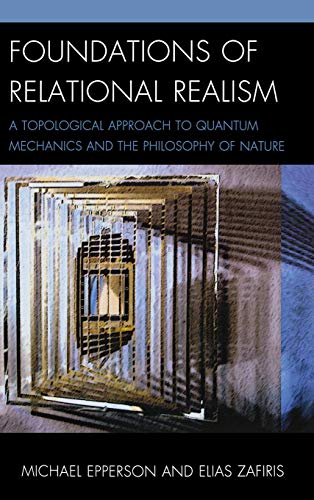
Ebook Info
- Published: 2013
- Number of pages: 422 pages
- Format: PDF
- File Size: 14.18 MB
- Authors: Michael Epperson
Description
If there is a central conceptual framework that has reliably borne the weight of modern physics as it ascends into the 21st century, it is the framework of quantum mechanics. Because of its enduring stability in experimental application, physics has today reached heights that not only inspire wonder, but arguably exceed the limits of intuitive vision, if not intuitive comprehension. For many physicists and philosophers, however, the currently fashionable tendency toward exotic interpretation of the theoretical formalism is recognized not as a mark of ascent for the tower of physics, but rather an indicator of sway–one that must be dampened rather than encouraged if practical progress is to continue. In this unique two-part volume, designed to be comprehensible to both specialists and non-specialists, the authors chart out a pathway forward by identifying the central deficiency in most interpretations of quantum mechanics, and indeed, in modern philosophy more generally: That in the conventional, metrical depiction of extension, inherited from the Enlightenment, objects are characterized as fundamental to relations–i.e., such that relations presuppose objects but objects do not presuppose relations. The authors, by contrast, argue that in quantum mechanics physical extensiveness fundamentally entails not only relations of objects, but also relations of relations. In this way, quantum mechanics exemplifies a concept of extensive connection that it is fundamentally topological rather than metrical, and thus requires a logico-mathematical framework grounded in category theory rather than set theory.By this thesis, the fundamental quanta of quantum physics are properly defined as units of logico-physical relation rather than merely units of physical relata as is the current convention. Objects are always understood as relata, and likewise relations are always understood objectively. Objects and relations are thus coherently defined as mutually implicative. The conventional notion of a history as ‘a story about fundamental objects’ is thereby reversed, such that the classical ‘objects’ become the story by which we understand physical systems that are fundamentally histories of quantum events.These are just a few of the novel critical claims explored in this volume–claims whose exemplification in quantum mechanics will, the authors argue, serve more broadly as foundational principles for the philosophy of nature as it evolves through the 21st century and beyond.
User’s Reviews
Editorial Reviews: Review “A startling development in the last century has been the overflowing of theoretical and observational sciences into the fields of philosophy, particularly by quantum mechanics and cosmology. The present book is twice valuable on this fascinating subject in my opinion: on one hand for its clear and lucid exposition and application of Whitehead’s ontology as a most attractive framework for this kind of query, and on the other hand, for its extension of the dialectics of ontology through an original use of advanced concepts from modern mathematics.”ROLAND OMNÈS, Professor Emeritus of Theoretical Physics at the University of Paris-Sud, author of The Interpretation of Quantum Mechanics and Converging Realities (both Princeton University Press).”This is a unique book in its scope, approach and method. A novel physical and philosophical interpretation of sheaf theory sheds new light on the quantum measurement problem, entanglement, locality and truth. A new systematic and rigorous relational realistic paradigm for natural philosophy has emerged, rooted on the same principles with Abstract (Modern) Differential Geometry, that transmutes the above into a fully fledged dynamical theory.”ANASTASIOS MALLIOS, Professor Emeritus of Mathematics, Department of Mathematics, University of Athens, author of Geometry of Vector Sheaves (Springer) and Modern Differential Geometry in Gauge Theories(Birkhäuser).“Recommended reading for graduate students and researchers/faculty. One of the driving contentions in modern physics has been the inability to reconcile the dominance of classical thought in the theory of relativity with the indeterminate nature of quantum mechanics. Some would argue that one such attempt at a compromise had arrived in the form of quantum field theories, with multiple ideas for resolving the asymmetrical features between relativity and ordinary quantum mechanics. Here, Epperson and Zafiris decide to return to ordinary quantum mechanics and propose sheaf theory, a theory that grew out of the abstract algebra of topology and set theory, as a solution to the stubborn paradoxes found in quantization attempts. They then compare the theory’s interpretive value to the category scheme found in Whitehead’s Process and Reality (1929). Epperson’s earlier work, Quantum Mechanics and the Philosophy of Alfred North Whitehead (2004), is a good predecessor to the current book.” CHOICE (March 2014, reviewed by C. Lee, Duke University)”[Foundations of Relational Realism] contributes to a body of literature which seeks to apply sheaf theory (and in many cases, topos theory in particular) to the discussion of quantum non-locality. Particularly noteworthy are the research programs initiated by Butterfield and Isham, Doering and Isham, and Landsman et al., respectively, which seek (modulo subtle differences) to develop a sheaf-theoretic account of quantum mechanics, as well as recent work by Abramsky et al. which brings various types of quantum nonlocality and contextuality under a sheaf-theoretic rubric (but without absorbing the entire structure of quantum mechanics).” METASCIENCE From the Inside Flap Among the many exotic interpretations of quantum theory–those entailing ‘multiverse’ cosmologies, ‘time reversal,’ ‘retro-causality,’ physical superpositions of alternative actual system states–lies a single core principle: That quantum theory’s most emblematic feature is its invalidation of classical logic–the very foundation of intuitive, critical reasoning–at the level of fundamental physics. As a result, quantum mechanics has become widely popularized, and in many cases, marketed, as mystifying and essentially incomprehensible to non-specialists. Yet at the heart of this popularization lies a paradox: The rules of classical logic purportedly invalidated by quantum mechanics are, at the same time, necessarily presupposed by quantum mechanics; indeed, they are the very rules used to formalize quantum mechanics in the first place. In their groundbreaking new book, Michael Epperson and Elias Zafiris provide a powerful new solution to this paradox by upgrading quantum theory’s presupposed set theoretic, metrical structure, grounded in object elements, to a more refined category theoretic, topological structure grounded in object relations. To this end, the book presents a novel, intuitive interpretation of quantum mechanics, based on a revised decoherent histories interpretation, structured within a category theoretic topological formalism. About the Author Michael Epperson did his doctoral work in philosophy of science and philosophy of religion at The University of Chicago, and earned his Ph.D. there in 2003. His dissertation, Quantum Mechanics and the Philosophy of Alfred North Whitehead, was written under the direction of philosopher David Tracy and physicist Peter Hodgson, Head of the Nuclear Physics Theoretical Group at the University of Oxford. It was published the following year by Fordham University Press, and re-released in paperback by Oxford University Press in 2012. He is currently Director of the Center for Philosophy and the Natural Sciences in the College of Natural Sciences and Mathematics at California State University, Sacramento, where he is a Research Professor and Principal Investigator. Elias Zafiris holds a M.Sc. (Distinction) in Quantum Fields and Fundamental Forces from Imperial College at the University of London, and a Ph.D. in theoretical physics from Imperial College. He has published numerous papers on category-theoretic methods in quantum physics and complex systems theories, topological localization and modern differential geometry in quantum field theory and quantum gravity, generalized spacetime quantum theory, decoherence, and many other topics in the foundations of physics. He is a research professor in theoretical and mathematical physics at the Institute of Mathematics at the University of Athens, and is currently a visiting professor in the Department of Logic, Institute of Philosophy, Eötvös Loránd University in Budapest. He is also a senior research fellow and Principal Investigator at the Center for Philosophy and the Natural Sciences in the College of Natural Sciences and Mathematics at California State University, Sacramento. Read more
Reviews from Amazon users which were colected at the time this book was published on the website:
⭐While it is good to use the Whitehead concept of an occasion of activity as an analytic device for interpretation of experiments, sad to say Epperson and Zafiris have not come to grips with the basic fallacy of the famous Bell argumentation. They uncritically accept the Bell argumentation and so their book is largely drivel, dressed up in fancy language and very technical theorizing. I am sorry to report this, but I think it best to speak plainly about such an important matter.
⭐This work presents a profound new epistemological view of the world – based on the subtle and under appreciated schemata of A. N. Whitehead – and backs it up with hard mathematics. It is consequently not an easy read but will greatly reward close study. It belongs on the shelf of every serious student of philosophy, mathematics or physics.
⭐the pages 391-421 are missing. there must have been a mistake in printing and binding, and i would appreciate receiving those pages.
⭐An excellent development of Whitehead’s speculative philosophy to issues of quantum mechanics.
⭐Leveraging rigorously-tested core quantum physics results, in combination with careful philosophical distinctions and new mathematical developments (topology and category theory), Drs. Epperson and Zafiris have achieved a uniquely viable interpretation of all known quantum experiments (including many rigorously- checked Bell inequality tests) in a way that is intuitively reasonable and avoids the usual exotica. In addition, their predictions on non-local quantum correlations associated with global topological phases have been confirmed in recent experiments. Epperson provides very readable yet in-depth philosophical and interpretive foundations (210 pages) followed by Zafiris’ rigorous treatment of mathematical foundations (177 pages). This work is a must read for all those interested in the philosophy of physics, as well as those concerned with foundational philosophical questions impacted by such new physics results.Tim Eastman, PhD, Physics
⭐The strand of thinking ably represented here is that the success of quantum theory should lead us to recognise the inadequacy of our assumptions in physics. The central problem is succinctly characterised as: “The absence in quantum mechanics of a formal means of depicting local-global relations in an extensive continuum.” If this phrase might mean something to you, then you may enjoy reading & learning from this book (as I did).While I consider that the radical aspect presented, a purported need to replace set theory by category theory as basis, is ambitious (I would prefer to extend the current conceptual framework), nevertheless there is a wholly consistent thesis, very well described, & its core has been demonstrated ‘not wrong’ by the evidence in quantum experiments. If you can consider relations to be as fundamental as objects, then this is a good place to read about it. I haven’t found anything so satisfying since encountering Bohmian mechanics.
Keywords
Free Download Foundations of Relational Realism: A Topological Approach to Quantum Mechanics and the Philosophy of Nature in PDF format
Foundations of Relational Realism: A Topological Approach to Quantum Mechanics and the Philosophy of Nature PDF Free Download
Download Foundations of Relational Realism: A Topological Approach to Quantum Mechanics and the Philosophy of Nature 2013 PDF Free
Foundations of Relational Realism: A Topological Approach to Quantum Mechanics and the Philosophy of Nature 2013 PDF Free Download
Download Foundations of Relational Realism: A Topological Approach to Quantum Mechanics and the Philosophy of Nature PDF
Free Download Ebook Foundations of Relational Realism: A Topological Approach to Quantum Mechanics and the Philosophy of Nature