Ebook Info
- Published: 2010
- Number of pages: 550 pages
- Format: PDF
- File Size: 8.39 MB
- Authors: J. J. Sakurai
Description
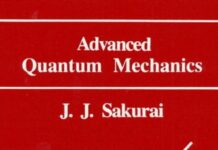
This best-selling classic provides a graduate-level, non-historical, modern introduction of quantum mechanical concepts. The author, J. J. Sakurai, was a renowned theorist in particle theory. This revision by Jim Napolitano retains the original material and adds topics that extend the text’s usefulness into the 21st century. The introduction of new material, and modification of existing material, appears in a way that better prepares the student for the next course in quantum field theory. You will still find such classic developments as neutron interferometer experiments, Feynman path integrals, correlation measurements, and Bell’s inequality. The style and treatment of topics is now more consistent across chapters. The Second Edition has been updated for currency and consistency across all topics and has been checked for the right amount of mathematical rigor.
User’s Reviews
Editorial Reviews: About the Author The late J.J. Sakurai, noted theorist in particle physics, was born in Tokyo, Japan in 1933. He received his B.A. from Harvard University in 1955 and his PhD from Cornell University in 1958. He was appointed as an assistant professor at the University of Chicago, where he worked until he became a professor at the University of California, Los Angeles in 1970. Sakurai died in 1982 while he was visiting a professor at CERN in Geneva, Switzerland.Jim Napolitano earned an undergraduate Physics degree at Rensselaer Polytechnic Institute in 1977, and a PhD in Physics from Stanford University in 1982. Since that time, he has conducted research in experimental nuclear and particle physics, with an emphasis on studying fundamental interactions and symmetries. He joined the faculty at Rensselaer in 1992 after working as a member of the scientific staff at two different national laboratories. He is author and co-author of over 150 scientific papers in refereed journals. Professor Napolitano maintains a keen interest in science education in general, and in particular physics education at both the undergraduate and graduate levels. He has published a textbook, co-authored with Adrian Melissinos, on Experiments in Modern Physics. Prior to his work on Modern Quantum Mechanics,Second Edition, he has taught both graduate and upper-level undergraduate courses in Quantum Mechanics, as well as an advanced graduate course in Quantum Field Theory.
Reviews from Amazon users which were colected at the time this book was published on the website:
⭐Apparently, this book was published posthumously, patched together from Sakurai’s notes after his demise. You can tell. Also apparently, this book exists and is so popular more as a tribute to Sakurai’s memory than for any other reason. I waited until a year after taking a course using this book as its text, to make sure I was sufficiently calmed down. This is a terrible textbook. t is not a terrible textbook in the way a student might complain about Jackson. This book is poorly arranged and much of the material is poorly explained, if it’s explained at all.You will notice that every five-star reviewer, after what a superb and elegant book this is, go on to tell you that you need to supplement it. That is because this book is not sufficient to properly cover all of the material of graduate-level quantum mechanics. This book does not contain all – or even most – of the mathematical and physical material that a student of physics would need access to in order to master quantum mechanics. Viz, it is not a good textbook.My professor also felt it necessary to supplement this book. Which basically meant that he used two much better and stronger and *cheaper* texts – the Dover reprints of Messiah and Byron and Fuller – writing up his own summaries of functional analysis and symmetry operators and everything in between enough while keeping the terrible notation of Sakurai. If you want to do that much work, then instead assign the texts you are going to reference – it isn’t like Sakurai is the Jackson of QM. If you don’t want to do that much work, then instead assign a different book, otherwise your students will not learn these crucial concepts.Take for example the first chapter. This is often praised as a particularly brilliant piece of pedagogy. And if this chapter were the transcript for some kind of undergraduate seminar or lecture on how ket space works with an illuminating example, I would completely agree; brilliant pedagogy. As a chapter in a book intending to lay a mathematical foundation for the concept of quantum HIlbert space at a graduate level, it is severely wanting. Everything is introduced in terms of light polarization and spin, which works with the running example and would be great as a seminar lecture, but is a single example. Everything is based on comparison to spin 1/2. Again, it’s good at showing how concepts in quantum mechanics relate back to polarized light and the Stern-Gerlach experiment, but just is not enough to teach 1st year graduate students about Hilbert space. If the 1st year graduates are assumed to have only done wave mechanics, it is insufficient, and if the 1st year graduates are assumed to already know matrix mechanics then it is way too long and unnecessary. Either way, as a “here’s the math” chapter, it doesn’t work.Let me also point out, as have many others, that the notation is very bad. Sakurai stubbornly insists on labeling most quantum states by a. Whatever it is, but mostly for energy. If he needs to represent two states, he’ll go to a and a’. If three or more, then a, a’, a”, and then a”’, then a””… And it actually is kind of confusing. A student unfamiliar with Dirac notation might think that this is necessary, and he seems to treat it as necessary. He also uses the same symbol for the observable operator as for the classical quantity; that is, you will find equations like x|x’>=x’|x’>. So x without a prime is an operator and x’ is a number giving a position. If you have two distinct positions in one equation, he goes to x’ and x”, and then to x”’, etc. The same thing happens for momentum: p|p’>=p’|p’>. However, dynamic variables that are not being treated as quantum observables are also unprimed and often appear in the same formula as operators. Near as I can tell, this is his own convention that is not used elsewhere.One good thing about the book is that it sticks to its guns on Heisenberg’s matrix mechanics. No waves here. Sakurai is almost unconcerned with the wavefunction as anything more than a basis for expressing the observables, which are always forefront to the discussion. This is a strength of the book.The book is also good in that it relies primarily on the group-theoretical properties of quantum systems in its derivations… but no where is group theory explained. It didn’t really click with me what Sakurai was doing in his introduction to angular momentum until after I had taken a course on group theory. Without knowing the tools and motivations of group theory – which first year graduates almost certainly will not, and which Sakruai makes no effort to introduce to them – the motivations of the chapters dealing with group theory will seem like cheap tricks or mathematical sorcery. Sakurai does say that he is using group theoretical properties, but just what that word means is in the dark; I was originally a math major and very familiar with groups and their properties from undergraduate study, but why we care that rotations form a group was lost on me. The idea of irreducible representations is not clear from the text.The chapter on quantum dynamics jumps around a lot and is not very streamlined. It starts with infinitesimal time evolutions in kets to derive the Schrodinger equation for time evolution operators, then covers Heisenberg’s picture before, thirty pages later, deriving Schrodinger’s wave equation from the equation for time evolution operators. Heisenberg’s equation is derived *after* the Schrodinger equation for time evolution operators, rather than the latter as a special case of the former — if this were to get students comfortable with a familiar equation, then it’s a wasted effort as students are not fully shown the equivalence of Schrodinger’s equation for operators and wave functions, again, until some thirty pages later. There are also several physical examples that make reference to material involving spin and angular momentum, which is not covered until chapter 3. This chapter includes the WKB approximation, which inexplicably is in the chapter on quantum dynamics and not in the chapter on approximation schemes. The sections on gauge transformations and path integrals also seem misplaced, occurring as they do in the second chapter, essentially right after the correspondence of wave mechanics and matrix mechanics. The example used for potential gauges is the Aharanov-Bohm effect, which really is more appropriate to a chapter after the introduction of angular momentum.The chapter of angular momentum presents rotational properties in three dimensions according to their group properties, which is a fitting introduction… then jumps to ensembles and density operators. It’s a single subchapter within the chapter on angular momentum. It comes between the subchapters “SO(3), SU(2), and Euler Rotations” and “Eigenvalues and Eigenstates of Angular Momentum”. This simply is not an appropriate place for this section. It has very little to do with angular momentum and is not necessary to any of material that follows it. My professor just skipped it, and it is the only place where the extremely important concepts of ensembles and density matrices are touched on at all, to my recollection — maybe later chapters mention it, but a two-semester course is not likely to get much past the chapter on approximations. Section 3.5 picks right up as if the digression in 3.4 never even occurred, which is the most that can be said of this organization. Then, in Section 3.5 of the chapter on angular momentum, is when he stops the convention of using a and b to represent energy states. The eigenvalues and vectors of angular momentum are in fact developed as |a,b>. I guess at least he did change it.One of the biggest flaws in this chapter is its method of defining the extremely complicated and subtle functions and coefficients from angular momentum. The subject is inherently messy, and Sakurai can’t help that the Clebsch-Gordon coefficients have to be typeset as three lines because they are so atrociously ugly, but he can help that the 3-j symbol is not intuitively defined; rather than defining 3-j in terms of the C-G, it is the C-G defined in terms of the 3-j. It’s not really a big deal and just requires some division… so why didn’t Sakurai just define it that way? What really sent me in to a screaming fury was the definition of the double-bar matrix element. Mainly because there is not one. The Wigner-Ekhart theorem uses in its statement the double-bar matrix element
⭐Sakurai’s book is not an introductory text. If you have covered Introduction to Quantum Mechanics by David J. Griffiths this book should not be a problem. Sakurai’s book is really a refinement on Griffiths book. Sakaurai goes heavy into the use of Dirac notation. The basic difference between the two books is that Sakurai goes into the detail of QM. When you are finished with Sakurai’s book you will understand where things came from up to the point where it takes Quantum Field Theory to understand things. For example in QM the Pauli exclusion principle is given as a rule, in QFT it is proven.Sakurai starts out showing you how to think of the measurement problem with the use of spin. This is a great way to do this because he uses spin of one half and it has only two states. He uses this to get you into what he calls the “Quantum way of thinking”. When people ask me what is wrong with QM I use this example to explain it to them. You do not know the state of system until a measurement is made, also called the collapse of the wave function. He not only teaching the math but also the general ideas behind QM.He shows how Schroedinger’s equation comes about. By doing this he is teaching you how to use Dirac notation. In quantum field theory it is assumed that you know
⭐I first learnt QM (or wave mechanics) from Griffith’s text, and it made an excellent introduction. But I noticed when rereading Griffith’s book to get an overview and to get a more abstract sense of how QM worked, it felt both slightly sloppy (a by-effect of the author’s lovable informality, no doubt) and chaotic.This is where Sakurai’s text comes in. I’ve used the most recent edition of Modern Quantum Mechanics and I’m absolutely loving it. It starts off with a brief experiment, and shows how QM has to be invoked to describe the observations. From there, the book has postulates, axioms, and theorems all following neatly. But the text has also some very nice, thoroughly physical examples of how the theory is applied. The book also goes beyond the basics by for example introducing group theory for generators of rotation groups, and discusses the time-reversal operator (for T-symmetry).Make no mistake, however: Sakurai assumes the reader knows some basics of wave mechanics, and lets you know it right away. This is not a book for a first course in QM (for which I warmly recommend Griffith’s Introduction to Quantum Mechanics). But the mathematical rigor and crystal clear outline makes it an ideal text for a second or third course.
⭐I think this is “the” textbook for graduate QM… Hard to find another one (that is not too opinionated). Also, this American/hardcover edition may be totally worth the extra money (even though, it’s quite a lot of more money compared to the “international” one).
⭐good title
⭐The course book for the quantum mechanics class I am taking.Compact but usually with good explanations.Has some odd notation such as not using ^ to mark operators.
⭐Great, thanks!
⭐Ho apprezzato particolarmente l’opera per la chiarezza e l’ordine espositivo.Ogni argomento viene presentato in tre passaggi: identificazione del problema, soluzione in casi semplici e intuitivi, formalizzazione.Ho apprezzato molto anche il continuo rimando alle evidenze sperimentali che non permette di perdersi nella (tanta) matematica necessaria per la trattazione.Tra i libri su cui ho studiato questo sicuramente eccelle.Se siete abbastanza pratici con l’inglese preferite questa edizione a quella italiana, per un prezzo simile avrete un oggetto migliore per qualità della carta, della copertina e della veste tipografica.
⭐
Keywords
Free Download Modern Quantum Mechanics (2nd Edition) 2nd Edition in PDF format
Modern Quantum Mechanics (2nd Edition) 2nd Edition PDF Free Download
Download Modern Quantum Mechanics (2nd Edition) 2nd Edition 2010 PDF Free
Modern Quantum Mechanics (2nd Edition) 2nd Edition 2010 PDF Free Download
Download Modern Quantum Mechanics (2nd Edition) 2nd Edition PDF
Free Download Ebook Modern Quantum Mechanics (2nd Edition) 2nd Edition