

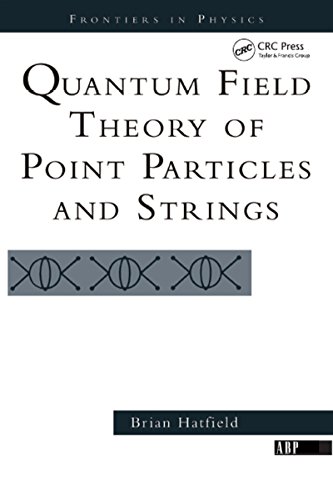
Ebook Info
- Published: 2018
- Number of pages: 734 pages
- Format: PDF
- File Size: 10.58 MB
- Authors: Brian Hatfield
Description
First Published in 2018. Routledge is an imprint of Taylor & Francis, an Informa company.
User’s Reviews
Reviews from Amazon users which were colected at the time this book was published on the website:
⭐This book is a truly work of art! as simple as that. It is by far the best book I have encounter on Quantum Field Theory, the explanations of each topic a very, very clear. For instance, it has a marvelous short section where it explains in very simple terms how Lorentz invariance of the theory implies locality, causality, the existence of antiparticles and the existence of a relation between spin and statistics. Another excellent point of the book is that it really gives the true connection between first and second quantization!, By this I mean that finally a book explains to me the missing part between these two formalisms and how from a second quantized field theory can a first quantized model be born (such the ones we usually study in Quantum Mechanics courses although not necessarily non relativistic). But what I really think makes this book unique is the three chapters (9,10,11) that it devotes to the analysis of Quantum Field Theory in “The Schroedinger Representation”, I simply not know of any other book where you can find this material!!!….As if this facts were few it has a total of 18 chapters on Quantum Field Theory and 8 more chapters devoted to String Theory!, To put it in simple words, if I had to compare this book with other books on QFT, I say all other books tell you almost nothing and this one tells you almost all…. So if you are thinking about getting this book don’t hesitate a second more it is truly a masterpiece written by someone who shows the signature of his Master, late professor Richard P. Feynman.Also I recently started studying the string theory chapters, they are the cleanest and more transparent introduction I have seen to String Theory, I am now finishing chapter 21 titled “The Mathematics of Surfaces” and is simply brilliant it covers the concepts of topology and topological spaces, homeomorphisms, connectedness and compactness, differential structures, differential manifolds, Hausdorff spaces, metrics, Homotopy, The fundamental group, connections, covariant differentiation, Curvature, the structural equation of Cartan, tangent spaces, tangent bundles, sections, fiber bundles, the Gauss Bonnet theorem, differential forms, covering spaces, covering groups, complex structures, almost complex structures, holomorphic functions, complex manifolds, the Uniformization Theorem of Poincare and Klein, conjugated groups, Moduli spaces, Teichmuller spaces, lattices, the modular group and this where I am up to now but I knows it brings material about Homology as well is just an incredible chapter and brings much more! All of this in preparation for the Path integral approach to String Theory using the Polyakov action, Brilliant book!
⭐An excellent text for graduate students or for self-study. Details are worked out and many technicalities explained clearly.
⭐Here is a book with a dual personality: quantum field theory of point particles coupled with introduction to Bosonic string theory. The material is not evenly split, as string theory begins in chapter 19 (page 475). You may choose not to go beyond chapter 18, because: “There is no a priori compelling reason to switch from point particles to nearly invisible strings.” (page 475). But, if you do skip string theory, you will miss: “Strings are a clever way of elevating the special properties of two-dimensional field theories into higher dimensions.” (page 486). Generally, I frown on single-volume quantum field theory textbooks, especially if strings or grand unification are also thrown into the mix. Even so, this is a well-written text. It does not aim to encompasses all aspects of quantum field theory, merely enough of a foundation for string theory.(1) I highlight chapter fifteen: Yang-Mills & Faddeev-Popov procedure ( “is just a change of coordinates“). This is a 20-page exposition (maybe the best and easiest I have encountered). The exposition begins at an elementary vantage (page 343, an elementary integral). It seems to me that Hatfield is more elementary than either Weinberg (volume two) or Peskin and Schroeder.(2) Dirac equation discussed early (page 59) mirroring Bjorken and Drell’s approach. I align with Weinberg on this point: “Dirac’s original motivation for this equation as a sort of relativistic Schrodinger equation does not stand up to inspection.” (page 565, volume one,1995). Path integrals are here presented late (page 271, say, in comparison to Zee’s chapter one). Later seems pedagogically superior for the beginner.(3) I highlight two chapters: nine (functional calculus, pages 179-199) and 17 (renormalization of QED).(4) As there are many excellent quantum field theory texts available, I now concentrate on the portion of the book dealing with strings, this is really where this text excels. An overview provides motivation (that is: gravitons–massless, spin two state, appearing alongside finiteness and anomaly freedom). Read: “the string picture must be qualitatively correct.” (page 479). Connection to Ising model is here (page 481) and “it is impossible to do true phenomenology from string perturbation theory alone (page 485).Bosonic strings are the only ones quantized in this text (page 486).(5) We proceed stepwise: from a Lagrangian to the Nambu-Goto action (page 492) to “first quantization.” Along the route utilize: chain-rule, integration-by-parts, wick-rotation, dimensional analysis. Analogy to point particle mechanics is invoked often (page 496). Next step: String position promoted to operators. Analogy is utilized (that is, chapter five generalized to strings–excellent pedagogic strategy). We will first work in light-cone gauge (Zwiebach for more). Zeta-function regularization is invoked (but, not derived) in order to arrive at the magical value of a sum (page 514). For more: Zwiebach (page 243, problem 12.4). (7) There is a pretty computation involving the value of renormalized zero-point energy (pages 522-525). Tachyons re-appear, ghost particles re-appear. Difficult proofs are generally omitted (example, page 531).(6) Chapter 21 is mathematical (surfaces). If you enjoy differential geometry you will enjoy this long (65-page) chapter. There is demonstration of the Euler-formula for polyhedra (page 547). Tensor and wedge products introduced (page 558). Homotopy and complex analysis invoked on our way to Riemann sphere (page 566). Finally, equivalence classes to the Riemann sphere as prelude to Moduli Spaces (page 578).(7) Next up, path integral approach to string theory (review chapters twelve and thirteen, path integrals). Then, review Faddeev-Popov procedure: you will generalize that to strings. This is a difficult chapter (22).Green’s functions utilized to good effect (pages 612-616). The section on conformal anomaly is difficult. You utilize Fadeev-Popov again (page 658). Jacobians and determinants are your trusted tools. Quantum gravity touched upon (page 670) with links to QCD explored in a descriptive manner (page 680).(8) The final chapter (thirty pages) introduces superstrings. The chapter merely whets the appetite, so you turn elsewhere after finishing it. Concluding my review: This is a well-written textbook. Exercises for the student reader are here. The field theory part emphasizes material needed for the second part, thus not a complete course in that respect. I reiterate, the string theory part deals with only the Bosonic string.Most computational details are presented in full glory. A useful, lucid, textbook.
⭐I truly don’t get why this book is not considered as classic or all-time-best in field theory in most reviews and evaluation.This is a masterpiece that starts from review of Quantum Mechanics and takes the reader to String Theory in depth with covering every single bit of used Math.I tried to find more about the author but did not get any result sadly but i wish i had found this book long long time ago.Definitely more clear and more advanced than Ryder,Peskin /Schroder or any other famous Field theory book.Thanks Brian Hatfield for making me not only good at QFT (not string yet) but also love it and feel confident.
Keywords
Free Download Quantum Field Theory Of Point Particles And Strings (Frontiers in Physics) 1st Edition in PDF format
Quantum Field Theory Of Point Particles And Strings (Frontiers in Physics) 1st Edition PDF Free Download
Download Quantum Field Theory Of Point Particles And Strings (Frontiers in Physics) 1st Edition 2018 PDF Free
Quantum Field Theory Of Point Particles And Strings (Frontiers in Physics) 1st Edition 2018 PDF Free Download
Download Quantum Field Theory Of Point Particles And Strings (Frontiers in Physics) 1st Edition PDF
Free Download Ebook Quantum Field Theory Of Point Particles And Strings (Frontiers in Physics) 1st Edition