

Ebook Info
- Published: 2003
- Number of pages: 508 pages
- Format: PDF
- File Size: 14.94 MB
- Authors: Erich Joos
Description
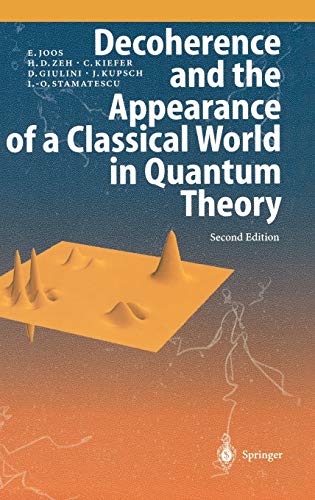
A unique description of the phenomena that arise from the interaction between quantum systems and their environment. Because of the novel character of the approach discussed, the book addresses scientists from all fields of physics and related disciplines as well as students of physics.
User’s Reviews
Editorial Reviews: Review From the reviews of the second edition:”This book is essential for anyone who is working in the quantum-classical divide.” (Contemporary Physics 2005, 46, page 146)”The goal of this collective book is the understanding, in the framework of quantum mechanics, of the appearance of our macroscopic classical world … . I strongly recommend it to all those interested in an understanding of quantum mechanics that goes beyond the pragmatic point of view summarized in the formula: ‘for all practical purpose’.” (Philippe Spindel, Physicalia Vol. 57 (2), 2005)”This book is essential for anyone who is working in the quantum-classical divide. Most of the material is written in a pedagogical style so that it can easily be used as an aid to start ones research in this field. The size of the reference list is impressive … .” (J.Hartley, Contemporary Physics, Vol. 46 (2) 2005)”Since quantum mechanical interpretational issues are usually very sensitive matters, not to mention controversial, the authors are commended for putting together a coherent text … . is highly recommended reading for anyone with a serious interest in basic problems in physics, notwithstanding being a senior scientist or an advanced graduate student. It constitutes an excellent portrayal of issues related to our fundamental conception of natural science. It also has much to offer to readers who already have experienced knowledge of physics.” (Erkki J. Brändas, International Journal of Quantum Chemistry, Vol. 99, 2004) From the Back Cover This book describes the phenomena that arise from the interaction between quantum systems and their environment. Since the first edition appeared in 1996, the concepts of decoherence have become firmly established experimentally and are now widely used in the literature. Its major consequences are the emergence of “classicality”, superselection rules, the border line between microscopic and macroscopic behavior, the emergence of classical spacetime, and the appearance of quantum jumps. Most of the new developments in this rapidly evolving field are discussed in this second edition: chaos theory, quantum information, neuroscience, primordial fluctuations in cosmology, black holes and string theory, experimental tests, and interpretational issues. While the major part of the book is concerned with environmental decoherence derived from a universal Schrödinger equation, later chapters address complementary or competing approaches, such as consistent histories, open system dynamics, algebraic methods, and collapse models.
Reviews from Amazon users which were colected at the time this book was published on the website:
⭐The chapters two and three are quite accessible (mostly need only undergraduate Quantum to understand) and I learned a lot from them. I now have a much better idea what decoherence is, though parts of it are still very mysterious. I am now asking questions that I have never asked myself before, like, how can an apparatus change its state through interaction with a particle while the particle is unchanged? Where does the information about the apparatus’ initial state go? These points are addressed in the text, but I’m still struggling to get my head around it. For me, this is a lot of fun!Chapter 4 jumps straight into field theory but still it is pretty easy to follow.This book is very well written. If I were to teach undergraduate Quantum, I would certainly include information & examples from this book. I did have to go online to learn a little bit about density matrix theory cause I’d never seen that before. Within a few hours, I learned enough to follow the text.I would recommend this book both for people who are interested in getting into the field, but also for dilettantes like myself who have a love for physics.
⭐If you are looking for a single source to learn about “environmental decoherence” this is probably the best you can do. Review papers and many other books are often loaded with jargon and don’t span a wide range of topics. This volume allows you to start at the beginning and go as far as you want. It is NOT a book for the general public. You will need a background in undergraduate level quantum mechanics.
⭐One of the problems addressed by this book has concerned me ever since I was a graduate student: how the spreading of wave packets might be limited over the course of time. That is, if you imagine an electron wave packet traveling though free space, quantum dispersion mandates that it must become broader and broader as it goes from one point to another (see
⭐by Kim & Noz for a detailed exploration of this topic).The discussion of quantum coherence in this volume, in the section authored by Joos, develops the theory that ambient scattering of other particles off of this wave packet, be they massive particles, photons, or otherwise (e.g. neutrinos), increase the local entropy and limit the spreading of the wave packet. It is also argued that ambient scattering and its entropic influence decrease the intensity of diffraction effects. Joos argues that free particles might go on spreading more and more if it were not for ambient particles or radiation bouncing off of the wave packet. He notes that even in deep space starlight and the 3-degree Kelvin black body radiation left over from the Big Bang should limit the spreading of wave packets. Joos also discusses the interference between two moving wave packets as a function of the degree of coherence (pp.66-68), a problem that is equivalent to the double slit diffraction experiment, as each wave packet can be thought of as emerging from one of the two slits. Joos also addresses the contribution of friction to decoherence (pp. 79-81), and the time dependence of entropy (pp.73-75; 125-134).Zeh makes a brief mention (p.276) of complex potentials as “the absorption of the projectile into other reaction channels” resulting in the possibility of “different histories” as “in the Everett [i.e. many worlds] interpretation.” This mention of complex potentials, however, brings to mind a topic near and dear to my heart, that of inelastic scattering. I was somewhat disappointed that inelastic scattering was not explicitly mentioned as contributed to decoherence. Although this book does not have an index, it has a list of all papers referenced, and Bethe’s papers on inelastic scattering are not listed. For a discussion of inelastic scattering see
⭐by Bethe and Jackiw. For a treatment of inelastic scattering as applied to coherence in high-resolution (i.e. atomic scale imaging) transmission electron microscopy see Z. L. Wang’s book
⭐.It is also worth noting that all of the six contributors to this volume live and work in Germany. Giulini and Kiefer are at Univ. Freiburg. Stametescu and Zeh are at Heidelberg. Kupsch is at Univ. Kaiserslautern and Joos is at Schenefeld.
Keywords
Free Download Decoherence and the Appearance of a Classical World in Quantum Theory in PDF format
Decoherence and the Appearance of a Classical World in Quantum Theory PDF Free Download
Download Decoherence and the Appearance of a Classical World in Quantum Theory 2003 PDF Free
Decoherence and the Appearance of a Classical World in Quantum Theory 2003 PDF Free Download
Download Decoherence and the Appearance of a Classical World in Quantum Theory PDF
Free Download Ebook Decoherence and the Appearance of a Classical World in Quantum Theory