

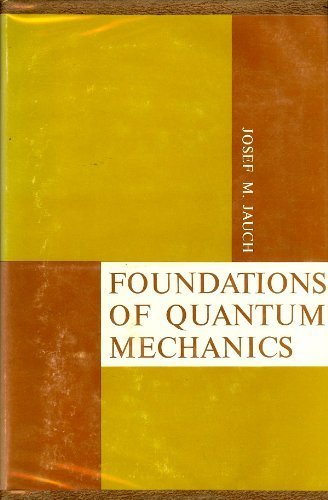
Ebook Info
- Published: 2010
- Number of pages: 299 pages
- Format: PDF
- File Size: 7.94 MB
- Authors: Josef Maria Jauch
Description
User’s Reviews
Reviews from Amazon users which were colected at the time this book was published on the website:
⭐This is a classic book in Quantum Mechanics. It exposes in a comprehensive manner how the basic (non relativist) principles of Quantum Mechanics can be deduced from a formal system of propositions, assumed to represent the answers that one can obtain about a physical system through measures. This is a modern, and improved, version of earlier works by von Neumann and Birkhoff. Jauch does not hide the difficulties of this endeavour (such as the complex representation), and gives some view of the philosophical background which supports it.So this is a good book for people who want to get a – classic but rational – answer to the question :where does the QM come ?.
⭐A well-written text on foundational aspects of Quantum Mechanics. Less advanced than Mackey, more advanced thanPrugovecki. All three books should be consulted for a well-rounded view. Of the newer offerings, it would be difficult to surpass Isham’s text. Let us stay on track with a tour Jauch’s insightful monograph:(1) First things first: have a copy of Riesz and Nagy on hand, Functional Analysis. That will help you through part one of mathematical preliminaries. Here, a birds-eye-view by way of a selection of exercises:(a) “There exist measurable functions which are not continuous.” (page 13)(b) “If a linear operator is continuous at one point, it is continuous everywhere.” (page 37)(c) “If z=x+iy, for y not zero, then the range is the entire Hilbert space.” (page 53).It is easy to see that the initial sixty pages will be challenging. Jauch writes: “mathematical rigor…we replace a traditional and often antiquated language, by a precise but necessarily abstract mathematical language, with the result that many physically important notions formerly shrouded in a fog of words become crystal clear and of surprising simplicity.” (preface). That is the motivation for Part One of the monograph.(2) Part Two begins the Physical Aspects: Kinematics, first. Here you will learn of the so-called propositional calculus and lattices. Next, Dynamics: states and observables. We read of superposition: “we can now understand why the validity of the superposition principle is so characteristic for quantum systems–it implies the non-Boolean character of the proposition system.” (page 107). Think about that !(3) Chapter eight is a beauty: Proposition Systems and Projective Geometries. Recall: “there are only three fields which contain the Reals as a subfield–the reals themselves, complex numbers and the quaternions.” (page 131). That is another statement worth repeating ! An exercise: “show that the expectation value for any state is a linear functional on all observables.” (page 133).(4) Next up, Symmetries. Have Eugene Wigner as a reference. A later reference can be made in the textbooks of Steven Weinberg. Read: “from now on we shall concentrate on the projective representations of symmetry groups in Hilbert space and we shall study the representation in a connected component of the lattice of subspace.” (page 147).(5) Dynamics: A nice Table exhibits “time evolution in Schrodinger, Heisenberg and Dirac pictures.” (page 156)(6) Measurement, next. Read: “the deeper understanding of quantum phenomena began with the discovery of the uncertainty relations.” (page 160). An introduction to “paradoxes” is presented: that is, Schrodinger’s Cat, Einstein-Podolsky-Rosen, Wigner’s Friend. (pages 185-190). Your references should include: Pauli (1958), Von Neumann (1932). Perusal of the Wheeler-Zurek compendium and Gottfried will prove to be an asset.(7) After 192 pages, we begin Part Three, entitled Elementary Particles. Nice that this part begins with a quote from Max Born, what is not so nice is that we hear little else from Max Born throughout. Along those lines, probability is a concept little-touched upon in this text. What is here, then ? “commutation rule in Weyl’s form.” (page 198), a nice discussion of harmonic oscillator (page 214), a nice discussion of localizability, homogeneity, isotropy and kinematics of rotation (pages 227-234). Also, an introduction to gauge invariance. Wigner’s imprint abounds.(8) Spin, this topic concludes the book. We read: “to emphasize again the distinction between extrinsic properties (which depend on the state of the system) and intrinsic properties (which are independent of the state).” (page 275). The book concludes at the brink of quantum field theory. That is, a brief excursion into vacuum state, creation and destruction operators, Bosons and fermions, and Fock Space. A fitting conclusion.(9) Jauch has presented a beautiful excursion into foundational issues. As with the best of expositions, a mix of mathematical analysis and physical acumen. Highly recommended for enrichment at an advanced level.
Keywords
Free Download Foundations of Quantum Mechanics in PDF format
Foundations of Quantum Mechanics PDF Free Download
Download Foundations of Quantum Mechanics 2010 PDF Free
Foundations of Quantum Mechanics 2010 PDF Free Download
Download Foundations of Quantum Mechanics PDF
Free Download Ebook Foundations of Quantum Mechanics