

Ebook Info
- Published: 2012
- Number of pages: 446 pages
- Format: PDF
- File Size: 55.84 MB
- Authors: David S. Saxon
Description
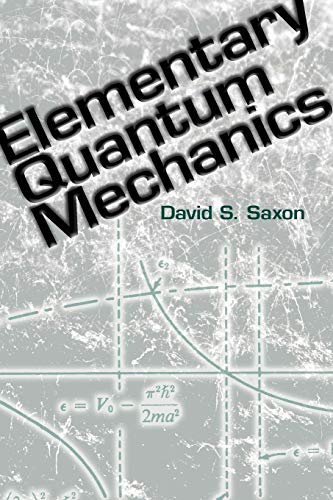
Based on lectures for an undergraduate UCLA course in quantum mechanics, this volume focuses on the formulas of quantum mechanics rather than applications. Widely used in both upper-level undergraduate and graduate courses, it offers a broad self-contained survey rather than in-depth treatments.Topics include the dual nature of matter and radiation, state functions and their interpretation, linear momentum, the motion of a free particle, Schrödinger’s equation, approximation methods, angular momentum, and many other subjects. In the interests of keeping the mathematics as simple as possible, most of the book is confined to considerations of one-dimensional systems. A selection of 150 problems, many of which require prolonged study, amplify the text’s teachings and an appendix contains solutions to 50 representative problems. This edition also includes a new Introduction by Joseph A. Rudnick and Robert Finkelstein.
User’s Reviews
Editorial Reviews: About the Author David S. Saxon (1920–2005) was a longtime physics professor and administrator at UCLA. He was a leader in the UCLA administration from 1967 to 1975 and head of the University of California system from 1975 to 1983.
Reviews from Amazon users which were colected at the time this book was published on the website:
⭐this is a book on elementary quantum theory . Is is very good but not too advanced.
⭐No book on quantum mechanics should use the word ‘Elementary’ in its title. This too is true of this book. I haven’t extensively read any other books on QM, but I have referred to them from time to time, so I have a vague idea how this book stacks up to some of the others out there.Pro’s:1. Its cheap. Really cheap. This is partially because it is not a hardback and the paper stock is quite cheap, fragile and overly absorbent. The other reason is that it is somewhat dated (1968!), but really the topics it introduces have changed very little. No applications are mentioned anywhere, which is probably just as well, as this would have truly made the book obsolete.2. It is light enough to carry around with you.3. The depth this book gets into is plenty deep enough for the neophyte.Cons:1. Cheap paper stock (see above), but not beneath what you would expect for the price.2. The writing is extremely dense. You skip a sentence or a paragraph, and some fundamental tenet of quantum mechanics will be lost.3. There are misprints, which should not be the case for a book that has been in print for so long. So in places h-bar has been replaced with h, an exponent has been dropped and square [a,b] commuter brackets have been replaced with (a,b) brackets.4. At times the worked examples have left many intermediate steps out, making it much harder for someone who is not intimately familiar with QM to follow. This also applies to the solutions.If this was my only resource, I would have had a very difficult time in QM. But fortunately it wasn’t, and in conjunction with the other ones, this book was capable of teaching you a lot. But it is most certainly NOT recommeded for the curious layperson hoping to get some intuitive feel for quantum mechanics.
⭐Basic but excellent!!
⭐This book, first published in 1968, is the one I used as an undergraduate for a first course in quantum mechanics and one that I used to teach such a course. It introduces the subject from a physical standpoint but does not hesitate to use the appropriate mathematical tools, without getting too involved in the structure of Hilbert spaces, which might be too overbearing for the typical undergraduate. A familiarity with ordinary linear differential equations and Fourier series is assumed, along with some knowledge of special functions. The author therefore treats mainly the quantum mechanics of one-dimensional systems, but motion in three dimensions is also discussed in the last three chapters of the book. It is also assumed that the student has a background in classical mechanics the covers the Hamiltonian formalism. It would be helpful of course if the student has had a prior course that discussed elementary quantum phenomena, such as a sophomore-level course in “modern physics”. The goal of the book is to introduce students to bread-and-butter calculations in quantum mechanics, and not to entice them to think critically about the subject, or propose alternatives to it. Due to space considerations, I will only review the first 6 chapters of the book. The first chapter of the book endeavors to explain the historical origins of quantum theory and its need to explain various experiments that could not be resolved using “classical physics”. These include the equipartition theorem, the stability of the atom, and the photoelectric effect. The move by Max Planck in 1901 to introduce “energy quanta” solved the equipartition problem and introduced the quantum theory, the success of which is now well-established and has had enormous consequences for physics and technology. Interestingly, the author engages in a little philosophical speculation in this chapter, holding to the idea that quantum theory is based on constructs removed from experience, such as state functions and observables. The origin of the Heisenberg uncertainty principle is then discussed as a consequence of the nature of quantum observables as being discrete in nature. The wave nature of matter, the de Broglie hypothesis, is discussed in the context of the Davisson-Germer experiment. Chapter 2 attempts to explain the nature of state functions and their interpretation, this being done in the context of the famous statistical (Born) interpretation. The principle of superposition of state functions is discussed, and care is taken to differentiate the probabilistic nature of quantum mechanics (the relation between interference and superposition) from that of classical statistic mechanics. The double slit experiment is discussed as a thought experiment, and no mention is made that this experiment has never been done in the way described (using electrons). The author also uses wave packets as a way of making the correspondence between quantum and classical descriptions of a state. Current research on quantum decoherence and quantum chaos was not available at the time of publication, and so the author is (justifiably) comfortable with using wave packets to make this correspondence. In chapter 3 the author studies linear momentum in quantum mechanics and uses the state function to describe a particle with a definite linear momentum. Interestingly, and importantly, he uses symmetry considerations to deduce the form of this state function. After superposing many such state functions, Fourier transforms are then brought in to find the form of this superposition in position space. The origin of the momentum and position operators then follows nicely. The motion of a free particle is considered in chapter 4. The form of the frequency dispersion relation in momentum space is derived using the correspondence principle, giving the familiar Planck relation. This derivation is dependent very strongly on the particle being free (and the author understands this), for if one attempts to do this in more complicated situations, such as in classically nonintegrable systems, it becomes very complex, involving highly esoteric mathematical constructions. The Schrodinger equation for the free particle is then derived later in the chapter. The Schrodinger equation for a particle under the influence of a conservative force is the subject of chapter 5. The Schrodinger equation is represented first as an operator H that acts on a state function and gives its time derivative (multiplied by Planck’s constant times i). The author proves right away that because of probability conservation, H must be Hermitian. He then uses the correspondence principle to identify H as the total energy. Using again the Fourier transform, the author derives the Schrodinger equation in both configuration and momentum space. The reader can see the equations becomes an integral equation in momentum space, and the equation is much more complicated than the free particle case, due to the influence of the external force. The technique of separation of variables is then used to find the stationary states and the energy spectrum. More general mathematical considerations occupy the rest of the chapter, wherein the author finds the eigenvalues and eigenfunctions of a Hermitian operator, studies what it means for a set of operators to be complete, proves the uncertainty principle for a general observable, and discusses the basic postulates of quantum mechanics. Chapter 6 is an overview of the quantum-mechanical states of a particle moving in a potential. Symmetry principles make their appearance here, via the classification of states according to their parity. The author then studies the bound states of a particle in a square-well potential. He then gives a detailed treatment of the harmonic oscillator in one dimension using the method of power series and the method of factorization. The latter method introduces the all-important creation and annihilation operators. And even more importantly, the author studies the motion of a wave packet in the harmonic oscillator, introducing the propagator or Green’s function, and then showing the existence of minimum uncertainly wave packets, the famous “coherent states”. Then after a discussion of the purely quantum-mechanical phenomena of tunneling through a barrier, the author ends the chapter with a discussion of the numerical solution of the Schrodinger equation.
⭐This text has been with us since 1968 and still in classrooms for a reason—because it’s a fine treatment of a queer subject. The author, David S. Saxon (1920 – 2005) from Minnesota was professor of physics in much nicer weather at UCLA after a storied career at MIT’s famous Rad Lab during and after WWII (Rad for radiation/radar). He also survived Trump’s crooked mafia lawyer Roy Cohn and his pal Joseph McCarthy during the Red Scare. While Cohn and McCarthy went to hell, Saxon got tenure, became a member of Woods Hole Oceanographic Institute, and president of the University of California system.This is also the text I used all those years ago when blazing a streak across the college physics sky when I suddenly hit the black hole of quantum that quenched the burn from my trajectory. How all of physics could make intuitive sense, even Relativity, only to find quantum defy that in my last semester left me dazed. Having years later made friends with quantum and now part of personal pursuits (hence my return to the text), it’s hard to say if it was me, the instructor, Saxon, or some combination. I believe the first listed, however, in rereading the text I see in my marginalia the same questions I have now regarding his “assumed” starting functions and “evidently” such and such as true. “Where did that come from? What makes you say that?” I wrote. I also have a new comparison: David J. Griffith’s 2017 “Intro to Quantum” 2nd Ed. While Saxon’s text still holds a sentimental place for me all those years ago when I was young and the world was new, if I had a son or daughter exposed to this subject they would read Griffith. Little I’ve seen can compare to the intuitive excitement of Griffith’s treatment. For that reason I would rate Saxon’s work as solid, at times exceptional (see his interference of wavefunctions to explain the double slit experiment), but with a bow to the new guy on the block: Griffith.
⭐Llego en tiempo y forma, yo tenia uno pero ya muy viejo así que gran compra
Keywords
Free Download Elementary Quantum Mechanics (Dover Books on Physics) in PDF format
Elementary Quantum Mechanics (Dover Books on Physics) PDF Free Download
Download Elementary Quantum Mechanics (Dover Books on Physics) 2012 PDF Free
Elementary Quantum Mechanics (Dover Books on Physics) 2012 PDF Free Download
Download Elementary Quantum Mechanics (Dover Books on Physics) PDF
Free Download Ebook Elementary Quantum Mechanics (Dover Books on Physics)