

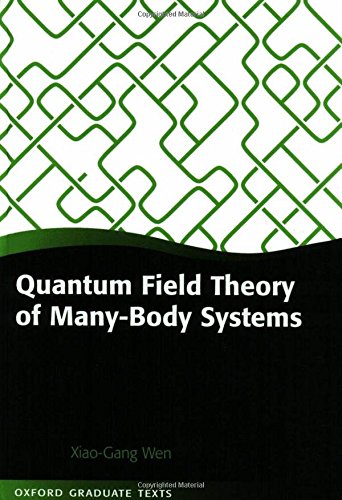
Ebook Info
- Published: 2007
- Number of pages: 505 pages
- Format: PDF
- File Size: 17.99 MB
- Authors: Xiao-Gang Wen
Description
For most of the last century, condensed matter physics has been dominated by band theory and Landau’s symmetry breaking theory. In the last twenty years, however, there has been the emergence of a new paradigm associated with fractionalization, topological order, emergent gauge bosons and fermions, and string condensation. These new physical concepts are so fundamental that they may even influence our understanding of the origin of light and electrons in the universe. This book is a pedagogical and systematic introduction to the new concepts and quantum field theoretical methods in condensed matter physics. It discusses many basic notions in theoretical physics, which underlie physical phenomena in nature, including a notion that unifies light and electrons. Topics covered are dissipative quantum systems, boson condensation, symmetry breaking and gapless excitations, phase transitions, Fermi liquids, spin density wave states, Fermi and fractional statistics, quantum Hall effects,topological/quantum order, spin liquid and string condensation. Methods discussed include the path integral, Green’s functions, mean-field theory, effective theory, renormalization group, bosonization in one- and higher dimensions, non-linear sigma-model, quantum gauge theory, dualities, slave-boson theory, and exactly soluble models beyond one-dimension. This book is aimed at bringing students to the frontiers of research in condensed matter physics.
User’s Reviews
Editorial Reviews: Review “As a whole, Quantum Field Theory of Many-body Systems is an inspirational and forward-looking book exploring the mysteries and never ending wonders of many-particle quantum mechanicsBoth for ambitious graduate students and for gray-haired veterans, Wen’s book offers a refreshing look at the mysterious quantum world.”–Physics Today”… covers an extremely wide-ranging and stimulating series of topics in modern theoretical condensed matter physics.”–Nigel Cooper, University of Cambridge”… responds to a serious need for a modern book on field-theory approaches to condensed matter theory.”–Allan H. MacDonald, University of Texas at Austin About the Author Xiao-Gang Wen is a professor in the Department of Physics at Massachusetts Institute of Technology.
Reviews from Amazon users which were colected at the time this book was published on the website:
⭐This is a VERY difficult book. I think the first 6 chapters are FABULOUS. then Wen takes us into quantum hall effects and loses us!If you’re well familiar with QFT in many body systems then this book has much to offer.Starting at chapter 9 he gets into his bread and butter of the speculative theory of string-nets. You won’t find this topic in any other book so this is a valuable resource if you’re curious as to how string-nets emerge gauge fields and all that.One thing that bugs me is his interpretation of fermions of the jordan-wigner transformation.He says that a spin 1/2 hubbard model is actually a bosonic model because you can also think about it as a system of bosons with hard core repulsion. Then he says it’s amazing to see fermionic excitations emerge from a “purely bosnic model”But it’s NOT “purely bosonic”. We started with a Hubbard model and then in our head we “thought about it” as though they were bosons. I really don’t understand his stance that the Hubbard model of spin 1/2 fermions is “purely bosonic”He doesn’t explain in detail why he thinks this way…just that we can “think of it as bosonic”That bugs me. Spin 1/2 particles are fermionic!He also claims that fermions are non-local because you can use the jordan&-wigner transformation! In my mind this is nothing more than a mathematical device. But Wen considers this nonlocality in order to set up his stringnet perspectiveI digress.Otherwise this book is quite illuminating and enjoyable.
⭐The message this book has to the reader “in between the lines” is: “Here are some interesting calculations. I won’t show you (at least not to the requisite level of detail) how to DO them, but I can tell you that they’re interesting (much like a densely-written journal article). I also have some exercises for you, and I wrote them to emphasize the _physical_, rather than ‘obtain equation such-and-such from equation so-and-so’.”. The pile of books I have read through to see what steps have been skipped is noticeably larger than any other text. The author does make it clear that this is his intention, stating: “Novelty is more important than correctness” at the immediate outset (this is, in fact, the title of Section 1.6). The problem, of course, is that the student learning something for the first time must achieve 100% correctness as they work through to the conclusions that a text proposes; hence, we return to the problem that this text makes no effort to be pedagogical.In conclusion, think of this textbook as a collection of journal articles, but with exercises. Note, also, that ultimately in physics one is interested in the physical, rather than “drill” type or “checking/verifying” type problems (though the latter certainly arises in the context of research, it is always motivated by the physical). Perhaps it can be seen in this regard as doing its reader a favour by keeping their mind on the physical picture.This text would take a lifetime for someone like me to master, so take my review and rating with a grain of salt, for I certainly have not read through the book the whole way, and even if I did, I’m certain that later on the road of my physics-career (at the time of writing this, I am a PhD student), I might see the text with new eyes.
⭐The other two reviewers have both noted that the book may not be a good starting point for a beginner, and I entirely agree.Think Weinberg’s three-volume QFT, or Feynman’s Lectures on Physics. These books are good, full of insights, and will teach you a lot more if you already have some basic understanding of the respective subjects. However, you will suffer if these books are used as introductory texts.That said, I find Wen’s book generally a good read, and it nicely explains several concepts that I didn’t understand until now. Well, I am a field theorist in my 4th year of grad school– not exactly a beginner. But still.One such instance is the section on Berry phase of a spin. Granted, Wen pretty much just throw at you the concept of a coherent state, but that part I learned just all right from other places. What’s important is, Wen’s book explains the next step “coherent state –> Berry phase” clearly. It’s the only comprehensible derivation I’ve seen so far. (See, for example, Fradkin’s Field Theories for Condensed Matters for an **unintelligible** derivation.)I do sometimes find Wen’s narrative style annoying. But hey, it’s a theoretical physics textbook, and as long as he makes sound arguments (he does), how he delivers the arguments isn’t that important.
⭐This book should be required reading for any student of modern condensed matter theory. Having prior exposure to the basics of condensed matter physics and introductory QFT would be very helpful, but besides that, the book is mostly self-contained. Most of the big topics of modern CMT are covered. If you don’t know anything about a specific topic (spin liquids, fractional quantum hall, string-nets, etc.), this is a good place to start. If you know something about these topics already, this book will offer a fresh perspective and make you rethink past assumptions. Besides covering the core material very well, this book is most notable for its philosophical viewpoint. No other book paints such a vivid and coherent picture of what modern condensed matter physics really is and why it should be taken seriously as a fundamental theory. My only hope is that we eventually get an updated version. A lot has happened in the last decade! The book could especially use a section on SPT phases and an updated treatment of topological order.
⭐I have a love-hate relationship with this book. On one hand, it’s great that it highlights a lot of important subtleties we would miss with a standard condensed matter field theory course. On the other hand, the notation is very weird/non-conventional, which makes comparing expressions with other books very painful. Sometimes, the notation is also sloppy/wrong, and self-studying from this book can be like pulling teeth.
⭐I have found this text very simulating. It summarises modern condensed matter theory. It is clearly written both textually and mathematically. I have found it very useful in my Loop Quantum Gravity research were I am trying to use Xiao-Gang Wen’ s theory to provide bosons and fermions. This matter formation occurs within the context of the Group field theory Bose-Einstein condensation of quantum tetrahedra to form spacetime.
⭐Cristal clear. It contains some opinionated (philosophical) content but it is in a different font and you can decide to read or skip
⭐Was recommended by a professor as a modern update of condensed matter physics, I like it very much so far, easy to follow.
⭐A true master piece.
⭐量子ホール効果の基礎を他書(日本語)で勉強したあと、英語の本を読みたいと思ったので、比較的新しくて評判の良いことからこの本を選びました。図が見やすく、内容も面白いので満足です。
Keywords
Free Download Quantum Field Theory of Many-body Systems: From the Origin of Sound to an Origin of Light and Electrons (Oxford Graduate Texts) in PDF format
Quantum Field Theory of Many-body Systems: From the Origin of Sound to an Origin of Light and Electrons (Oxford Graduate Texts) PDF Free Download
Download Quantum Field Theory of Many-body Systems: From the Origin of Sound to an Origin of Light and Electrons (Oxford Graduate Texts) 2007 PDF Free
Quantum Field Theory of Many-body Systems: From the Origin of Sound to an Origin of Light and Electrons (Oxford Graduate Texts) 2007 PDF Free Download
Download Quantum Field Theory of Many-body Systems: From the Origin of Sound to an Origin of Light and Electrons (Oxford Graduate Texts) PDF
Free Download Ebook Quantum Field Theory of Many-body Systems: From the Origin of Sound to an Origin of Light and Electrons (Oxford Graduate Texts)