

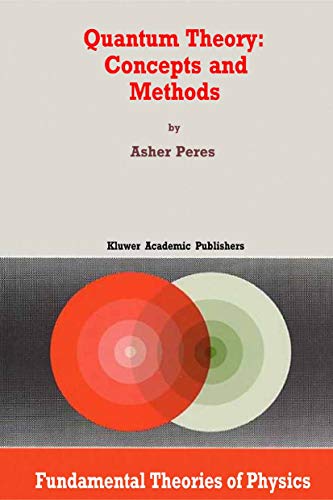
Ebook Info
- Published: 2006
- Number of pages: 464 pages
- Format: PDF
- File Size: 4.42 MB
- Authors: A. Peres
Description
There are many excellent books on quantum theory from which one can learn to compute energy levels, transition rates, cross sections, etc. The theoretical rules given in these books are routinely used by physicists to compute observable quantities. Their predictions can then be compared with experimental data. There is no fundamental disagreement among physicists on how to use the theory for these practical purposes. However, there are profound differences in their opinions on the ontological meaning of quantum theory. The purpose of this book is to clarify the conceptual meaning of quantum theory, and to explain some of the mathematical methods which it utilizes. This text is not concerned with specialized topics such as atomic structure, or strong or weak interactions, but with the very foundations of the theory. This is not, however, a book on the philosophy of science. The approach is pragmatic and strictly instrumentalist. This attitude will undoubtedly antagonize some readers, but it has its own logic: quantum phenomena do not occur in a Hilbert space, they occur in a laboratory.
User’s Reviews
Reviews from Amazon users which were colected at the time this book was published on the website:
⭐Extant reviews regarding this text include these words: “clear, fully elaborated” (Physics World) and “well-written, stimulating” (Contemporary Physics) and “excellent job.” (Physics Today). Happily, those words are accurate. Asher Peres has written a masterful textbook. The goal is to clarify the conceptual meaning of ‘standard’ Quantum Theory. Read (preface): “This book considers only standard quantum theory, the one that is actually used by physicists to predict or analyze experimental results. Readers who are interested in deviant mutations will not be able to find them here.” The textbook is pitched at graduate level, although, useful for independent study. Peres presents uncluttered mathematical and physical development of principles and concepts. Three major parts constitute the finished product: (1) Gathering the Tools – Hilbert Space, Linear Operators, Spectral Theory (roughly one hundred pages). We read:” the new feature introduced by quantum theory is that the probabilistic nature of the outcome of a measurement is inherent.” (page 56). (2) Crypto-determinism and inseparability, Bell’s theorem, Gleason’s theorem (all couched within exposition of one- hundred pages). Read: ” there is no escape from nonlocality, it is the entire universe which is an indivisible, nonlocal entity.” (page 173). (3) Quantum dynamics and information, Wigner & symmetry, thermodynamics and measurement. Read: ” By analogy with the classical formalism, we shall assume that the evolution of a quantum state is given by the unitary transformation satisfying the group property.” (page 239). This last part (part three) is a feast for those inclined to peruse this marvelous resource. A few words from Asher Peres:(1) ” Quantum theory is nothing more than a set of rules whereby physicists compute probabilities…” (page 18).(2) ” Amplitudes, not probabilities, are fundamental…from which the probabilities are derived.” (page 43).(3) “…analogy is admittedly vague…must ultimately break down.” (page 298, referring to correspondence principle).A table illustrates relationship between Dirac’s bra-ket scheme and complex vectors (page 78). Words from chapter twelve, Measurement of Time: ” time is not a dynamical variable” and “…there is no time operator.” Time was discussed earlier in the book, where ” The asymmetry between past and future is fundamental in the axiomatic development of quantum theory.” (page 12). Read: ” in quantum theory frequency means energy.” (an issue often ignored). (4) An interesting discussion of Fock space (pages 136-145). One of the few texts introducing Wigner’s functions which “may give a qualitative feeling of the approximate location of a quantum system in phase space.” (page 314). Read: ” the notion of truth and falsehood acquire new meanings in the logic of quantum phenomena.” (page 288),(5) The bibliography includes, The Mechanics Of The Atom, by Max Born: “a remarkable book, one of the best sources for canonical transformations, action-angle variables and Hamilton-Jacobi theory.” (page 22). Read Max Born !(6) Concluding: this advanced textbook should be part and parcel of the education of every student and instructor.Highly recommended !
⭐First of all, let me say that I personally recommend this book to everyone that I know; not only physicists. This book is sufficiently accessible that my friends who are philosophers of science, computer scientists, etc. are able to read it. Anyone with an interest in Quantum Theory, really, can handle this book. That, and this book has an Easter-egg; look up “uncertainty principle” in the index!This book does an incredible at presenting quantum theory from a perspective with the *fewest* assumptions. For anyone interested in foundational/interpretational questions, this is essential. That being said, it can be a challenging read even for a researcher in physics. Aspects of the Hilbert Space formalism that are usually suppressed under a simpler undergraduate presentation (eg. Griffiths or Liboff) or the standard graduate presentation (eg. Sakurai) are brought to the forefront. By largely abandoning Dirac notation, the reader is forced to think more about the operational approach to quantum mechanics, not simply how to calculate quantum probabilities. The exercises aren’t exceptionally difficult, are practical, and well chosen.Once the foundation is set, the book proceeds to cover those topics of quantum theory that have had the greatest philosophical and conceptual impact since the theory’s conception. Peres devotes a great deal of the book to issues such as EPR and Bell’s inequalities. He continues by introducing contextuality and the Kochen-Specker theorem; KS is nearly as important a result as Bell’s inequalities, but isn’t mentioned in most introductory presentations of QM.After committing the book to various other frequently uncovered topics (see the book’s contents) he even goes on to talk about quantum information and the measurement process.I’ll summarize with this: for the reader who is interested in learning about quantum mechanics and not simply learning how to be a quantum mechanic, this is, hands down, the single best book. After reading, your insights are bound to run far deeper than ever before.
⭐It is the best source of standard quantum theory out there. It is at the graduate level. I read it when I was a senior undergrad, physics. It was definitely challenging for me but manageable, for it is more an independent study source.If you are interested to know quantum theory as it is genuinely practiced, in the laboratory, and its standard Copenhagen Interpretation, then this is the book. In this book quantum theory is unfolded as it actually works, and not lending itself to Deepak Chopraik charlatanism. Quantum Theory is conceived as a set of rules for calculating the probabilities of atomic and subatomic phenomena; that is it and no more and no less. It is a highly professional and practical version of the theory.
⭐The author has put serious work and thought to writing this excellent book. It is a graduate level exploration of quantum theory but it is written very clearly. A background in college level physics and mathematics are necessary of course but the book is so well designed that the reader requires only common sense and persistence to complete the journey. I found some of the insights very illuminating. and most of the mathematical work was clear enough for me to comprehend the logic behind the ideas, not just through the accompanying discussion but through the maths itself.I am not a physicist nor a mathematician, just someone who is scientifically inclined with a deep interest in quantum theory and this book is a very valuable addition to my library. I highly recommend it. the author in my opinion literally guides you through an excellent exploration of the subject matter.
Keywords
Free Download Quantum Theory: Concepts and Methods (Fundamental Theories of Physics Book 57) 1995th Edition in PDF format
Quantum Theory: Concepts and Methods (Fundamental Theories of Physics Book 57) 1995th Edition PDF Free Download
Download Quantum Theory: Concepts and Methods (Fundamental Theories of Physics Book 57) 1995th Edition 2006 PDF Free
Quantum Theory: Concepts and Methods (Fundamental Theories of Physics Book 57) 1995th Edition 2006 PDF Free Download
Download Quantum Theory: Concepts and Methods (Fundamental Theories of Physics Book 57) 1995th Edition PDF
Free Download Ebook Quantum Theory: Concepts and Methods (Fundamental Theories of Physics Book 57) 1995th Edition