

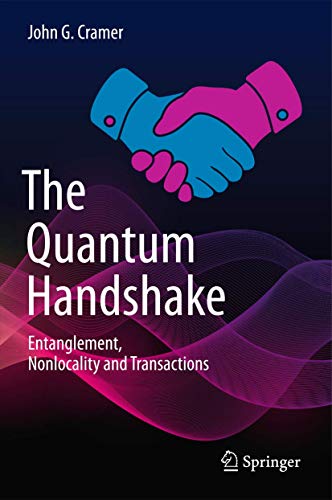
Ebook Info
- Published: 2016
- Number of pages: 243 pages
- Format: PDF
- File Size: 7.42 MB
- Authors: John G. Cramer
Description
This book shines bright light into the dim recesses of quantum theory, where the mysteries of entanglement, nonlocality, and wave collapse have motivated some to conjure up multiple universes, and others to adopt a “shut up and calculate” mentality. After an extensive and accessible introduction to quantum mechanics and its history, the author turns attention to his transactional model. Using a quantum handshake between normal and time-reversed waves, this model provides a clear visual picture explaining the baffling experimental results that flow daily from the quantum physics laboratories of the world. To demonstrate its powerful simplicity, the transactional model is applied to a collection of counter-intuitive experiments and conceptual problems.
User’s Reviews
Editorial Reviews: Review “The book … is a fundamental work on the transactional interpretation of quantum mechanics, which was proposed by Cramer himself and that provides a different way to look at quantum mechanics. The work is, thus, of major interest for physicists, researchers working on quantum technologies, students learning quantum mechanics as well as researchers working on the foundations of quantum mechanics. … the book is a key work on quantum theory, providing for an alternative interpretation of quantum mechanics … .” (Carlos Pedro Gonçalves, zbMATH 1358.81001, 2017)“As Cramer (emer., physics, Univ. of Washington) notes, the Copenhagen interpretation of quantum mechanics has serious flaws that have led to many alternatives. This work presents one of these alternatives: the transactional interpretation. The Quantum Handshake is primarily for nonphysicists, though physicists might find this new approach interesting. … Summing Up: Highly recommended. All academic library collections in physics.” (E. Kincanon, Choice, Vol. 53 (11), July, 2016) From the Back Cover This book shines bright light into the dim recesses of quantum theory, where the mysteries of entanglement, nonlocality, and wave collapse have motivated some to conjure up multiple universes, and others to adopt a “shut up and calculate” mentality. After an extensive and accessible introduction to quantum mechanics and its history, the author turns attention to his transactional model. Using a quantum handshake between normal and time-reversed waves, this model provides a clear visual picture explaining the baffling experimental results that flow daily from the quantum physics laboratories of the world. To demonstrate its powerful simplicity, the transactional model is applied to a collection of counter-intuitive experiments and conceptual problems. About the Author John G. Cramer is known to many as author of the award-nominated hard-SF novels Twistor and Einstein’s Bridge, and contributor of nearly 200 popular-science articles published in Analog Science Fiction and Fact Magazine. He is Professor Emeritus of Physics at the University of Washington in Seattle, where he has five decades of experience in teaching undergraduate and graduate physics. From 1983 – 1990 he served as Director of the UW Nuclear Physics Laboratory. John has done cutting-edge research in experimental and theoretical nuclear physics and ultra-relativistic heavy ion physics, fields in which he has published extensively. He has also worked on the foundations of quantum mechanics and is the originator of its Transactional Interpretation. John and his wife Pauline live in the View Ridge neighborhood of Seattle, Washington. Read more
Reviews from Amazon users which were colected at the time this book was published on the website:
⭐John Gleason Cramer, Jr. is Professor Emeritus of Physics at the University of Washington in Seattle; he has been an active participant at the Relativistic Heavy Ion Collider (RHIC) at Brookhaven National Laboratory, and the CERN particle accelerator in Geneva.He wrote in the Preface to this 2016 book, “This book gives an overview of the interpretational problems of quantum mechanics, provides an introduction to the Transactional Interpretation, and then demonstrates the use of it in understanding what is going on ‘behind the scenes’ in many otherwise strange and mysterious problems of quantum optics. The target audience is the intelligent readers with some grasp of basic mathematics and a curiosity about quantum mechanics, what it is and how it works… The reader is also warned that there are a large and growing number of interpretations of quantum mechanics, of which the Transactional Interpretation is only one… Most of the resulting interpretational attempts have the problems that they introduce changes to the standard quantum formalism or they address only a restricted subset of the many interpretational problems and issues of the quantum formalism. In this book we will focus on the Transactional Interpretation and will only compare it with the orthodox Copenhagen Interpretation. We will discuss alternative interpretations only peripherally.”He states, “The Copenhagen Interpretation is sometimes described as the ‘don’t ask; don’t tell’ interpretation of the quantum world. It advises us to focus on measurable quantities and not to inquire about what is going on behind the scenes, to ‘shut up and calculate.’ This view derives in part from the philosophy of logical positivism, which was fashionable … in the late 1920s… when quantum mechanics was being developed. Philosophy has moved well beyond logical positivism, but the Copenhagen Interpretation remains stuck in that era… The Copenhagen Interpretation is a consistent but unsatisfying way of approaching the quantum world. In this boo, we will provide a better alternative: the Transactional Interpretation of quantum mechanics.” (Pg. 8)He explains, “in the late 1920s… The emerging Copenhagen Interpretation … fulfilled the needs of those who wanted to calculate and make predictions, but frustrated those who wanted to understand what went on behind the scenes.” (Pg. 25) He continues, “The central tenets of the Copenhagen Interpretation can be summarized as follows: *A system is completely described by a wave function… *One should focus on the observable quantities of a system and avoid asking questions about aspects that are not subject to measurement. *The quantum mechanical description of nature is probabilistic and random… *It is not possible to know the precise values of all the properties of a system at the same time… *Matter and light exhibit wave-particle duality… *Measuring devices … essentially … measure classical properties such as position and momentum… *The quantum mechanical description of a system … should closely correspond to its classical description.” (Pg. 27)He notes, “The classical electrodynamics described by [Richard] Feynman and [John] Wheeler (WF) was intended to deal with the problem of the self-energy of the electron in an innovative way… the calculation succeeded in describing electrodynamic interactions in a completely time-symmetric way. Effectively the retarded and advanced waves together did a ‘handshake’ that arranged for the transfer of energy and momentum …” (Pg. 51-52)He laments, “A major part of the problem with understanding the role of quantum interpretations is that textbooks used to teach quantum mechanics at the graduate level often ignore the whole concept of an interpretation and by example encourage the graduate -student to ‘shut up and calculate.’ … Thus, students learning quantum mechanics in graduate school are for the most part unaware that there are any interpretational problems, and they may or may not even be explicitly exposed to the ideas of the Copenhagen Interpretation.” (Pg. 59)He suggests, “The transactional model not only provide a description of the process that underlies the calculation of a quantum mechanical matrix element, but it also explains and justifies Born’s probability rule… The Born probability rule is an assumption of the Copenhagen Interpretation, asserted axiomatically without justification as one of the tenets of the interpretation. On the other hand, the Born probability rule follows naturally from the transactional account of the Transactional Interpretation and does not need to be added as a separate assumption. In that sense, the Transactional Interpretation is superior to the Copenhagen Interpretation because it is more philosophically ‘economical,’ requiring fewer independent assumptions.” (Pg. 65) He acknowledges, however, that the Transactional Interpretation “does not provide a detailed mathematical description of transaction formation… [But] In our view, the mathematics is (and should be exclusively contained in the standard quantum formalism itself.” (Pg. 66)He asserts, “The Copenhagen Interpretation, with its focus on observers and observer knowledge, has a severe problem with … a universal wave function. A universal wave function that would be interpreted as a description of observer knowledge would seem to require an observer OUTSIDE the universe to have knowledge of it and to collapse the wave function. The Transactional Interpretation, which is independent of observers and observer knowledge, has no such problems. Further, it is relativistically invariant, and therefore should, in principle, be extensible to a theory of quantum gravity, should one emerge from the current effort.” (Pg. 73)He observes, “Given that a measurement on one part of an extended quantum system can affect the outcomes of measurements performed in other distant parts of the system, the question that naturally arises is: can this phenomenon be used for nonlocal communication between one observer and another? Demonstration of such nonlocal quantum communication would be a truly game-changing discovery, because it would break all the rules of normal communication. No energy would pass between the send and receive stations; the acts of sending and receiving could occur in either time order and would depend only on the observer-chosen instants at which the measurements were made; there would beno definite signal-propagation speed, and messages could essentially be sent faster than light-speed, or ‘instantaneously’ in any chosen reference frame, or even, in principle, backwards in time. The average member of the physics community, if he or she has any opinion about nonlocal communication at all, believes it to be impossible, in part because of its superluminal and retrocausal implications.” (Pg. 135)He comments, “Teleportation is [a] familiar idea in science fiction… But modern hard-SF has largely abandoned teleportation as a concept that has more to do with fantasy and parapsychology than with real science. Imagine my surprise, then, to discover in 1993 an article on the subject of teleportation in ‘Physical Review Letters.’ The article… describes an in-principle procedure for copying and transporting a pure quantum state from one location and one observer to another by a process that the authors characterize as teleportation.” (Pg. 152)Turning to ‘quantum computing,’ he says, “I prefer to visualize the operation of a quantum computer using the Transactional Interpretation. The programming of the quantum computer that sets up the problem has created a set of conditions such that the quantum mechanical wave function can only from a final transaction and collapse by solving the problem… The net result is that the solution transaction forms, the wave function collapses into the solution state, and the result is read out. This, I think, provides a simple, economical, and insightful view of what goes on in a quantum computer.” (Pg. 158)He clarifies, “Let us make an analogy. The handshakes depicted by the Transactional Interpretation bear some resemblance to the handshakes that take place on Internet lines these days when one uses a debit card to make a purchase… There is a one-to-one correspondence between the amount the store receives … and the amount that is deducted from your bank account…. A quantum event as described by the Transactional Interpretation follows the same kind of protocol. There is a one-to-one correspondence between the energy and other conserved quantities … that are conveyed from the emitter to the absorber, but aside from the enforcement of conservation laws, the future absorber does not influence the past emission event. ‘Free will’ does not include the freedom to violate physical laws. Therefore, the ‘determinism’ implied by the Transactional Interpretation is very limited in its nature, with plenty of room left over for free choice.” (Pg. 165)He concludes, “The Transactional Interpretation of quantum mechanics… easily accounts for nonlocality and provides the tools for understanding the many counter-intuitive aspects of the quantum formalism and for visualizing nonlocal quantum processes. The transaction model is ‘visible’ in the quantum formalism itself, once one associates the wave function with an offer, he conjugated wave function with a confirmation, and quantum matrix elements with completed transactions… we have seen that the Transactional Interpretation of quantum mechanics is unique among the plethora of partial ‘interpretations’ that have arisen in the physics literature over the years in dealing with ALL of the interpretational problems of quantum mechanics and is providing tools for visualizing the mechanisms that lie behind many puzzling and counter-intuitive results that are emerging from quantum optics laboratories around the world. The Transactional Interpretation gives us a new way of looking at the universe.” (Pg. 167-168)Definitely not a “beginners’ book,” this book will be of great interest to those studying the Transactional Interpretation, as well as other aspects of quantum mechanics.
⭐I bought this book because I was trying to figure out the whole “observation/wave-collapse” thingy – didn’t really have an understanding of “interpretations” of QM, formalism, and other fundamentals – just got interested because of the possibilities of an observer “creating” the world around them. Well, Dr. Cramer shattered my illusion of creating reality by observation – and that’s a good thing! “Observation Collapse” never really made sense to me, but Dr. Cramer’s “Transactional Interpretation” makes total sense – and fits with what we perceive to be “real”.The best Amazon review of this book is by Simon Booth, so I suggest you read his review for a really good overview of the book. However, I disagree with Mr. Booth in one particular. He states: “Apparently the source of an offer wave selects from the time-reversed confirmation waves it receives according to some sort of hierarchy whilst making sure that conservation laws are upheld. This seems to require a larger set of rules and mechanisms bolted on top of the QM formalism than even Copenhagen or [Many Worlds] require.” Actually, Dr. Cramer addresses this issue in Section 5.5 – basically, the emitter (source) evaluates many echo waves based on amplitude (proximity) and phase similarity – the more echoes from one source having similar phase as the emitter, and with amplitudes that add up collectively, the greater the probability that a transaction will occur. This seems to me to be pretty straight forward, thus not needing any additional mathematics beyond simple statistics to show how it COULD occur. And, as Dr. Cramer notes, the final transaction is atemporal, so all of this “evaluating” can occur essentially simultaneously. Certainly this hierarchical process is much more capable of mathematical proof than is “observer collapse” (which seems to be unsupported by any mathematical basis).As Dr. Cramer points out many times, an interpretation of QM is merely a theory that attempts explain what we cannot observe, but that is consistent with what we do know (i.e., comports with the “formalism”, or the mathematics, that “work” for quantum mechanics). The better the theory fits the mathematical predictions, the more likely it is to be “what’s really happening behind the curtain” (which we may never know).However, a cautionary tale is told by the Antikythera Mechanism, a 2000 year old scientific apparatus designed to predict solar, lunar and planetary events. (See “A Portable Cosmos”, Alexander Jones, 2017) The Antikythera apparatus was designed using mathematics which comported to the known orbits of the bodies, in order to determine gear ratios, etc. to build the apparatus. And the apparatus worked remarkably well. The only problem is that the math was based on a fundamentally WRONG “interpretation” of the solar system – i.e., it was based on a geocentric model (versus a heliocentric model) of the solar system! The moral of the story is that erroneous mathematics can represent an accurate, but fundamentally flawed, interpretation of reality. In the case of QM, the maths seem to be settled, and it’s only the interpretation that is in dispute. But consider that the maths might be wrong – i.e., they give good predictions, but are based on a fundamentally flawed model (as per the Antikythera Mechanism). For anyone to stake a claim as to having the “correct interpretation”, or even the “correct mathematics”, to describe quantum mechanics is pure folly. We cannot even describe how (i.e., the mechanism by which) an electo-magnetic wave propagates though the supposed vacuum of space, or how mass distorts space to create gravity, so let’s not foreclose any possibility of the mechanism of Cramer’s “Transactional Interpretation” unless it can be proven to be mathematically impossible. Cramer’s “TI” fits all of the models and QM experiments (as recited ad nauseam in Ch. 6), so it is at least worthy of consideration. It certainly makes more sense than the Copenhagen Interpretation.As a final comment, Cramer does an excellent job of educating the novice regarding “the lay-of-the-land” of QM. His Appendix A, “Frequently Asked Questions”, might just be the best starting point for reading this book.
⭐I’ve been fascinated by the Transactional Interpretation of QM since reading In Search Of Schrodinger’s Cat many years ago – treating quantum processes as bidirectional interactions in time seems to make all that is mysterious in the quantum world comprehensible. Experiments such as the delayed choice quantum eraser all but scream that at the lowest levels of reality time is a two way street, and the arrow of time we see in the macroscopic world is a bulk statistical property.It has baffled me ever since that whilst there are countless reams dedicated to discussing the Copenghagen interpretation (utter nonsense) or the Many Worlds interpretation (problematic), the Transactional Interpretation is rarely mentioned. When it did get a mention it was generally greeted with mumblings that people had heard that somebody or other had proved it was inconsistent, so they’d never really investigated it… surely this was a clear case of the tyranny of orthodoxy in the scientific community!The Quantum Handshake is therefore perhaps very overdue – a book in which the originator of the Transactional Interpretation, Professor John G. Cramer, sets out his theory in detail and explains how it handles some of the surprising results in quantum experiments, which other interpretations can only explain by bolting extra mechanisms and rules on to the mathematical formalism of QM.The book starts with a brief summary of the development of QM and the arguments over its interpretation in the 20th Century (notably between Bohr and Einstein), a subject that is becoming popular in the literature recently as it starts to occur to people that perhaps the reason there has been so little progress in fundamental physics over the past 40 years or so is because nobody really understands what QM is trying to tell us.Copenhagen and Many Worlds are introduced, along with some of the ways in which they fail as interpretations of the mathematical formalism of QM. The Transactional Interpretation is then introduced, in fairly rigorous mathematical detail (you’ll want to brush up on your Greek alphabet before reading this book, but Cramer explains the terms and equations as he introduces them). Various famous experiments and gedankenexperiments are then interpreted and explained in the context of TI.Unfortunately, when the TI is laid out in detail it disappoints. Although Prof. Cramer seems to believe that the TI is nothing but the mathematical formalism of QM converted into words, a number of additional mechanisms are bolted on to explain how a transaction arises in response to offer and confirmation waves (the interpretation of the Schrodinger wave equation in TI). This part of the process seems to be very unclear, with the description being almost anthropomorphic. Apparently the source of an offer wave selects from the time-reversed confirmation waves it receives according to some sort of hierarchy whilst making sure that conservation laws are upheld.This seems to require a larger set of rules and mechanisms bolted on top of the QM formalism than even Copenhagen or MW require – and if there is a proposed mechanism for how the selection process happens then its description here is so vague as to be incomprehensible.So it seems that the Transactional Interpretation is not and cannot be the “correct” interpretation of Quantum Mechanics because at the critical moment it waves its hands and mumbles, leaving gaping questions open about what happens and how it happens during a transaction. Maybe Cramer has a vision in his mind, but he has not been able to set it down on paper here.It’s a shame… Superposition, entanglement and the inescapable randomness found in the maths of QM all suggest that quantum interactions involve some sort of collaboration between past and future. Whilst the Transactional Interpretation almost certainly isn’t the correct, final way to understand these phenomena, I am glad that this book exists – perhaps it will inspire some future theorist to look at the quantum world in a new way, and they’ll come up with an interpretation that finally makes sense of it all.
⭐An excellent and overdue text on what I think is the most beautiful and elegant interpretation of quantum mechanics.Worth every penny, and even those with pretty rusty maths will soon get back into the swing of things, though this is not a very mathematical text.
⭐An excellent overview of the quantum mysteries and arguments supporting possible explanations of the weirdness of nature. I found this book lies between the ‘popular’ science books and the real research going on in the labs. Its not dumbed down, but not overly mathematical either. Thanks to Dr Cramer.
⭐New views of physical reality can be challenging. Fortunately, the logic, solid foundation, clarity of writing, and what we might think of as “plain ol’ sense-making” of what is contained in this book will turn out to be a true gift for many. If you are a mathematical physicist focused on and working in the various fields of Quantum Mechanics, this clear explication will be very helpful to you and your students. If you are a philosopher of science exploring and illuminating the invitations and thresholds of what we think we understand about Quantum Mechanics — shall I say it again? — this clear explication will be very helpful to you and your students. If you claim befuddlement, headaches, or worse when confronted (for example) by line after line of hyper-specialized and obscure equations (which do not appear here), I suspect you will be delighted with the fine writing and clear explanations that provide not only enlightenment but understanding. This is the kind of book where, for the eager reader, “the light goes on, and stays on.”
⭐The book has a valuable well written section on the history of quantum mechanics and a good perspective on the quest for an interpretation of quantum behavior. But it fails to provide a convincing argument for why we need interaction transactions, as the theory is not testable and adds no new knowledge to quantum mechanics. Much like the old ether discussion for propagation of light; the ether could exist all right – but add no value to the theories of light.
Keywords
Free Download The Quantum Handshake: Entanglement, Nonlocality and Transactions in PDF format
The Quantum Handshake: Entanglement, Nonlocality and Transactions PDF Free Download
Download The Quantum Handshake: Entanglement, Nonlocality and Transactions 2016 PDF Free
The Quantum Handshake: Entanglement, Nonlocality and Transactions 2016 PDF Free Download
Download The Quantum Handshake: Entanglement, Nonlocality and Transactions PDF
Free Download Ebook The Quantum Handshake: Entanglement, Nonlocality and Transactions