

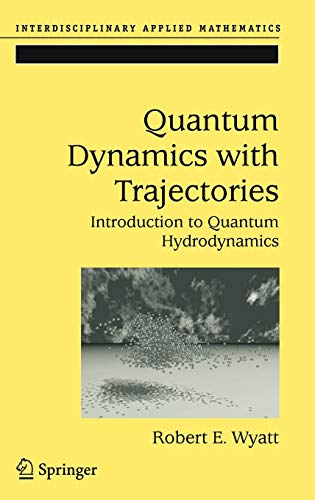
Ebook Info
- Published: 2005
- Number of pages: 430 pages
- Format: PDF
- File Size: 7.09 MB
- Authors: Robert E. Wyatt
Description
This is a rapidly developing field to which the author is a leading contributor New methods in quantum dynamics and computational techniques, with applications to interesting physical problems, are brought together in this bookUseful to both students and researchers
User’s Reviews
Editorial Reviews: Review From the reviews: “This excellent book covers a wide range of topics associated with Quantum Hydrodynamics. It’s an excellent survey of the history, current state-of-the-field, and future research directions.” (Brian Kendrick, Theoretical Division, Los Alamos National Laboratory, Los Alamos, NM, USA)”The book is unique in that it addresses with equal expertise, computational methodology and theoretical connections at the interface between de Broglie-Bohm theory and phase space moment methods. A highly didactic text, to be recommended to graduate students and researchers in physics and chemistry.” (Irene Burghardt, Dépt. de chimie, Ecole Normale Supérieure, Paris, France)”Wyatt shows how one can use the ideas drawn from Bohm’s interpretation to develop new and efficient computational methods for both time dependent and time independent quantum mechanics.This is THE definitive text on practical Bohmian mechanics.” (Eric Bittner, Dept. of Chemistry, University of Houston, TX, USA)”The book under review is a good introduction to quantum hydrodynamics and an invaluable survey of the subject. It is written in clear and rigorous language and may be helpful both for novices having basic knowledge in quantum mechanics and experts. … Numerous illustrations, results of numerical computations and historical comments make reading more fascinating.” (Sergei A. Nemnyugin, Mathematical Reviews, Issue 2006 k)”This book presents the state of the art in the quantum trajectory (QT) method and its applications in quantum hydrodynamics. … In addition to advanced issues at the level of professional researchers, the book also contains many introductory elements that can nicely serve also to graduate students as a suitable extension of their textbook literature on quantum mechanics. Numerous boxes with outlines and summaries of basic results of chapter are particularly valuable to those who need a brief and concise information on a particular item.” (Vladimir Cadež, Zentralblatt MATH, Vol. 1107 (9), 2007) From the Back Cover Remarkable progress has recently been made in the application of quantumtrajectories as the computational tool for solving quantum mechanical problems. This is the first book to present these developments in the broader context of the hydrodynamical formulation of quantum dynamics. In addition to a thorough discussion of the quantum trajectory equations of motion, there is considerable material that deals with phase space dynamics, adaptive moving grids, electronic energy transfer, and trajectories for stationary states. On the pedagogical side, a number of sections of this book will be accessible to students who have had an introductory quantum mechanics course. There is also considerable material for advanced researchers, and chapters in the book cover both methodology and applications. The book will be useful to students and researchers in physics, chemistry, applied math, and computational dynamics.”This excellent book covers a wide range of topics associated with Quantum Hydrodynamics. It’s an excellent survey of the history, current state-of-the-field, and future research directions.”Brian Kendrick,Theoretical Division, Los Alamos National Laboratory, Los Alamos,NM, USAThe book is unique in that it addresses with equal expertise, computational methodology and theoretical connections at the interface between de Broglie-Bohm theory and phase space moment methods.A highly didactic text, to be recommended to graduate students and researchers in physics and chemistry.Irene Burghardt,Departement de chimie, Ecole Normale Superieure, Paris, FranceWyatt shows how one can use the ideas drawn from Bohm’s interpretation to develop new and efficient computational methods for both time dependent and time independent quantum mechanics.This is THE definitive text on practical Bohmian mechanics.Eric Bittner,Department of Chemistry, University of Houston, Tx, USA
Reviews from Amazon users which were colected at the time this book was published on the website:
⭐Great for chemists that want to write programs to simulate quantum systems using Bohmian mechanics. I love this book, so much useful information, gives great introductions to adjacent concepts as well, like Wigner functions and so on. So, I’ll give it 5 stars, excellent.
⭐Professor Wyatt is an expert of reactive scattering and co-editor (with John Zhang) of “Dynamics of Molecules and Chemical Reactions”. He has applied conventional quantum mechanics theoretical and computational methods to study many molecular systems. In this book, Professor Wyatt presents the de Broglie – Bohm theory of quantum mechanics, both theoretically and computationally. It is a very challenging task because Peter Holland’s “The Quantum Theory of Motion” is considered a comprehensive account of de Broglie – Bohm and computationally speaking the calculation of quantum trajectories often involves numerically unstable division of “0/0”. Professor Wyatt’s book meets the challenges very well by presenting history, philosophy, and computational results. Before this book, not many quantum potentials and quantum trajectories have been published other than those for the double-slit ideal experiment. Professor Wyatt gave some real physical cases. For computational details, interested readers may refer to the PhD dissertation of Corey Trahan, who is listed as a contributor to the book.
⭐This is a well written book by a leader in the field on the subject. The author has included a mix of theory, computation, and history that gives the reader a broad depth of understanding of, not just what Bohmian mechanics is all about, but how to go about writing a computer program to simulate quantum dynamics using the hydrodynamic equations. As a computational chemist I am delighted to see books written in a more modern way by focusing on computation instead of the traditional theoretical approach. It’s no trivial task going from knowing how to write down the correct time-dependent Schroedinger equation to propagating a gaussian wavepacket, even for simple model problems. The book contains numerous examples ranging from bound states, scattering, and even electronically non-adiabatic problems. Most of the examples are taken from published studies, primarily by the author.A big reason for purchasing this text, as opposed to just reading all the available literature on the subject, was the inclusion of an example QTM “program”. This is where I was most disappointed. The program in the appendix is incomplete. It doesn’t even include the most critical part of the quantum trajectory method, evaluation of the spatial derivatives. The call to the generic deriv routine appears to use all the grid points in the evaluation of spatial derivatives at each reference point. You wouldn’t want to do this as it adds considerable numerical errors, especially at the end points and in regions where the function is rapidly varying. Much of what this book should have discussed I had to learn by trial and error doing my own coding. The inclusion of a complete working code with a few pages devoted to describing it and how to use it is what this book needed. It’s very misleading to a purchaser to include in the contents section “Example QTM Program” and then end up providing nothing more than a pseudocode description of the method. The author should make a complete working and functional QTM program available on his website.Since Professor Wyatt is a computational chemist I was expecting to see more chemistry applications. Too much of the book focused on harmonic oscillators, uphill/downhill ramp potentials, scattering through an Eckart potential, etc … What about the H + H2 reaction, or scattering cross-sections? This book deserves more stars if it were more complete and something additional to the available published literature. I wouldn’t recommend purchasing this book unless you simply don’t have the motivation to read the available literature on the subject (and there’s really not a lot of literature out there yet). I hate to give this book just 3 stars because it is very readable and well put together, it just failed where it should have excelled.
Keywords
Free Download Quantum Dynamics with Trajectories: Introduction to Quantum Hydrodynamics (Interdisciplinary Applied Mathematics, 28) 2005th Edition in PDF format
Quantum Dynamics with Trajectories: Introduction to Quantum Hydrodynamics (Interdisciplinary Applied Mathematics, 28) 2005th Edition PDF Free Download
Download Quantum Dynamics with Trajectories: Introduction to Quantum Hydrodynamics (Interdisciplinary Applied Mathematics, 28) 2005th Edition 2005 PDF Free
Quantum Dynamics with Trajectories: Introduction to Quantum Hydrodynamics (Interdisciplinary Applied Mathematics, 28) 2005th Edition 2005 PDF Free Download
Download Quantum Dynamics with Trajectories: Introduction to Quantum Hydrodynamics (Interdisciplinary Applied Mathematics, 28) 2005th Edition PDF
Free Download Ebook Quantum Dynamics with Trajectories: Introduction to Quantum Hydrodynamics (Interdisciplinary Applied Mathematics, 28) 2005th Edition