

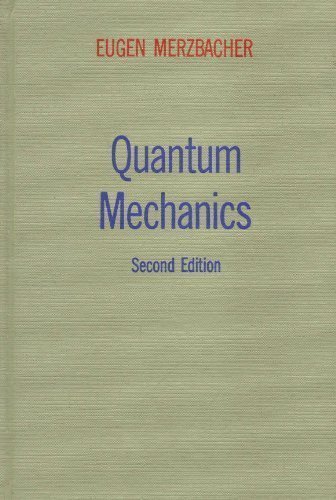
Ebook Info
- Published:
- Number of pages:
- Format: PDF
- File Size: 44.94 MB
- Authors:
Description
User’s Reviews
Reviews from Amazon users which were colected at the time this book was published on the website:
⭐Despite being listed as hardcover, this is the paperback version of the book and checking the ISBN on the publisher’s site confirms this. I only did so, however, after speaking to customer service and receiving two replacements which were also paperback. So if you order this book, do not expect a hardcover copy. I don’t think there is a hardcover version of this book currently in print. So be aware of this if it matters to you.
⭐One very very thick book!Merzbacher’s Quantum Mechanics is not the most popular graduate text for QM; however, it is one of the options that some professors will choose.This text tries to be a very thorough study of quantum mechanics, but at times it is definitely very difficult to follow. Let’s say we’re looking to study topic A, and you turn to the index to look for it. You’ll most likely find it in several different chapters, linked to different topics.The book also doesn’t give enough information for you to solve the problems inside, maybe this is just because I am just not bright enough though…Nonetheless, it would be worthwhile to buy this book if you’re taking a class that requests it. It’s very difficult to navigate the book in an electronic form.Happy shopping! :>
⭐It is a very high level book, if you don`t have a background on Q.M. like Griffiths or Shankar this is a waste of money.
⭐I would look for another book to understand grad level Quantum.
⭐The book is really what I wanted. And its is very cheap. It costs me only 12 USD. Really good!
⭐It is completely new, I really got surprised!
⭐Not surprisingly, the enthusiasm with which I support this graduate-level text (I refer to the second edition) is hardly shared by a majority of reviewers. However, read the review in Physics Today: “notable for making contents accessible to the average student, new ideas are exposed via very simple mathematics and thus presented in a simple way.” (1971, Volume 24, Number 6). That review is less enthusiastic than mine, however ! Peruse articles written by Eugen Merzbacher in American Journal of Physics, there absorb his teaching style. Background of Eugen Merzbacher:(A) “Two of his articles on quantum mechanics formalism were deemed by readers to be among the fifty most important published by the American Journal of Physics in its first 50 years.”(B) The American Association of Physics Teachers presented him with Oersted Medal in 1992 (read: AJP, Volume 60).While much of the material in this text is standard, much is also unique, both in viewpoint and execution:(1) The manner in which the imaginary unit is brought forth in chapter one offers a different perspective (compare Merzbacher to Schiff’s derivation).(2) Turn to chapter eight: basic principles of wave mechanics), as lucid as one finds elsewhere (compare Schiff).(3) The interspersed student exercises are effective for imparting simple manipulative skill. Few are beyond the reach of an average student. Merzbacher writes: “these exercises supplement the main text.” Additional problems, end of chapter problems, are extensions of the main text and require more work.(4) Scattering Theory: Merzbacher excels here (as to be expected, as this is a portion of his research specialty). Exercise #11.1 is useful in this regard, a numerical exercise associated with wave packets (second edition, page 221). Green’s functions are introduced in the span of five pages and utilized throughout chapter eleven. Parabolic coordinatesfor Coulomb potential lucidly presented (again, compare to Schiff ).(5) Next up, spin. A nugget of wisdom (often downplayed): “….unless the electron, moving in the field of the nucleus, possesses intrinsic angular momentum, conservation of angular momentum can not be maintained for an isolated system such as an atom…” This chapter is preparation for the dynamics of two-level- systems and another nugget of wisdom: “…in practical terms the experimental arrangement usually tells us unambiguously when the homogeneous ensemble of a correlated state may to a very high degree of approximation be replaced by a suitably weighted mixture of its components (page 293, second edition).(6) Fourteenth Chapter: Linear Vector Spaces, introduction to the Dirac bra and ket formalism. Nowadays, it is usual to find this material located earlier, however, the placement here follows Merzbacher’s logical progression. One notes that Shankar’s excellent text places the material in chapter one. In contrast, Merzbacher “builds” up to the material.(7) Correspondence Principle: “…it does not give us an unambiguous prescription of how to construct the quantum version of any given classical theory.” (page 338). Also: “there are unitary transformations which have no classical analog.” (page 345). Next, the algebra of raising and lowering operators for harmonic oscillator is presented.(8) Rotations and Symmetry: A tour de force (Of that topic I possess a copy of class notes from the author’s lectures).(9) Merzbacher writes that his final chapters (19-24) are referred to as Advanced Quantum Mechanics: a preview of quantum electrodynamics, high-energy particles, many-body theory (compare Sakurai). A satisfying conclusion to a fine graduate-level textbook. Reiterating: complete the exercises as they occur in the text (this instills confidence and alerts one to upcoming harder problems, those at the end of chapter). Hints are often provided. Before continuing to the following section of any portion of this text, complete the exercises !(10) Prerequisites: ” … earlier exposure to quantum concepts, course in classical mechanics and electromagnetism,” not to mention the mathematics which one is presumed to have already assimilated (Mary Boas, Mathematical Methods). The homage to his teacher, Julian Schwinger, is apparent in his methodology for treating angular momentum.Are there easier graduate-level texts ? Perhaps. Certainly, there are less densely worded texts, but, consider spending some time perusing one of the great teaching books by a great teacher.
⭐Merzbacher is one of the `classic’ learning books on quantum mechanics. It is commonly grouped together with Messiah, Schiff and Davydov. Unlike most of the other classics however, Merzbacher has moved with the times and managed to keep up with current trends in quantum mechanics.When I originally flipped through this book I was impressed by the wealth of the content and the large number of interesting exercises that applied the fundamentals to the basic principles of various fields of research (quantum optics and quantum information for example). I then resolved to work through all of the problems and exercises. After having completed this book I am less impressed than I hoped I would be.The problems in this book are divided into two classes, the first being exercises interspersed throughout the text, the second being problems at the end of each chapter. None of the exercises in the text are difficult but they tend to disrupt the flow of the book as they (especially towards the end of the book) are of the form: `now you have seen the most trivial case, verify this formula for the cases n=5,6,7 which will involve you inverting 27 4×4 matrices’ (I exaggerate slightly). I am a little irritated by this as it requires the reader to switch into autopilot and wade through pages of algebra to get a result you knew you would get anyway. The problems at the end of each chapter range from the ultimately trivial to applications to some research topics (but still fairly straightforward).The style of the presentation of the subject matter is a little quirky and idiosyncratic in places. This book is in its 3rd edition and it is easy to pick additions in this edition. The typo density increases in these chapters/sections and the text just skims the derivations. Merzbacher seems to occasionally choose a deliberately more complicated explanation for some topics.I would not recommend this book for a reference as Merzbacher does leave some useful formulas to the problems/exercises. I have trouble recommending this book as a learning book as well. Shankar is certainly the best (modern) learning book in my opinion. You could simulate the content of Merzbacher by using Shankar and then referring to the literature/references for the advanced topics that Merzbacher treats.
⭐Ce livre mérite de figurer parmi les très grands classiques du genre ; il est clair et détaillé de A à Z ; c’est un exposé magistral , plus clair que bien des ouvrages existant sur le sujet ;indispensable à tout étudiant en physique théorique , il permet d’apprendre seul , il est aussi nécessaire pour tout mathématicien intéressé par la physique contemporaine : on ne peut pas se passer de se livre si on veut poursuivre en théorie quantique des champs ; tous les ouvrages qui traitent de ce sujet supposent une connaissance très sérieuse de la mécanique quantique ; les problèmes sont intéressants , bien gradués ; le seul regret est de ne ps avoir de moyen de tester si les solutions trouvées sont correctes.. Mais ce défaut est celui de beaucoup d’ouvrages de ce type , qui présentent un matériel faisant partie d’un curriculum NORMAL avec interaction avec un professeur ; c’est dommage ; mais c’est l’unique défaut de ce livre ; à conseiller absolumentEl libro que he recibido no es el de la imagen, corresponde a otra edición más barata, el libro que me llegó estaba en perfecto estado.une des ouevre de référence de la mécanique quantique en anglais (pas de traduction français), il est a conseillé dès la licence 3 (les 100 première pages environs) et plus. Remarque il couvre largement les domaine étudier en master.recommande pour les physicien et ceux qui aspire a le devenir !
Keywords
Free Download Quantum Mechanics, 2nd Edition [7/4/1970] Eugen Merzbacher in PDF format
Quantum Mechanics, 2nd Edition [7/4/1970] Eugen Merzbacher PDF Free Download
Download Quantum Mechanics, 2nd Edition [7/4/1970] Eugen Merzbacher PDF Free
Quantum Mechanics, 2nd Edition [7/4/1970] Eugen Merzbacher PDF Free Download
Download Quantum Mechanics, 2nd Edition [7/4/1970] Eugen Merzbacher PDF
Free Download Ebook Quantum Mechanics, 2nd Edition [7/4/1970] Eugen Merzbacher