

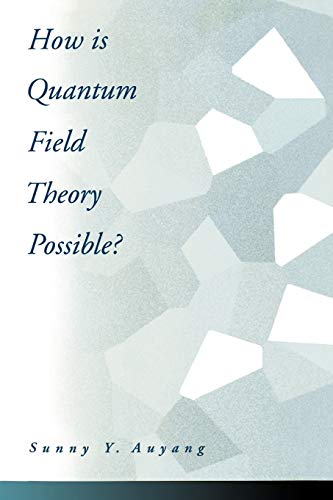
Ebook Info
- Published: 1995
- Number of pages: 288 pages
- Format: PDF
- File Size: 21.92 MB
- Authors: Sunny Y. Auyang
Description
Quantum field theory (QFT) combines quantum mechanics with Einstein’s special theory of relativity and underlies elementary particle physics. This book presents a philosophical analysis of QFT. It is the first treatise in which the philosophies of space-time, quantum phenomena, and particle interactions are encompassed in a unified framework. Describing the physics in nontechnical terms, and schematically illustrating complex ideas, the book also serves as an introduction to fundamental physical theories. The philosophical interpretation both upholds the reality of the quantum world and acknowledges the irreducible cognitive elements in its representation. The interpretation is based on an analysis of our ways of thinking as the are embedded in the logical structure of QFT. The author argues that philosophical categories are significant only if they play active and essential roles in our knowledge and hence constitute part of the theories in actual use. Thus she regardsphysical theories as primary, extracts their categorical structure, and uses it to rethink key philosophical questions. Among the questions this book tries to answer are: What are the quantum properties independent of measurements? How do we refer to individual things in a continuous field? How do theories relate to objects? What are the general conditions of the world and of our ways of thinking that make possible our knowledge of the microscopic realm, which is so intangible and counterintuitive? As a penetrating analysis of vital themes in contemporary science, the book will engage the interest of students and professionals in physics and philosophy alike.
User’s Reviews
Editorial Reviews: Review “The union of quantum mechanics and special relativity and its importance to the basic structure of the physical world.”–Science & Spirit From the Back Cover Quantum field theory (QFT) combines quantum mechanics with Einstein’s special theory of relativity and underlies elementary particle physics. This book presents a philosophical analysis of QFT. About the Author Sunny Y Auyang is at Massachusetts Institute of Technology. Read more
Reviews from Amazon users which were colected at the time this book was published on the website:
⭐This is not a recent book concerning quantum field theory, but it is still very worthwhile to read. The author assumes a basic knowledge of physics, mathematics and philosophy, so it is addressed, I would say, to a rather narrow audience. Also, the philosophical content is very substantial, as Dr. Auyang is considering the question of how the theory is possible, which is not directly oriented toward science and mathematics. I think that for someone like myself who happens to have basic backgrounds in physics, mathematics and philosophy, the book is very interesting. I especially appreciated her use of fibre bundles and differential geometry as a unifying framework for all of physics, as it is very simple (once one gets over the initial hurdle of understanding) and gives very informative visual representations, without bringing in much in the way of mathematical formalism. I found her points of view to be, quite frequently, fairly subtle and almost always well thought out and clearly delineated. She has produced a brilliant work here, that is still meaningful after more than 20 years since its publication. I strongly recommend this book for philosophers who have very good backgrounds in physics. Her delineation of classical arguments related to Aristotle, Leibniz, Hume, and Kant are especially appealing.
⭐I desire an overview of QFT separately from its mathematical formalism. There are very few books in this area, so we can appreciate Auyang as one of them. I did learn some things I wished to know, but someone needs to take it much further.
⭐This is probably the most sophisticated conceptual and philosophical treatment of both quantum theory and quantum field theory in the literature today.
⭐Wow. For the sake of emphasis I will say it again, Wow!Before getting into any meaty discussions on quantum mechanics, we all should recall Feynman’s words, ” no one understands quantum mechanics, and if they tell you they do, they are lying.”This is a perfect book for anyone that made it through grad school in physics, and still loves quantum mechanics. It is not one of these toned-down books that uses hand waving and poetry to bring quantum to the masses. This is a scholarly, thoughtful, thoroughly researched and referenced, nuts and bolts, exercise-left-to-the-reader book. It will leave you wishing you knew more about quantum. Sunny Auyang does not preach, she does not claim to know everything. She invites you into her thinking, welcomes you too to explore quantum. H.G. Wells invites us in to explore the full ramifications of his era’s world view, for example in his Time Machine he brings us along to see what really are the logical conclusions one reaches by applying Darwinism to the future evolution of human society. Similarly, Ms Auyang has the courage to say, well, what if this part of the quantum theory really is true? Does anyone really understand the difference between eigenvalues and probability? What do stationary states tell about the nature of Time? And if QFD is self-referential, how far can we really trust the approximation solutions?Other articles are available at […]Note: about no one understanding quantum mechanics – this is a very good warning to all of us. If we broaden our bounds, we can certainly say that the truths explicated in quantum have been approached and explicated by men and women who are not 20th/21st century physicists. Any Truth (with a capital T) must be explicable by the scientist, the philosopher, the artists, and the religious person. Captial-T truth is above any human capacity, and will be approached, depending upon the time and place, sometimes nearer by the saint, sometimes nearer by the artist, sometimes the philosopher, sometimes the scientist. Much could be learned from quantum mechanics about the nature of time, space, and dimensions if we only new how to think about it all. Let us look briefly at the double slit experiment. The correct results are gotten only by assuming the photons actually travel all possible paths. You have to say it again, to really get the emphasis: actually traverse all possible paths. In this case it is a mistake to say “as if they traversed all possible paths”. There is no “as if” here. Quantum shows us the relations between levels. The human observer is on such a different time and space scale from the photon. Quantum shows us the relations between such different scales. To the human observer, the photons do actually traverse all possible paths. What do the photons see themselves doing? Quantum does not tell us this.I have much more to say about all this, but blogging is an inefficient way to go into it all. So if you want to know more, let me know.
⭐This book contains some good ideas, but large parts of it are too hard for me to get anything out of, both due to an assumption that the reader knows a good deal about quantum mechanics and due to a style which probably requires rereading most parts multiple times in order to decipher even those parts which don’t require an understanding of quantum mechanics.I was impressed by her explanation of how we should understand the uncertainty of position and momentum measurements. She says the quantum entities have genuine deterministic properties, but we shouldn’t try to think of position and momentum as properties of any persistent entities. They are properties associated with specific measurements. The properties of persistent entities such as atoms are mostly stranger than what we can measure, and measurements only give us indirect evidence of those properties.Her descriptions of coordinate systems used in quantum physics seem inconsistent with the impressions I got from Smolin’s Trouble with Physics. Smolin implies (but doesn’t clearly state) that quantum theory retains Newtonian background dependent coordinates. Auyang’s descriptions of quantum coordinate systems seem very different. It’s clear that I’ve only scratched the surface of what’s needed to understand these issues.
Keywords
Free Download How Is Quantum Field Theory Possible? 1st Edition in PDF format
How Is Quantum Field Theory Possible? 1st Edition PDF Free Download
Download How Is Quantum Field Theory Possible? 1st Edition 1995 PDF Free
How Is Quantum Field Theory Possible? 1st Edition 1995 PDF Free Download
Download How Is Quantum Field Theory Possible? 1st Edition PDF
Free Download Ebook How Is Quantum Field Theory Possible? 1st Edition