

Ebook Info
- Published: 2015
- Number of pages: 324 pages
- Format: PDF
- File Size: 5.31 MB
- Authors: Thomas Witelski
Description
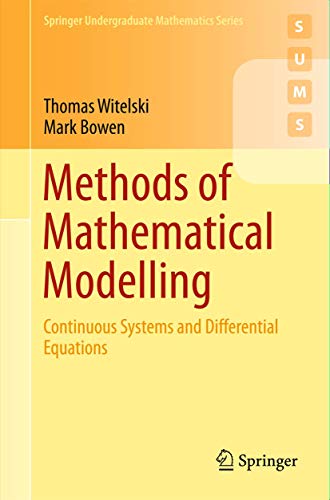
This book presents mathematical modelling and the integrated process of formulating sets of equations to describe real-world problems. It describes methods for obtaining solutions of challenging differential equations stemming from problems in areas such as chemical reactions, population dynamics, mechanical systems, and fluid mechanics.Chapters 1 to 4 cover essential topics in ordinary differential equations, transport equations and the calculus of variations that are important for formulating models. Chapters 5 to 11 then develop more advanced techniques including similarity solutions, matched asymptotic expansions, multiple scale analysis, long-wave models, and fast/slow dynamical systems.Methods of Mathematical Modelling will be useful for advanced undergraduate or beginning graduate students in applied mathematics, engineering and other applied sciences.
User’s Reviews
Editorial Reviews: Review “The text is well written. The authors have provided a clear and concise presentation of many important topics in a way that should be accessible to students following a first course in differential equations. … More advanced students could easily learn a significant amount of useful mathematics reading the text independently. … Methods of Mathematical Modelling is a welcome addition to the SUMS series and should prove to be useful for many instructors and students.” (Jason M. Graham, MAA Reviews, maa.org, February, 2016)“The purpose of this text is to introduce the reader to the art of mathematical modeling … . The book provides an account of a number of useful for mathematical modelling techniques which are illustrated with examples and complemented with problems for self study.” (Yuriy V. Rogovchenko, zbMATH 1333.00025, 2016) From the Back Cover This book presents mathematical modelling and the integrated process of formulating sets of equations to describe real-world problems. It describes methods for obtaining solutions of challenging differential equations stemming from problems in areas such as chemical reactions, population dynamics, mechanical systems, and fluid mechanics.Chapters 1 to 4 cover essential topics in ordinary differential equations, transport equations and the calculus of variations that are important for formulating models. Chapters 5 to 11 then develop more advanced techniques including similarity solutions, matched asymptotic expansions, multiple scale analysis, long-wave models, and fast/slow dynamical systems.Methods of Mathematical Modelling will be useful for advanced undergraduate or beginning graduate students in applied mathematics, engineering and other applied sciences. About the Author Thomas Witelski is a Professor of Mathematics at Duke University specializing in nonlinear partial differential equations and fluid dynamics. He is a long-time participant in many study groups on mathematical modelling and industrial problems. He is the co-Editor-in-Chief of the Journal of Engineering Mathematics and also serves on the editorial board for the European Journal of Applied Mathematics. Witelski received his Ph.D. in Applied Mathematics from the California Institute of Technology in 1995 and was a postdoctoral fellow at the Massachusetts Institute of Technology.Mark Bowen is an Associate Professor in the International Center for Science and Engineering Programs at Waseda University, where he teaches courses in differential equations and nonlinear dynamics. His expertise is in asymptotic analysis, nonlinear differential equations and fluid dynamics. He received his Ph.D. in Applied Mathematics in 1998 from the University of Nottingham. Read more
Reviews from Amazon users which were colected at the time this book was published on the website:
⭐Here I am no expert, but I appreciate the info the book provided. I got it because of the sections on the pi theorem and on similarity solutions. It did not disappoint. Helpful worked out examples.
⭐Great book for students of mathematical modeling through differential equations. What I thought was fantastic:+Chapter on similarity solutions and the few examples provided (highly relevant examples!)What I had a tough time understanding on the first go:-Chapter on Scaling analysis and Buckingham Pi theorem. Takes a bit of meditation, particularly the section on Buckinghams pi theorem, which is required to read the chapter on similarity solutions. Perhaps this could also have been explained in terms of more specific rules as published in fluid mechanics textbooks? (how to organize PI numbers and groups).I had the opportunity to listen to either Dr.Witelski or members of his research group at one of the APS meetings a good half a decade ago and that prompted me to obtain this book through my university’s library.—Beginning career teaching track faculty in Mechanical engineering
Keywords
Free Download Methods of Mathematical Modelling: Continuous Systems and Differential Equations (Springer Undergraduate Mathematics Series) in PDF format
Methods of Mathematical Modelling: Continuous Systems and Differential Equations (Springer Undergraduate Mathematics Series) PDF Free Download
Download Methods of Mathematical Modelling: Continuous Systems and Differential Equations (Springer Undergraduate Mathematics Series) 2015 PDF Free
Methods of Mathematical Modelling: Continuous Systems and Differential Equations (Springer Undergraduate Mathematics Series) 2015 PDF Free Download
Download Methods of Mathematical Modelling: Continuous Systems and Differential Equations (Springer Undergraduate Mathematics Series) PDF
Free Download Ebook Methods of Mathematical Modelling: Continuous Systems and Differential Equations (Springer Undergraduate Mathematics Series)