

Ebook Info
- Published: 2004
- Number of pages: 175 pages
- Format: PDF
- File Size: 17.83 MB
- Authors: Edward Bernays
Description
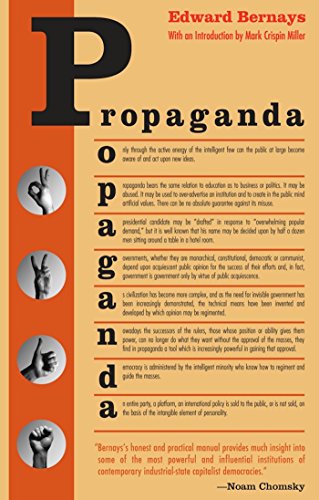
“Bernays’ honest and practical manual provides much insight into some of the most powerful and influential institutions of contemporary industrial state capitalist democracies.”—Noam Chomsky“The conscious and intelligent manipulation of the organized habits and opinions of the masses is an important element in democratic society. Those who manipulate this unseen mechanism of society constitute an invisible government which is the true ruling power of our country.”—Edward BernaysA seminal and controversial figure in the history of political thought and public relations, Edward Bernays (1891–1995), pioneered the scientific technique of shaping and manipulating public opinion, which he famously dubbed “engineering of consent.” During World War I, he was an integral part of the U.S. Committee on Public Information (CPI), a powerful propaganda apparatus that was mobilized to package, advertise and sell the war to the American people as one that would “Make the World Safe for Democracy.” The CPI would become the blueprint in which marketing strategies for future wars would be based upon.Bernays applied the techniques he had learned in the CPI and, incorporating some of the ideas of Walter Lipmann, as well as his uncle, Sigmund Freud, became an outspoken proponent of propaganda as a tool for democratic and corporate manipulation of the population. His 1928 bombshell Propaganda lays out his eerily prescient vision for using propaganda to regiment the collective mind in a variety of areas, including government, politics, art, science and education. To read this book today is to frightfully comprehend what our contemporary institutions of government and business have become in regards to organized manipulation of the masses.
User’s Reviews
Reviews from Amazon users which were colected at the time this book was published on the website:
⭐you MUST read this book. No joke.I highly recommend reading this. The author literally invented propaganda and wrote the book on it. It’s an eye opener. Once you read it you more readily see how we’re all being influenced, brainwashed, and manipulated, constantly. This guy explains what he’s figured out in plain terms and how to use it. It’s a short book.Of course, when I try to tell people about things like this they’re certain that I’m not only stupid but crazy on top of it..Oh, and did I mention he was a close relative of Sigmund Freud? What a coincidence, huh??
⭐This work from 1922 explains the new ‘science’ of propaganda discovered in WW1. They found the ability of professionals to persuade the populace to die and suffer for – What?”From his observations on the Allied propaganda drives’ immense success (and his own stint as a U.S. war propagandist), and from his readings of Gustave LeBon, Graham Wallas and John Dewey, among others, Lippmann had arrived at the bleak view that “the democratic El Dorado” is impossible in modern mass society, whose members—by and large incapable of lucid thought or clear perception, driven by herd instincts and mere prejudice, and frequently disoriented by external stimuli—were not equipped to make decisions or engage in rational discourse.”(I just read Gustave Le Bon’s “The Crowd: A Study Of the Popular Mind”. Great!)Wow! Society ”incapable of lucid thought”. Now what?” ‘Democracy’ therefore requires a supra-governmental body of detached professionals to sift the data, think things through, and keep the national enterprise from blowing up or crashing to a halt. Although mankind surely can be taught to think, that educative process will be long and slow. In the meantime, the major issues must be framed, the crucial choices made, by ‘the responsible administrator.’ ”Requires a ”supranational governmental body”! Who is that? “It is on the men inside, working under conditions that are sound, that the daily administration of society must rest.” While Lippmann’s argument is freighted with complexities and tinged with the melancholy of a disillusioned socialist, Bernays’s adaptation of it is both simple and enthusiastic:“We are governed, our minds are molded, our tastes formed, our ideas suggested, largely by men we have never heard of.””These “invisible governors” are a heroic elite, who coolly keep it all together, thereby “organizing chaos,” as God did in the Beginning.“It is they who pull the wires which control the public mind, who harness old social forces and contrive new ways to bind and guide the world.” While Lippmann is meticulous—indeed, at times near-Proustian—in demonstrating how and why most people have such trouble thinking straight, Bernays takes all that for granted as “a fact.”‘Pull the wires on the puppets!’ What? As God did? Who is this?”It is a sort of managerial aristocracy that quietly determines what we buy and how we vote and what we deem as good or bad.“They govern us,” the author writes, “by their qualities of natural leadership, their ability to supply needed ideas and by their key position in the social structure.”Man . . . this is . . . bad . . . right? It . . . is . . . so . . . scary!I – ORGANIZING CHAOSII – THE NEW PROPAGANDAIII – THE NEW PROPAGANDISTSIV – THE PSYCHOLOGY OF PUBLIC RELATIONSV – BUSINESS AND THE PUBLICVI – PROPAGANDA AND POLITICAL LEADERSHIPVII – WOMEN’S ACTIVITIES AND PROPAGANDAVIII -PROPAGANDA FOR EDUCATIONIX – PROPAGANDA IN SOCIAL SERVICEX – ART AND SCIENCEXI – THE MECHANICS OF PROPAGANDAWW1 changed everything -”It was not until 1915 that governments first systematically deployed the entire range of modern media to rouse their populations to fanatical assent. Here was an extraordinary state accomplishment: mass enthusiasm at the prospect of a global brawl that otherwise would mystify those very masses, and that shattered most of those who actually took part in it. The Anglo-American drive to demonize “the Hun,” and to cast the war as a transcendent clash between Atlantic “civilization” and Prussian “barbarism,” made so powerful an impression on so many that the worlds of government and business were forever changed.”Propaganda now rules!”Today, however, a reaction has set in. The minority has discovered a powerful help in influencing majorities. It has been found possible so to mold the mind of the masses that they will throw their newly gained strength in the desired direction. In the present structure of society, this practice in inevitable. Whatever of social importance is done today, whether in politics, finance, manufacture, agriculture, charity, education, or other fields, must be done with the help of propaganda.”‘Minority dominates the majority’! Mold the mind of the ‘masses’!Wow!”Propaganda is the executive arm of the invisible government. Universal literacy was supposed to educate the common man to control his environment. Once he could read and write he would have a mind fit to rule. So ran the democratic doctrine. But instead of a mind, universal literacy has given him rubber stamps, rubber stamps inked with advertising slogans, with editorials, with published scientific data, with the trivialities of the tabloids and the platitudes of history, but quite innocent of original thought.”‘Education kills original thought’! What deceit! How . . . so . . . demeaning!”Each man’s rubber stamps are the duplicates of millions of others, so that when those millions are exposed to the same stimuli, all received identical imprints. It may seem an exaggeration to say that the American public gets most of its ideas in this wholesale fashion. The mechanism by which ideas are disseminated on a large scale is propaganda, in the broad sense of an organized effort to spread a particular belief or doctrine.”‘Everyone approves . . . wants . . . believes . . . exactly the same thing! Even if destructive!The balance of this book explains how this new ‘propaganda’ can/does function.Fascinating!(Rebecca Goldstein notes in her book on Gödel – ”He came to believe that there was a vast conspiracy, apparently in place for centuries, to suppress the truth “and make men stupid.” Those who had discovered the full power of a priori reason, men such as the seventeenth-century’s Leibniz and the twentieth-century’s Gödel, were, he believed, marked men.” (Is this so different than Bernays? One sophisticated influence peddler, the other an ivory tower world famous logician! Amazing!)(See – ”Propaganda: The Formation of Men’s Attitudes”, by Jacques Ellul. This focuses on the psychological/philosophical basis of propaganda. Outstanding!)
⭐First of all, the book is outdated. The mediums for disseminating ideas at the time were mainly newspapers and radio. This should not be a problem since group psychology hasn’t changed, and it can be manipulated by any medium. But the problem is Bernays scarcely touches on the research of Wallas and Lippman, and the science behind group manipulation.Instead he plods through on case by case examples of manipulation, focusing on the mechanics of it but not the psychology behind it.And the book crashes and burns – or at least, shows how outdated and thus irrelevant it is now – when he gives high praise to newspaper Editors for their independence and impartiality. A sampling:“It [typical American newspaper] does not ask whether a given item is propaganda or not. What is important is that it be news. And in the selection of news the editor is usually entirely independent. In the New York Times – to take an outstanding example – news is printed because of its news value and for no other reason. Times’ editors determine with complete independence what is and what is not news. They brook no censorship. They are not influenced by external pressure nor swayed by any values of expediency or opportunism.”Reading that is enough to make you barf. Nowadays, nothing could be further from the truth.
⭐Was a good book. but not what I thought it was going to be as far as content.
⭐The book prompted me to think deeper about every purchase decision, social interaction, and consumed news.I’ve read my fair share of sales and marketing books, and well familiar with the concept of purchasing decision based in emotions, impulses, habits, and group think. I’m also familiar with various cognitive biases, such as confirmation bias, selection bias, and illusion of control. So the book didn’t change my world, but rather confirmed and systematized what I already knew. The book provided theoretical underpinning of propaganda: how it came about in a complex and constantly evolving society a century ago, and where it evolved to by now. How propaganda methods started being used in political campaigns, continued into routine way of doing business in large corporations (aka public relationship), and permeated every sales & marketing strategy, and social media by now.The book starts with the phrase: “The conscious and organized manipulation of the organized habits and opinions of the masses is an important element in democratic society”. So there is nothing wrong with propaganda per se. It’s just a way to manage complex society by applying well-hidden selective filtering, and a means to organize chaos.Writing this review at the end of tumultuous 2020, the COVID19 year, it’s interesting to reflect on the events on the society thru the lens of propaganda. What is objective information, and what are hidden influences, manipulations, half-truths, or plain lies. Well, time will tell. And this book is going to be helpful as well.
⭐Now more than ever we need to read this book. Our own media channels constantly bombard us with the”russian propaganda” story, whilst claiming their unbiased, objective stance.Once you read this book, you will see who is telling the truth and who is in control of propaganda.
⭐This is one of those books that I’ve wanted to read for years, as a primary reference to understand how the world really operates. It’s great to read books and to watch documentaries which talk about these things, but you can only truly appreciate what’s going on around you when you go straight to the source. And Edward Bernays, the early 20th century propagandist who used the psychological insights of his uncle, Sigmund Freud, to transform the propaganda industry into what we now call “public relations”, is one of the most crucial primary sources. Interest on his life and work have been reinvigorated within recent years, due to activists such as Noam Chomsky citing him as a pivotal spearhead of the Big Brother society, and an award winning BBC documentary by Adam Curtis, `Century of the Self’.This short book, `Propaganda’, is essentially propaganda for propaganda. By the 1920s, the once neutral word “propaganda” had been tainted with the same connotations it still has until now. Bernays, a professional propagandist, tasked himself with the mission of giving acceptability back to what he considered a legitimate advertising technique. This was back before he would realise that the word would never become fashionable again, replacing it with “public relations”, or P.R.(opaganda). And, so, this short book acts essentially as an advertisement for “educated Americans”, to teach them of the value of propaganda. The first half of the book is basically an apology for propaganda, and the wise men behind the scenes that we have “consented” to employ it for “our own good”, to sway our opinions into the right direction and to prevent chaos from ensuing as a result of having no wise guidance in our lives. The second half is more of a practical manual of how propaganda can be successfully utilised in areas of business, politics, education, and others. While I found the first half more interesting, the second half is surprisingly relevant to today’s seemingly far removed world from the 1920s, when this book was written.In many ways, Edward Bernays’ `Propaganda’ is not as sinister as I had expected it to be. Bernays seems convinced that propaganda is a natural and unavoidable part of life, and he makes many convincing arguments to back up this assertion (though he is a master propagandist, so it’s no surprise that his outlook seems convincing). Furthermore, he continually reminds his readers of their ethical duty to tell the truth and to not mislead the people whose thoughts they wish to sway to their cause. Nor did Bernays, like the propagandists who would come after him, seem to believe that the masses are brainless idiots (or, if he did believe this to be so, he didn’t even so much as allude to that opinion within these pages). Bernays, it seems, dreamed of a world in which an unseen group of benevolent wise men would guide mankind, through propaganda, into making rational choices for the good of society. However, the role of today’s advertising and P.R. world, which Bernays breathed into existence, is (as Noam Chomsky explains) to hurl the masses into making irrational decisions, the complete opposite of what Bernays seemed to have stood for.Edward Bernays’ `Propaganda’ offers a valuable insight into how our collective minds function, and the mentality of those who are really pulling the strings in society (the advertisers, big business leaders, as well as prominent politicians) think of us. To fully appreciate this book, read it in conjunction with some of Noam Chomsky’s numerous works on media manipulation, and watch Adam Curtis’s `Century of the Self’.
⭐This book, despite being a slim volume, is THE text on marketing techniques, written by the grand-master of the field. From making smoking socially acceptable and an ‘image’ (See Marlborough Man etc.) to selling Bacon (formerly a nearly unsellable stew dish the US meat industry had a problem with) as a breakfast mainstay, Bernays took all that he had discerned; acquired and formulated it all in to a Stratagem which is either quoted or simply Plagiarised with spangly bits on top.Though structured as part historical dialogue, leading into discourse of situation – solution, Bernays never leaves sight of the amalgamation of social sciences; psychology/psychiatry and geo-political nuances and ideologies; mythologies all tightly combined into an easy to read treatise on ‘Deliver the goods and more’.It is little wonder why this work resides on nearly every book shelf of the global elite.
⭐Bernays is clearly using this book to further the aims of himself and the industry he represents. It is however an interesting historical document showing the genesis of modern US style propaganda-that which we now term ‘marketing’ ‘image making’ and ‘public relations’. The book displays little of the authors own personality, but it’s amusing to notice how he has been propagandised into believing that a scientific solution to everything. His world seems black and white and filled with the naivety of American idealism, but that may well be just part of the propaganda he wants to push. Perhaps he doesn’t want to reveal too much which might distract from the message and therefore remains aligned with the general public mood of the time.It’s a way marker of its time-just as Bill Gates created an idea in the minds of the public about the potential of personal computing-so Bernays lays out the value of propaganda in the 20th century. Several times in the book he warns of the potential ‘misuse’ of propaganda, but he probably couldn’t have imagined just how much the American ideal would be changed by the very propaganda he was promoting.
⭐Judging by the title of the book and it’s reviews I was expecting to read a concise instructional work on how to emit and broadcast propaganda for your own ends. The author is well received by a lot of marketing professionals and I because of it’s utilitarian cover I was expecting something like a training guide but it’s not, I found it a little long winded, obfusc and self indulgent, but in some was its generality works in a way that involves the whole of humanity not just people who think they want to launch a propaganda campaigns. Instead of a flatpack with easy to assemble instructions I got a packet of seeds, easy to throw away and might take a little nurturing, but no doubt it will be enjoyable to watch them grow, and now for some light relief
⭐Last Seen in Bangkok
Keywords
Free Download Propaganda in PDF format
Propaganda PDF Free Download
Download Propaganda 2004 PDF Free
Propaganda 2004 PDF Free Download
Download Propaganda PDF
Free Download Ebook Propaganda