

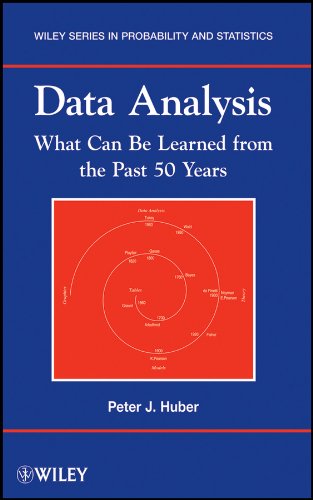
Ebook Info
- Published: 2012
- Number of pages: 302 pages
- Format: PDF
- File Size: 9.36 MB
- Authors: Peter J. Huber
Description
This book explores the many provocative questions concerning the fundamentals of data analysis. It is based on the time-tested experience of one of the gurus of the subject matter. Why should one study data analysis? How should it be taught? What techniques work best, and for whom? How valid are the results? How much data should be tested? Which machine languages should be used, if used at all? Emphasis on apprenticeship (through hands-on case studies) and anecdotes (through real-life applications) are the tools that Peter J. Huber uses in this volume. Concern with specific statistical techniques is not of immediate value; rather, questions of strategy – when to use which technique – are employed. Central to the discussion is an understanding of the significance of massive (or robust) data sets, the implementation of languages, and the use of models. Each is sprinkled with an ample number of examples and case studies. Personal practices, various pitfalls, and existing controversies are presented when applicable. The book serves as an excellent philosophical and historical companion to any present-day text in data analysis, robust statistics, data mining, statistical learning, or computational statistics.
User’s Reviews
Reviews from Amazon users which were colected at the time this book was published on the website:
⭐I really wanted to like this, but this is just a bunch of disparate material thrown together, much of it incredibly dated (yet without historical value) – e.g. an entire chapter on when data is or is not “big” – and with very little advice for practicing statisticians.
⭐Peter Huber is a statistician of unusual range as well as impressive depth. He early made a mark with major theoretical results in robust statistics and quickly became a leader in that field, but both before and afterwards his interests extended to serious data analysis and statistical computing. From time to time he has published more discursive papers reflecting on statistical theory and practice. Several of these are collected here with some new material as of 2011. Just as this book was not bang up-to-date in 2011, so also it has lost little value since then.Inevitably such collections are a little uneven and repetitive. But reading Huber easily repays the effort. It is hard to imagine anyone with a strong interest in statistical science who will not find many small gems here, whether it is a standard point neatly put or a provocatively different view. Occasionally, you will think Huber wrong-headed, but this is not a field for infallible gurus. His views on what is under-valued and what is over-sold in statistical science, and in statistical computing, remain fresh and usually bang on target.Huber is formidably well-read across many disciplines. A strong surprise for me was how well Clausewitz’s writings on war apply to statistical strategy. Some detailed examples are hard to follow if you don’t have the subject-matter expertise, but most are simple and effective. A recurrent difficulty is an assumption that the reader is aware of ISP, later PC-ISP, a very well thought out language for statistical computing, which seems to have peaked in popularity in the early 1990s before fading away quite rapidly. Too late now, but just a few pages of explanation and examples of PC-ISP philosophy and syntax would have helped.Although Huber is an articulate and witty writer, he was slightly let down by the publishers. who let through some quirky punctuation and unidiomatic phrasing, but it is easy enough to read through those. This is a resource to be mined for apposite quotations.There is no cross-reference for either, but anyone interested in the book should check out the interview with Huber published in Statistical Science and the review posted on Andrew Gelman’s blog.
Keywords
Free Download Data Analysis: What Can Be Learned From the Past 50 Years (Wiley Series in Probability and Statistics Book 874) 1st Edition in PDF format
Data Analysis: What Can Be Learned From the Past 50 Years (Wiley Series in Probability and Statistics Book 874) 1st Edition PDF Free Download
Download Data Analysis: What Can Be Learned From the Past 50 Years (Wiley Series in Probability and Statistics Book 874) 1st Edition 2012 PDF Free
Data Analysis: What Can Be Learned From the Past 50 Years (Wiley Series in Probability and Statistics Book 874) 1st Edition 2012 PDF Free Download
Download Data Analysis: What Can Be Learned From the Past 50 Years (Wiley Series in Probability and Statistics Book 874) 1st Edition PDF
Free Download Ebook Data Analysis: What Can Be Learned From the Past 50 Years (Wiley Series in Probability and Statistics Book 874) 1st Edition