

Ebook Info
- Published: 2016
- Number of pages: 248 pages
- Format: PDF
- File Size: 6.85 MB
- Authors: Edmund Hlawka
Description
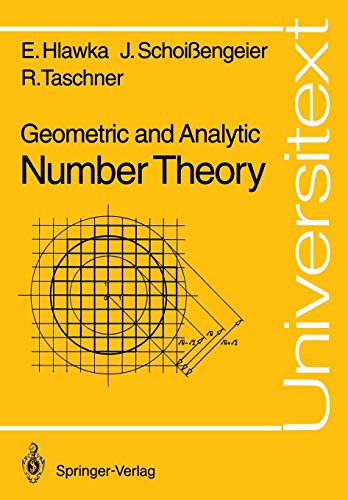
In the English edition, the chapter on the Geometry of Numbers has been enlarged to include the important findings of H. Lenstraj furthermore, tried and tested examples and exercises have been included. The translator, Prof. Charles Thomas, has solved the difficult problem of the German text into English in an admirable way. He deserves transferring our ‘Unreserved praise and special thailks. Finally, we would like to express our gratitude to Springer-Verlag, for their commitment to the publication of this English edition, and for the special care taken in its production. Vienna, March 1991 E. Hlawka J. SchoiBengeier R. Taschner Preface to the German Edition We have set ourselves two aims with the present book on number theory. On the one hand for a reader who has studied elementary number theory, and who has knowledge of analytic geometry, differential and integral calculus, together with the elements of complex variable theory, we wish to introduce basic results from the areas of the geometry of numbers, diophantine ap proximation, prime number theory, and the asymptotic calculation of number theoretic functions. However on the other hand for the student who has al ready studied analytic number theory, we also present results and principles of proof, which until now have barely if at all appeared in text books.
User’s Reviews
Reviews from Amazon users which were colected at the time this book was published on the website:
⭐Chapters 4-6 of this book would be a fine text for an undergraduate analytic number theory course. Students need to know some complex analysis but not that much; the authors don’t talk about analytic continuation anywhere that I saw and don’t use any advanced results like the Weierstrass product theorem, Jensen’s formula or the Phragmén-Lindelöf estimate. In fact an analytic number theory course using this book could be run concurrently with a complex analysis course. The authors present detailed calculations, and they seem to use less complex analysis than I remember in Davenport’s book, although I read that book line by line and have only read a few sections of this book in equal detail. Even for a course in elementary number theory that wanted to present a little analytic number theory, Chapter 4 would be an especially good resource. Each chapter has exercises and there are reasonably detailed solutions to all of them, which makes the book especially good for someone learning the subject on their own (Davenport’s book should only be read with a mentor or at least a reading partner.) The material is well organized.Chapter 4: This chapter presents results about the order and average order of arithmetic functions: the divisor function, the Euler totient function, the sum of divisors function, and r(n), the number of representations of n as a sum of two squares. The authors find the pole of the zeta function at s=1 using the Euler-Maclaurin summation formula. This chapter also introduces Dirichlet series. Using various manipulations including the Möbius inversion formula, it gets Dirichlet series for important functions like the logarithmic derivative of the zeta function. It also gives analytic results about the abscissa of convergence of a Dirichlet series. In the exercises it states the Fourier series for the periodic Bernoulli functions.Chapter 5: This chapter starts by proving Chebyshev’s theorem, and that the prime number theorem is equivalent to the Chebyshev function psi(x) being asymptotic to x. Using estimates for sums involving the von Mangoldt function that were proved as lemmas for Chebyshev’s theorem, the authors prove two estimates due to Mertens on the sums log(p)/p and 1/p. Their proof of the prime number theorem uses the Tauberian theorem of Newman. This leads to a clean proof of the prime number theorem, and the technique is of general interest rather than just being an ugly set of tricks to get to the goal. We still have to prove that zeta(1+it) is not 0 for nonzero t. They then prove the prime number theorem for the Gaussian integers, which could be skipped.Chapter 6: This chapter is a great introduction to character sums and Dirichlet L-functions. They present the Fourier transform on Z/n, i.e. the discrete Fourier transform, and express Dirichlet characters as Fourier series. They express Gauss sums G(n,chi) in terms of G(1,chi) multiplied by a Dirichlet character evaluated at n, show that the absolute value of the Gauss sum |G(n,chi)| is sqrt(m) if chi is a primitive Dirichlet character mod m, and use these two facts together with the Fourier transform to give a very direct and understandable proof of the Polya-Vinogradov inequality. To round off the chapter they give two proofs of quadratic reciprocity.
Keywords
Free Download Geometric and Analytic Number Theory (Universitext) in PDF format
Geometric and Analytic Number Theory (Universitext) PDF Free Download
Download Geometric and Analytic Number Theory (Universitext) 2016 PDF Free
Geometric and Analytic Number Theory (Universitext) 2016 PDF Free Download
Download Geometric and Analytic Number Theory (Universitext) PDF
Free Download Ebook Geometric and Analytic Number Theory (Universitext)