

Ebook Info
- Published: 2006
- Number of pages: 616 pages
- Format: PDF
- File Size: 9.31 MB
- Authors: Serge Haroche
Description
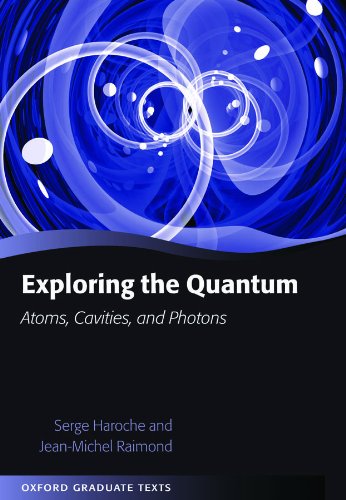
The counter-intuitive aspects of quantum physics have been long illustrated by thought experiments, from Einstein’s photon box to Schrödinger’s cat. These experiments have now become real, with single particles – electrons, atoms, or photons – directly unveiling the strange features of the quantum. State superpositions, entanglement and complementarity define a novel quantum logic which can be harnessed for information processing, raising great hopes forapplications. This book describes a class of such thought experiments made real. Juggling with atoms and photons confined in cavities, ions or cold atoms in traps, is here an incentive to shed a new light on the basic concepts of quantum physics. Measurement processes and decoherence at the quantum-classicalboundary are highlighted. This volume, which combines theory and experiments, will be of interest to students in quantum physics, teachers seeking illustrations for their lectures and new problem sets, researchers in quantum optics and quantum information.
User’s Reviews
Reviews from Amazon users which were colected at the time this book was published on the website:
⭐Before commencing with this text, avail oneself of the Nobel Prize winning lecture (2012) by Serge Haroche. After that lecture it is impossible to ignore this text. Indeed, this text is a goldmine of thought. A masterful combination of wit, insight, experiment and theory. No student, no instructor, no researcher should ignore what is here written. Ten chapters, from the first (a backward glance and survey) to the last (a brief look forward). Read: “As a general rule, the simpler the theoretical model the experiment can be reduced to, the more complex the experimental procedure.”Chapter two, its discussion of Linear Superposition, is itself worth the price of admission. We read: “…the Schrodinger equation does not correspond to the propagation of a real vibration in a material medium, or even a field, but describes the evolution of an abstract amplitude probability wave.” (page 32). That is worth repeating ! The student meets quantum teleportation which “exploits entanglement and non-locality” plus quantum computing (page 88).Chapters three and four provides groundwork for analyzing the behavior of open systems in quantum optics. Third chapter begins with the ever valuable harmonic oscillator, operation of quantum beam-splitters and Interferometers: “…in most cases not designed to illustrate Quantum Mechanics, but to measure precision optical phases.” (page 138).Fourth chapter, entitled, The Environment is Watching, spells out the properties of density operator; we read: “…approach can also be used to describe the imperfect system preparation, leading to fuzzy knowledge of the system’s initial state, even when no environment is involved.” (page 166). Finally, one is prepared to tackle cavity quantum electrodynamics: “physics of spin and an oscillator in interaction.” (page 231). An historical prelude, following which: perturbations, super-radiance and strong coupling. This fifth chapter, a detailed explication of many experiments along with qualitative considerations. Rydberg states given lucid exposition (pages 252-262). Next, the debt of modern day experiments due Einstein and Bohr is repaid. Again, a beautiful rendering is here presented. Read: ” The demolition of light quanta, though, is in no way required by quantum laws” and “Is it really the same photon that is inside the cavity at the end of the measurement, since it has been absorbed and re-emitted ? We should stress that such a question, natural in the macroscopic world, is meaningless in the quantum one.” (pages 298 and 326).Following that, Schrodinger and his cat. That is, optical cats: “One should still be cautious about trusting our intuition about photon numbers.” Wigner distribution functions prove invaluable for this chapter (appendix A.2 ) and proves to be a technically challenging discussion (see equation 7.131, master equation in Lindblad form, page 416).Chapter eight: Atoms in a Box; Ion Traps followed by quantum logic and quantum information. Much to assimilate. Ninth chapter: Entanglement and Matter Waves: “…new perspectives for fundamental research at the quantum-classical boundary.” A fifteen page bibliography provides further enrichment. A minor quibble: the index of the book is, unfortunately, lacking. A first course in quantum mechanics and mathematical proficiency will be your prerequisites.Concluding, a quote from earlier in the book: “This lack of objective reality of the wave function is a fundamental quantum feature.” (page 34).
⭐What a dandy book.Id suggest advanced undergraduates and graduates alike to use this text.Many little nuggets about! So very often while working through this text i came across a simple sentence that instantly unclouded my thinking on something or other.I definitely couldve made good use of this text in grad school!Worth every penny and one of my favorites in my library
⭐If you eat, drink, sleep, dream, and otherwise live thought-experiments-made-real in Quantum Physics, this book is for you.Deatiled qualitative discussions of experiments that have sought to shed-light or to othewrise expliucate further the counter-intuitive aspects of Quantum Physics, are given in this book.Heavy coverage of experiments on Spin systems and Caity electrodynamics.
⭐Written by a master … enough said
⭐I’m a first year PhD student of Superconducting quantum information hardware. I found this book illuminating, and it has been very helpful for me to learn the foundations of my field and the experiments in my lab. Would recommend to anyone who needs to learn about the implications of decoherence and quantum theory of cavities, ions and light-matter interactions.
⭐I only read the chapter called “The environment is watching”, and it was awfully pedestrian, sadly symptomatic of the practitioners of the theoretical aspects of the subject
⭐My previous review gave this book two stars. But after re-reading the first few chapters and looking up some missing pre-requisites in other textbooks, my opinion has changed. This book is quite well written and gives a lot of interesting details on the inner workings of the quantum world as applied to quantum optics and quantum information. The main theme of the book is on light matter interactions. With a strong background in (preferably at the graduate level) quantum mechanics and some classical electrodynamics, this book should be quite accessible and a pleasant but challenging read. My only complaint is that some concepts and results are stated without clear explanations and there are derivations missing important steps and makes it rather difficult for some students to follow. But as I mentioned if one is willing to grind through the equations and look up results elsewhere, the things will begin to make sense and the wonders of the quantum world will begin to unravel before their eyes.
⭐In spite of the weak comments on this book on your site, il’s exactly what I expected.
⭐Exemplaire en parfaite état si ce n’est la quatrième de couverture déchirée, certainement lors de la mise en colis vu l’aspect des dégâts …
Keywords
Free Download Exploring the Quantum: Atoms, Cavities, and Photons (Oxford Graduate Texts) 1st Edition in PDF format
Exploring the Quantum: Atoms, Cavities, and Photons (Oxford Graduate Texts) 1st Edition PDF Free Download
Download Exploring the Quantum: Atoms, Cavities, and Photons (Oxford Graduate Texts) 1st Edition 2006 PDF Free
Exploring the Quantum: Atoms, Cavities, and Photons (Oxford Graduate Texts) 1st Edition 2006 PDF Free Download
Download Exploring the Quantum: Atoms, Cavities, and Photons (Oxford Graduate Texts) 1st Edition PDF
Free Download Ebook Exploring the Quantum: Atoms, Cavities, and Photons (Oxford Graduate Texts) 1st Edition