

Ebook Info
- Published: 2008
- Number of pages: 334 pages
- Format: PDF
- File Size: 8.86 MB
- Authors: Klaas De Boer
Description
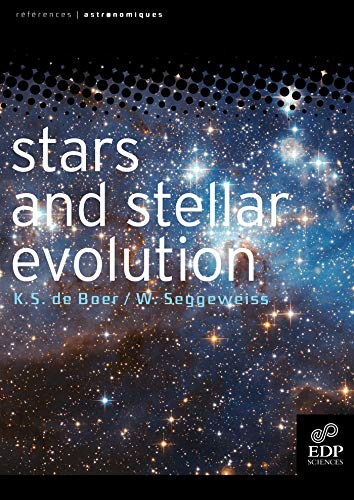
The diverse forms that stars assume in the course of their lives can all be derived from the initial conditions : the mass and the original chemical composition. In this textbook Stars and Stellar Evolution the basic concepts of stellar structure and the main roads of stellar evolution are described. First, the observable parameters are presented, which are based on the radiation emerging from a stellar atmosphere. Then the basic physics is described, such as the physics of gases, radiation transport, and nuclear processes, followed by essential aspects of modelling the structure of stars. After a chapter on star formation, the various steps in the evolution of stars are presented. This leads us to brown dwarfs, to the way a star changes into the red-giant state and numerous other stages of evolution and ultimately to the stellar ashes such as white dwarfs, supernovae and neutron stars. Stellar winds, stellar rotation and convection all infl uence the way a star evolves. The evolution of binary stars is included by using several canonical examples in which interactive processes lead to X-ray binaries and supernovae of type Ia. Finally, the consequences of the study of stellar evolution are tied to observed mass and luminosity functions and to the overall evolution of matter in the universe. The authors aim at reaching an understanding of stars and their evolution by both graduate students and astronomers who are not themselves investigating stars. To that end, numerous graphs and sketches, among which the Hertzsprung-Russell diagram is the dominant one, help trace the ways of stellar evolution. Ample references to specialised review articles as well as to relevant research papers are included.
User’s Reviews
Reviews from Amazon users which were colected at the time this book was published on the website:
⭐Extremely poorly printed. The typesetting is awful and the printing is so bad that I’m surprised it even passed quality control eye-checks. Most of the text is hugging the bottom of the page. I thought that I got a bad copy and had Amazon send me a new copy but the new one was worse! There are meant to be colour pictures of graphs, sun images and so on but it’s all poorly produced black and white images with much of the text as you see it in the images.I have no complaints of the authorship however
⭐This very affordable paperback of modest thickness is an excellent concise and very detailed primer on stellar evolution. All the observational facts are here, but without bogging the reader down with too much of the recondite physics of stellar interiors. This terse volume somewhat resembles an excellent set of university lecture notes, but it is also greatly padded out with ALL of the necessary details. It is not too maths heavy , and contains megatons of useful stellar data and HR diagrams! The factor that makes this book more approachable than the usual very physics-heavy text on stellar evolution is the fact that it presents the intricate and non-simplified details of how the many and various types of stars evolve, but mainly in terms of the observable quantities and their functional relations…..for instance: surface temperature, stellar mass, stellar luminosity, Color-magnitude diagrams, SEDs and spectra. So the necessary equations are there, but the pages of this book are not loaded with complex physics and mathematics.While aimed at a readership-level of upper level undergraduates, and above, in astronomy & physics, the book is understandable if you are a “resolute and undertaking character” that has already done the equivalent of a unit or two of rigorous physics at the university/advanced-college level and if you are also VERY comfortable with: functions and relations of variables, algebra, and the graphical display of numerical data. In addition, some calculus is necessary for a few hard sections. So, while fundamentally this is a densely-written and very highbrow text at the “complex technical level”, many individual pages only contain only a few, or even no, equations……but this book IS full of spectra, and color-magnitude and Hertzprung-Russell diagrams, and it contains very numerous graphs of the relations between various numerical parameters……for instance parameters such as Stellar mass, Stellar Surface Temperature and Radius, Stellar Luminosity, and time-elapsed since the formation of a star. Thus, this book takes fundamentally a descriptive, but also a “numerical and physics”, approach to explaining how stars of various types change with the passsage of time after their formation…..though for most of us ordinary mortals, this book will require some really serious study, and perhaps some struggle!Understanding this book will also be much easier for the sort of reader who has already read quite a number of astronomy books that are significantly more complex than “elementary & introductory popular-level astronomy books that gloss over details and oversimplify things”.There is also very concise, but remarkably cogent and detailed, coverage of topics such as stellar structure, the formation of stellar spectra, and nuclear fusion within stars. But the purpose of this book is more to describe, in great detail, what happens as stars evolve, instead of labouring away at developing all of the complex physics….. so this approach makes this text much more accessible to undergraduates in the physical sciences and to super-advanced amateur astronomers. But a word of warning here; this book will be much too hard for the average amateur astronomer.All in all, this is an excellent work….it is remarkably sophisticated and not oversimplified, and it is not somewhat out-of-date in the way that lower-undergraduate astronomy textbooks inevitably are. Instead of reading this complex and somewhat demanding book, you could instead read a very-simple descriptive text on stellar evolution, or you could read a lower-undergraduate astronomy textbook with “maximum handholding”……but it is far preferable to grapple with the intricate details of what is really going on by reading this book!
⭐One of the authors, Klaas de Boer, is well known to me. I think, he and his coauthor wrote an excellent book. Difficult theory is explained very clearly and all possible topics are covered.
⭐The quality of the print is very variable throughout the book, making some pages quite unconfortable to read (text not horizontal, too few ink so the text appears grey-ish instead of black). But the biggest problem lies in the cutting of the pages : to fit the format of the physical book, pages were cut extremely close to the text at the top and the bottom.Overall, the book itself is of poor quality, so much that I thought it came from an amateur printing shop.The content on the other hand is more than fine.
Keywords
Free Download Stars and Stellar Evolution in PDF format
Stars and Stellar Evolution PDF Free Download
Download Stars and Stellar Evolution 2008 PDF Free
Stars and Stellar Evolution 2008 PDF Free Download
Download Stars and Stellar Evolution PDF
Free Download Ebook Stars and Stellar Evolution