

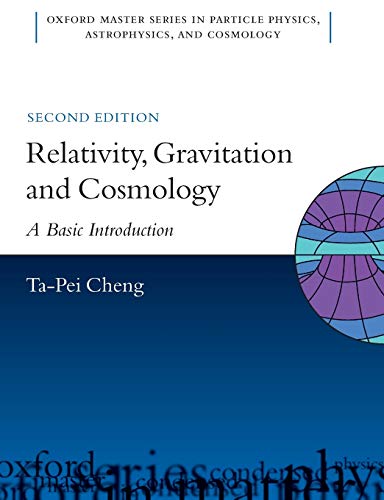
Ebook Info
- Published: 2010
- Number of pages: 456 pages
- Format: PDF
- File Size: 5.81 MB
- Authors: Ta-Pei Cheng
Description
Einstein’s general theory of relativity is introduced in this advanced undergraduate and beginning graduate level textbook. Topics include special relativity, in the formalism of Minkowski’s four-dimensional space-time, the principle of equivalence, Riemannian geometry and tensor analysis, Einstein field equation, as well as many modern cosmological subjects, from primordial inflation and cosmic microwave anisotropy to the dark energy that propels an accelerating universe.The author presents the subject with an emphasis on physical examples and simple applications without the full tensor apparatus. The reader first learns how to describe curved spacetime. At this mathematically more accessible level, the reader can already study the many interesting phenomena such as gravitational lensing, precession of Mercury’s perihelion, black holes, and cosmology. The full tensor formulation is presented later, when the Einstein equation is solved for a few symmetric cases. Many modern topics in cosmology are discussed in this book: from inflation, cosmic microwave anisotropy to the “dark energy” that propels an accelerating universe.Mathematical accessibility, together with the various pedagogical devices (e.g., worked-out solutions of chapter-end problems), make it practical for interested readers to use the book to study general relativity and cosmology on their own.
User’s Reviews
Editorial Reviews: Review The book “… is perhaps a bit modest in its title: Comprehensive rather than Basic is probably more appropriate. This second edition expands upon the 2005 textbook, which is a ‘Physics First’ presentation of relativity and cosmology.” — Journal of General Relativity & Gravitation (2011) 43:359-360. About the Author Ta-Pei Cheng is currently Emeritus Professor of Physics at the University of Missouri – St. Louis. He took his Ph.D. at Rockefeller University in 1969, followed by post-doctoral study at Rockefeller University and at the Institute for Advanced Study (Princeton). He has been on the faculty of University of Missouri – St. Louis from 1973 to the present day, and was elected a Fellow of the American Physical Society in 1982.
Reviews from Amazon users which were colected at the time this book was published on the website:
⭐Having spent lots of time over the years with many other intro GR books (incl. Hobson, Carroll, d’Inverno, A Most Incomprehensible Thing, Schutz, Zee), I like this one the best as an intro to the subject. At the very least it should be a go-to for a newcomer.The main reason is that this book, more than any other I’ve seen, focuses on symmetry. Not only is this the most beautiful/useful approach to relativity, but it also preps you well for similar concepts in other areas of physics, esp. gauge theories in particle physics. Indeed, I highly recommend checking out Cheng’s other (harder to find) book “Einstein’s Physics” for a highly pedagogical treatment of gauge theory and its structural similarity to GR. I.e. both get dynamics by postulating local coordinate symmetries.Beyond that, the notation is modern and clear, the figures are well-done and useful, and overall the explanations are as good or better than I’ve seen in other textbooks. The exposition of the geometric meaning of the Christoffel symbols is particularly illuminating. I also love the fact that Cheng gives a more basic treatment based on the metric line element before giving the full tensor apparatus toward the end of the book. To me, this is a nice way of offering the physics ‘punch-lines’ up front for those who don’t have time or need to dive into the full tensor formalism.This IS only an intro book, though. But for that purpose, it’s the best imo.
⭐I am a physics graduate student without pre-knowledge about GR, and I must say:This Ta-Pei’s book is MUCH better than Sean Carroll’s textbook <
⭐Let me preface this review by saying I majored in physics and finished college 14 years ago. I’ve always wanted to study GR but went to dental school right after college and so never got the chance. With the latest developments in cosmology, ie, dark flow, dark energy, dark matter, I finally couldn’t suppress my curiosity any longer. The framework for understanding cosmology is GR.I own the other GR books by Hartle, Schutz and Carroll. Each of them is more a textbook to accompany a lecture course than one for the self-taught.This book reads more like a novel. The author begins with why Einstein tackled the problem of generalizing special relativity and why that generalization would also be a theory of gravity (Equivalence Principle). The book includes a good intro to special relativiy (SR) at the intermediate college level. This is followed by Minkowski’s spacetime which is a deeper mathematical description of SR. From there, the next few chapters elucidate on the Metric tensor and the curvature of spacetime.After you’ve learned the Metric, there is a chapter on black holes and 3 chapters on cosmology (expanding universe, inflation, cosmic microwave background, the cosmological constant and how it can be used to take into account dark matter and dark energy, and much more). I particularly enjoyed the cosmology part of the book. It gives you a taste of how modern physicists are using GR to tackle the biggest questions in cosmology. And it gives you a break to absorb the theory before going deeper mathematically.The final part of the book gives a complete treatment of GR using tensors and ends with a chapter on gravity waves. This is the most difficult part of the book but as with the rest of the book, everything is well explained and there are no gaps in logic that would otherwise frustrate the autodidact.You must be willing to do some of the problems at the ends of each chapter. To get the most out of this book, you should read it with pencil and paper in hand. Solutions to the more difficult problems are provided in the back of the book which is great pedagogically.I would rank this up there with Shankar’s QM and Griffiths’ Intro to EM. It is by far the best intro book on GR out there.
⭐I’ve been preparing a short course on general relativity over the past year after after teaching special relativity. Yes I was using all the main classic texts by Weinberg, Wald, Schutz and the much referred to Misner, Thorne, Wheeler (though I find that a slog). To answer my questions on GR I usually had to read multiple books to piece the story together. Chang is different because it guides you through and fills in so many gaps that the other don’t. It’s such a well written book and I’d thoroughly recommend it for any undergraduate or postgraduate. There is only one other book that I’ve encountered that is perhaps as good if not better. That’s Hobson, Efstathiou and Lasenby’s General Relativity. That’s outstanding. There’s also Reflections on Relativity by Kevin Brown which complements all the above. But Chengs book is a must – I will be recommending it to students.
⭐This is the best book I have used on relativity. As suggested by one of the other reviewers it is an excellent follow on from Lambourne’s O,U. text and ,in many ways ,is rather better. I couldn’t make sense of some of the latter book without relying heavily on Fleisch’s Student Guide to Vectors and Tensors. This last is also a truly excellent text, which like Cheng’s and Lambourne’s provide full solutions to problems.Beware some other general relativity texts with problem solutions as these tend to rely on techniques not explained in text e.g. Walecka’s Introduction to GR.Cheng’s clarity of exposition is exemplary and his footnotes very informative. No steps in derivations are jumped or passed over with ‘just do this and this’ when following the recipe given is far from easy.
⭐This is a good introductory text to GR. The emphasis is on the physics, as highlighted by the fact that the full tensor development is left for Part IV, while parts II and III can be followed without getting bogged down in the maths.The main problem with this second edition is that it is plagued with errata: missing brackets, wrong signs and misspellings are common. There are also a few cases of incorrect equations. Fortunately, the reader can find an updated list of errata in the author’s website at the University of Missouri – St. Louis:[…]The list is long enough for me to regret having bought this 2nd edition. I rather had waited to a corrected third edition. I think buyers of the 2nd edition should be offered a refund (or at least a discount) when the 3rd edition is available.
⭐This book is aimed at the advanced undergraduate level and is a step up from the excellent books by Peter Collier and Robert Lambourne. It includes many questions with outline solutions, and each equation follows carefully from earlier results with related cross-references. I bought the paperback second edition as this has corrected the errors noted by another reviewer.
⭐1 again, a low-quality printing, this time the text is too clear, lacks ink (seems gray, instead of black)2 the packaging is so thin that it didn’t protect the book, which is slightly damaged in several places and in more than half the pages3 the first page is the table of contents, there is no proper printing information: title, printing house is Oxford Univ., ISBN, place, Library of Congress catalog info, etc.4 the covers should be pristine… seem used!Al
Keywords
Free Download Relativity, Gravitation and Cosmology: A Basic Introduction (Oxford Master Series in Physics, 11) 2nd Edition in PDF format
Relativity, Gravitation and Cosmology: A Basic Introduction (Oxford Master Series in Physics, 11) 2nd Edition PDF Free Download
Download Relativity, Gravitation and Cosmology: A Basic Introduction (Oxford Master Series in Physics, 11) 2nd Edition 2010 PDF Free
Relativity, Gravitation and Cosmology: A Basic Introduction (Oxford Master Series in Physics, 11) 2nd Edition 2010 PDF Free Download
Download Relativity, Gravitation and Cosmology: A Basic Introduction (Oxford Master Series in Physics, 11) 2nd Edition PDF
Free Download Ebook Relativity, Gravitation and Cosmology: A Basic Introduction (Oxford Master Series in Physics, 11) 2nd Edition