

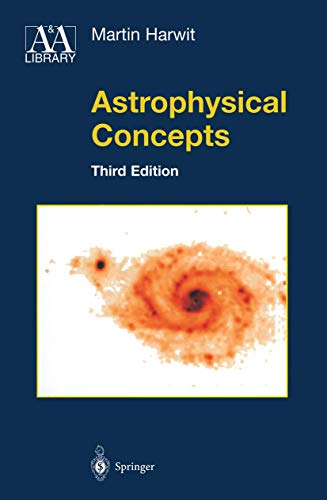
Ebook Info
- Published: 2000
- Number of pages: 651 pages
- Format: PDF
- File Size: 8.71 MB
- Authors: Martin Harwit
Description
This classic text, aimed at senior undergraduates and beginning graduate students in physics and astronomy, presents a wide range of astrophysical concepts in sufficient depth to give the reader a quantitative understanding of the subject. Emphasizing physical concepts, the book outlines cosmic events but does not portray them in detail: It provides a series of astrophysical sketches. For this third edition, nearly every part of the text has been reconsidered and rewritten; new sections have been added to cover recent developments, and most of the rest has been revised and brought up to date. The book begins with an outline of the scope of modern astrophysics and the elementary problems concerning the scale of cosmic objects and events. The basic physics needed to answer these questions is developed in the next chapters, using specific astronomical processes as examples. The second half of the book enlarges on the topics introduced at the beginning and shows how we can obtain quantitative insights into the structure and evolution of stars, the dynamics of cosmic gases, the large-scale behavior of the universe, and the origins of life.The emphasis is on astrophysics, so astronomical objects (white dwarfs, supernovae, comets, quasars) are mentioned throughout the text whenever the relevant physics is discussed rather than in individual sections. To compensate, there is an appendix that gives a brief background of astronomical concepts for students unfamiliar with astronomical terminology, as well as a comprehensive index. The extensive bibliography refers to other sources that treat individual topics in detail.
User’s Reviews
Editorial Reviews: From Scientific American Astronomer Harwit has finally updated his classic textbook to encompass the exciting developments of the decade since its last edition. It is ideal for those Scientific American readers who are mathematically literate and who want to pursue topics covered in the magazine to greater depth. Harwit takes a thematic approach to the subject, oriented around the guiding physical principles rather than the conventional sequence of planet, star, galaxy and cosmos. The approach rewards readers who just want to flip through the book as well as students who want to derive for themselves some of the basic equations in astronomy. Harwit also includes an idiosyncratic sampling of unorthodox topics such as faster-than-light particles, steady-state cosmology and panspermia. Review FROM REVIEWS OF THE PREVIOUS EDITION”a clear, solid introduction to astrophysics … that shows how physics can be applied to astronomical objects … One of the strong points is the problems (that) give students a real feel for the sort of calculations astronomers must do … were I teaching a junior/senior astrophysics course, this is the book I would use.” AMERICAN JOURNAL OF PHYSICS”This is a popular book among professional astrophysicists, produced with that meticulous detail and completeness of the house of Springer … This is indeed a theoretician’s book [and] Harwit has made a prodigious effort in organizing all this information in a logical sequence … A masterly mathematical exposition of a galaxy of astrophysical processes.” Astronomy
Reviews from Amazon users which were colected at the time this book was published on the website:
⭐What can I say? This text has been the “bible” of astrophysics (mainly used for the ‘backstory’ in further grasping the fundamentals of everything from Keplerian orbits, to stellar structure, to quantum processes as they apply to stars and nebulae and electromagnetic processes in space) for over 40 years.This book was indispensable to me when I took my first course in Stellar Structure and Evolution, then later on in providing essential details on E&M that proved highly beneficial to my first plasma physics and space physics courses in 1986, at grad level.I rate this book five stars as a perfect fit for a supplemental or supplementary text because that is how I have used it, i.e. in giving seminars on stellar evolution and radiative transfer. I especially liked his nice treatment of line profiles and equivalent width as well as the curve of growth, because while brief it’s very clear.His section on propagation of waves through ionized media is also terrifically done and very useful in conjunction with a plasma physics text like Francis Chen’s (see my previous review on it) say in a standard 1-year plasma physics course.In short, this is a text that no astrophysicist, or I’d say plasma physicist, should be without!
⭐I’m currently teaching a topics class on astrophysics to a collection of (mostly) senior level non-physics majors (engineers, math majors, computer scientists, etc) and had a lot of trouble trying to find an appropriate book. There are not many which are both (a) detailed, (b) broad, and (c) at the appropriate level. Most books for undergraduates are either too focused (i.e. on cosmology) or too elementary. Most of the comprehensive books are too advanced.This book strikes a nice balance between mathematical sophistication and generality, but it can be a little difficult to read in places, particularly for someone without a strong physics background. Since my class consists mostly of interested, advanced, non-physics majors I didn’t feel that the book meshed well with my class goals. However, the book did suit *me* very well and I’m using it extensively as a source of examples, additional problems and lecture preparation.I selected “Modern Astrophysics” by Carroll and Ostlie as the class text because it was a little more wordy and explanitory and because the “astrophysical sketch” approach taken in Harwitt’s book is fine for someone who has a strong background in physics (which is, after all, the intended audience) but not “user friendly” enough for advanced students from other fields.It was a tough choice though – this is an excellent book.
Keywords
Free Download Astrophysical Concepts 3rd Edition in PDF format
Astrophysical Concepts 3rd Edition PDF Free Download
Download Astrophysical Concepts 3rd Edition 2000 PDF Free
Astrophysical Concepts 3rd Edition 2000 PDF Free Download
Download Astrophysical Concepts 3rd Edition PDF
Free Download Ebook Astrophysical Concepts 3rd Edition