Ebook Info
- Published: 2009
- Number of pages: 322 pages
- Format: EPUB
- File Size: 0.37 MB
- Authors: Bertrand Russell
Description
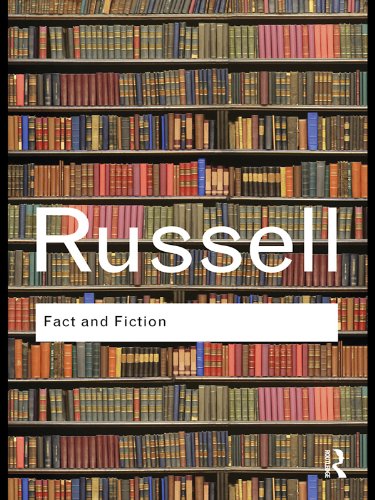
First published in 1961, Fact and Fiction is a collection of Bertrand Russell’s essays that reflect on the books and writings that influenced his life, including fiction, essays on politics and education, divertissements and parables. Also broaching on the highly controversial issues of war and peace, it is in this classic collection that Russell states some of his most famous pronouncements on nuclear warfare and international relations. It is a remarkable book that provides valuable insight into the range of interests and depth of convictions of one of the world’s greatest philosophers.
User’s Reviews
Reviews from Amazon users which were colected at the time this book was published on the website:
⭐The perfect gift for those who like to believe they know Russell incredibly well.
⭐Besides literary reviews (Shelley, Turgenev, Ibsen, Swift), B. Russell tackles in these short comments the crucial problems of our world: freedom, power, science, war and peace, truth or the real nature of mankind.Political, economic and mental freedomHolders of power, always and everywhere, are indifferent to the good or evil of those who have no power, except in so far as they are restrained by fear. Therefore, mankind needs democracy in order to break the monopoly of political power. Liberty cannot be secured without democratic elections. But within democracy, there should be tolerance against minorities cemented in laws.Economic freedom doesn’t mean `laissez-faire’. It consists in freeing man from economic compulsion. If a man is law-abiding and willing to work, he must not be allowed to starve. Laissez-faire cannot secure this result.Mental freedom means freedom of opinion, free discussion, free inquiry and free speculation. Education should promote the courage of dissent and free inquiry, and should combat the forces of militant ignorance.ScienceScience in itself is ethically neutral. It confers power, but for evil as much as for good. It has always had an intimate and sinister connection with war. If one wishes to exterminate the human race, it will show one how to do it. But, if Pythagoras, Galileo and James Watt had not existed, daily life would be profoundly different from what it is.War and peaceMilitarists have often been able to achieve their aims. History is a long series of imperialist conquests. Today, some who profess democracy admit that total war might end in total death. They are prepared to see the human race destroy itself rather than forgo the pleasures of fanaticism.But, wouldn’t it be better, instead of producing heaps of weapons of mass destruction, to lessen the load of poverty and malnutrition and to invest in real innovations in order to make the world happier?Mankind and hopeMankind descends from progenitors who exterminated their enemies, occupied their lands and grew rich. Man’s most effective ferocity is directed against his own species.But, B. Russell never lost hope: mankind can prosper and create a happy world, but only by unswerving courage in the pursuit of the truth, his shining goddess.Dangerous ideaB. Russell wants to install a world government with a monopoly for all armed forces.As K. Jaspers has said, `a world government with centralized power over the whole globe, holding the monopoly of all means of violence unchecked and uncontrolled by other sovereign powers, is not only a nightmare of tyranny, but also the end of all political life.’This formidable book, written by a superb free and independent mind, contains also incisive sarcastic satires and brilliant parables.A must read, certainly for all B. Russell fans.
⭐Bertrand Russell often gathered essays he thought would have lasting value, and published them as collections. This book not only has essays, but the text of talks he gave on the BBC. The topics are wide and disparate. He begins with books (and their authors) that made a deep impression on him while he was in his formative years. Then follow essays on politics, starting off with “What is Freedom?” and “What is Democracy?” — two basic questions that many people don’t even think about. The “Divertissement” section contains pieces of fiction. Russell stated that he found fiction a useful medium to express ideas he half-believed in, but had no firm grounds for belief. The last section is on “Peace and War,” and includes the famous Vienna and Manchester addresses on nuclear bombs. His style is incisive and pithy as usual. If you like Russell, you should not miss reading this book.
⭐Besides literary reviews (Shelley, Turgenev, Ibsen, Swift), B. Russell tackles in these short comments the crucial problems of our world: freedom, power, science, war and peace, truth or the real nature of mankind.Political, economic and mental freedomHolders of power, always and everywhere, are indifferent to the good or evil of those who have no power, except in so far as they are restrained by fear. Therefore, mankind needs democracy in order to break the monopoly of political power. Liberty cannot be secured without democratic elections. But within democracy, there should be tolerance against minorities cemented in laws.Economic freedom doesn’t mean `laissez-faire’. It consists in freeing man from economic compulsion. If a man is law-abiding and willing to work, he must not be allowed to starve. Laissez-faire cannot secure this result.Mental freedom means freedom of opinion, free discussion, free inquiry and free speculation. Education should promote the courage of dissent and free inquiry, and should combat the forces of militant ignorance.ScienceScience in itself is ethically neutral. It confers power, but for evil as much as for good. It has always had an intimate and sinister connection with war. If one wishes to exterminate the human race, it will show one how to do it. But, if Pythagoras, Galileo and James Watt had not existed, daily life would be profoundly different from what it is.War and peaceMilitarists have often been able to achieve their aims. History is a long series of imperialist conquests. Today, some who profess democracy admit that total war might end in total death. They are prepared to see the human race destroy itself rather than forgo the pleasures of fanaticism.But, wouldn’t it be better, instead of producing heaps of weapons of mass destruction, to lessen the load of poverty and malnutrition and to invest in real innovations in order to make the world happier?Mankind and hopeMankind descends from progenitors who exterminated their enemies, occupied their lands and grew rich. Man’s most effective ferocity is directed against his own species.But, B. Russell never lost hope: mankind can prosper and create a happy world, but only by unswerving courage in the pursuit of the truth, his shining goddess.Dangerous ideaB. Russell wants to install a world government with a monopoly for all armed forces.As K. Jaspers has said, `a world government with centralized power over the whole globe, holding the monopoly of all means of violence unchecked and uncontrolled by other sovereign powers, is not only a nightmare of tyranny, but also the end of all political life.’This formidable book, written by a superb free and independent mind, contains also incisive sarcastic satires and brilliant parables.A must read, certainly for all B. Russell fans.
Keywords
Free Download Fact and Fiction (Routledge Classics) 1st Edition in EPUB format
Fact and Fiction (Routledge Classics) 1st Edition EPUB Free Download
Download Fact and Fiction (Routledge Classics) 1st Edition 2009 EPUB Free
Fact and Fiction (Routledge Classics) 1st Edition 2009 EPUB Free Download
Download Fact and Fiction (Routledge Classics) 1st Edition EPUB
Free Download Ebook Fact and Fiction (Routledge Classics) 1st Edition