Ebook Info
- Published: 2009
- Number of pages:
- Format: PDF
- File Size: 4.12 MB
- Authors: John J. Benedetto
Description
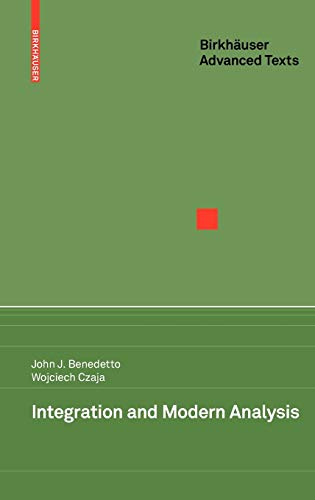
This textbook and treatise begins with classical real variables, develops the Lebesgue theory abstractly and for Euclidean space, and analyzes the structure of measures. The authors’ vision of modern real analysis is seen in their fascinating historical commentary and perspectives with other fields. There are comprehensive treatments of the role of absolute continuity, the evolution of the Riesz representation theorem to Radon measures and distribution theory, weak convergence of measures and the Dieudonné–Grothendieck theorem, modern differentiation theory, fractals and self-similarity, rearrangements and maximal functions, and surface and Hausdorff measures. There are hundreds of illuminating exercises, and extensive, focused appendices on functional and Fourier analysis. The presentation is ideal for the classroom, self-study, or professional reference.
User’s Reviews
Opiniones editoriales Review From the reviews:“This is one of the best graduate texts on real variables, measure theory and integration theory known to the reviewer. … The book is exceptionally accurate in up-to-date contents, structure of the text, comprehensibility and references (which is an excellent source for professionals). … In addition to the numerous illustrative examples and applications, [Integration and Modern Analysis] is replete with interesting remarks and historical notes contained either in the body of the text or in the ‘Potpurri and titillation’ section at the end of each chapter. … A subject Index, Index of Names, Index of Notation and a carefully prepared preface accompany this volume, being a useful guide to any reader. For teachers and for researchers, the book will prove a priceless resource, an avenue to new and often surprising ideas. Physically beautiful and elegantly printed, organized and written lucidly, this volume is a welcome addition and an important contribution to mathematical literature.” ―Mathematical Reviews (Grigore Ciurea, Romania)“Graduate analysis books are as common as tea served at department colloquia! Therefore, Integration and Modern Analysis by Benedetto and Czaja had better have something special to distinguish itself…Integration and Modern Analysis is not just your average cup of tea. Its goals go well beyond the usual prosaic objective of presenting rookie graduate students with a certain standard set of tools and skills in real analysis; Benedetto and Czaja aim to persuade the reader to their particular point of view and, indeed, to enlist him in their enterprise…Well, Benedetto and Czaja have a wonderful product to sell and are right in doing such enthusiastic preaching of their cause. Additionally, the exposition is solid, the book is loaded with exercises, and is dripping with the authors’ expertise. If you incline in this direction of analysis, Integration and Modern Analysis is unquestionably your cup of tea.” ―MAA Reviews (Michael Berg, Loyola Marymount University, Los Angeles, CA)“For the authors, the notion of ‘absolute continuity’, tracing back to Vitali, is basic for the whole theory as the unifying concept for all major results, such as the fundamental theorem of calculus, the Lebesgue dominated convergence theorem, and the Radon–Nikodým theorem. They find, that as yet in no textbook this point of view was carried through in an adequate way. Their text is intended as a remedy to the latter. As a consequence they include very carefully materials which are often omitted in monographs about real analysis and integration theory, such as Vitali’s necessary and sufficient conditions for interchanging limits and integrals, the Vitali–Hahn–Saks theorem, but also, quite unusually, Grothendieck’s theory of weak convergence of measures. The presentation of the material becomes most vivid by numerous remarks concerning the historical genesis, by biographical notes on the most important contributors, especially about Vitali, by discussion of problems, and by an excellent choice of examples and comments for motivation to an extent, that seem to be unique…All chapters end with sections (‘potpourri and titillations’) devoted to relations with other fields and problems intended for presenting new perspectives. This way a lot of information is provided and this makes the book interesting also for advanced study and for anybody interested in the field.” ―Zentralblatt MATH (Werner Strauß, Universität Stuttgart)“The aim of the present book is to emphasize how modern integration theory evolved from some classical problems in function theory, related mainly to Fourier analysis. … a nice book, containing a lot of results in measure theory and integration theory, making good connections between classical and modern ones. The lively style of exposition makes the reading both instructive and agreeable. It can be recommended … to students for self-study and to researchers in various domains of analysis as a reference text.” (S. Cobzaş, Studia Universitatis Babes-Bolyai, Mathematica, Vol. LV (4), December, 2010) From the Back Cover A paean to twentieth century analysis, this modern text has several important themes and key features which set it apart from others on the subject. A major thread throughout is the unifying influence of the concept of absolute continuity on differentiation and integration. This leads to fundamental results such as the Dieudonné–Grothendieck theorem and other intricate developments dealing with weak convergence of measures.Key Features:* Fascinating historical commentary interwoven into the exposition;* Hundreds of problems from routine to challenging;* Broad mathematical perspectives and material, e.g., in harmonic analysis and probability theory, for independent study projects;* Two significant appendices on functional analysis and Fourier analysis.Key Topics:* In-depth development of measure theory and Lebesgue integration;* Comprehensive treatment of connection between differentiation and integration, as well as complete proofs of state-of-the-art results;* Classical real variables and introduction to the role of Cantor sets, later placed in the modern setting of self-similarity and fractals;* Evolution of the Riesz representation theorem to Radon measures and distribution theory;* Deep results in modern differentiation theory;* Systematic development of weak sequential convergence inspired by theorems of Vitali, Nikodym, and Hahn–Saks;* Thorough treatment of rearrangements and maximal functions;* The relation between surface measure and Hausforff measure;* Complete presentation of Besicovich coverings and differentiation of measures.Integration and Modern Analysis will serve advanced undergraduates and graduate students, as well as professional mathematicians. It may be used in the classroom or self-study.
Reviews from Amazon users which were colected at the time this book was published on the website:
⭐This book does a particularly good job with differentiation and bounded variation. The space of functions of bounded variation deserves at least as much attention in a measure theory book as does the space of square-integrable functions, and a little less attention than the space of integrable functions. Indeed much of the early work in functional analysis had to do with measure theory questions like “Is the set of points at which an arbitrary function is differentiable a Borel set?” (The answer is yes.) I like that the authors are decently careful when they talk about a set being measurable: many books carelessly talk about a set being measurable without saying if they mean Borel measurable, i.e. in the smallest sigma algebra generated by the topology of a space, or Lebesgue measurable, which is defined following Carathéodory using outer measure. One way to see that this is confusing is that a beginner will say that a function is measurable if the inverse image of a measurable set is measurable, without specifying what sigma-algebra is being talked about; but this is *false* if we are talking about Lebesgue measurable sets. There is a good chapter on weak convergence of measures. When doing measure theory one often does not want to work merely with a single measure, but with, for example, push forwards of a measure by measurable functions, or sequences of measures. Finally, there is a pretty proof of a theorem of Khinchin in Diophantine approximation (Theorem 4.3.3): this is usually proved using the Borel-Cantelli lemma, but here it is proved using the fact that functions of bounded variation are differentiable almost everywhere.
⭐
⭐This textbook was required for a two-semester long graduate-level Real Analysis course at my university. Note that I only took the first semester of this course and have only read the first five chapters. If I could, I would give this book 3.5 stars.The book is incredibly dense and offers a comprehensive treatment of the subject. In some instances, the example problems cover important concepts to learn and help motivate many of the subsequent topics discussed in the book.However, the book’s primary drawback is that it is not written in a successive fashion, i.e. the book frequently refers to theorems or topics in *following* chapters that someone new to the material hasn’t read yet, so it is particularly difficult to follow if you don’t already know the material.Also, the subject index in the back is not very helpful. The Borel-Cantelli lemma is not featured in the index for example. I went ahead and secured a copy of the Royden/Fitzpatrick Real Analysis book to supplement this textbook because it is more clear on the high level concepts. On the plus side, reading a difficult book such as Benedetto has taught me how to learn independently by reading.
⭐
Keywords
Free Download Integration and Modern Analysis in PDF format
Integration and Modern Analysis PDF Free Download
Download Integration and Modern Analysis 2009 PDF Free
Integration and Modern Analysis 2009 PDF Free Download
Download Integration and Modern Analysis PDF
Free Download Ebook Integration and Modern Analysis