

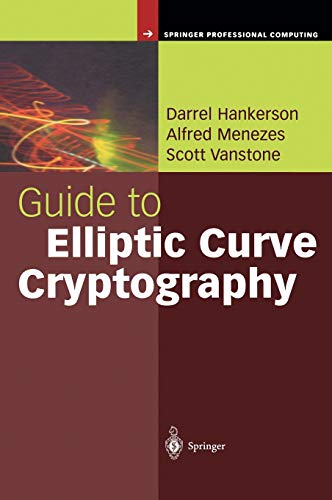
Ebook Info
- Published: 2004
- Number of pages: 332 pages
- Format: PDF
- File Size: 2.69 MB
- Authors: Darrel Hankerson
Description
After two decades of research and development, elliptic curve cryptography now has widespread exposure and acceptance. Industry, banking, and government standards are in place to facilitate extensive deployment of this efficient public-key mechanism. Anchored by a comprehensive treatment of the practical aspects of elliptic curve cryptography (ECC), this guide explains the basic mathematics, describes state-of-the-art implementation methods, and presents standardized protocols for public-key encryption, digital signatures, and key establishment. In addition, the book addresses some issues that arise in software and hardware implementation, as well as side-channel attacks and countermeasures. Readers receive the theoretical fundamentals as an underpinning for a wealth of practical and accessible knowledge about efficient application. Features & Benefits:* Breadth of coverage and unified, integrated approach to elliptic curve cryptosystems* Describes important industry and government protocols, such as the FIPS 186-2 standard from the U.S. National Institute for Standards and Technology* Provides full exposition on techniques for efficiently implementing finite-field and elliptic curve arithmetic* Distills complex mathematics and algorithms for easy understanding* Includes useful literature references, a list of algorithms, and appendices on sample parameters, ECC standards, and software toolsThis comprehensive, highly focused reference is a useful and indispensable resource for practitioners, professionals, or researchers in computer science, computer engineering, network design, and network data security.
User’s Reviews
Editorial Reviews: Review From the reviews:”It is the first book to give a comprehensive and careful presentation of all the implementation issues involved with ECC. … The book contains chapters on implementing finite field arithmetic … . There is also an extensive chapter on engineering considerations … . is very clearly written and numerous algorithms are presented in a format suitable for easy implementations. The book will be useful for engineers and computer scientists who want to know about the important issues in implementing ECC.” (Steven D. Galbraith, Mathematical Reviews, 2005)”This book is entirely dedicated to elliptic curve cryptography. It starts – after a short overview – with finite field arithmetic … . The book is a guide for security professionals and developers … . It is very carefully written and may serve as a reference book for mathematicians as well.” (J. Schoissengeier, Monatshefte für Mathematik, Vol. 144 (1), 2005)”This is a very useful handbook for anybody who is or must be interested in practical elliptic curve cryptography and its applications. … is presented in a rather non-theoretical way and at a beginner to intermediate level. On the other hand, researchers should find the book useful because of the extensive survey of the related literature (each chapter ends with notes and further references, the bibliography containing almost 500 items).” (EMS Newsletter, September, 2005) From the Back Cover After two decades of research and development, elliptic curve cryptography now has widespread exposure and acceptance. Industry, banking, and government standards are in place to facilitate extensive deployment of this efficient public-key mechanism. Anchored by a comprehensive treatment of the practical aspects of elliptic curve cryptography, this guide explains the basic mathematics, describes state-of-the art implementation methods, and presents standardized protocols for public-key encryption, digital signatures, and key establishment. In addition, the book addresses some issues that arise in software and hardware implementation, side-channel attacks and countermeasures, and efficient parameter generation. Readers receive the theoretical fundamentals as an underpinning for a wealth of practical and accessible knowledge on efficient application. Features:*Breadth of coverage and unified, integrated approach to elliptic curve cryptosystems*Describes important protocols developed by industry and government, such as the FIPS 186-2 standard from the U.S. National Institute for Standards and Technology*Provides full exposition on key techniques for efficiently implementing finite-field and elliptic curve arithmetic*Distills complex mathematics and algorithms for easy understanding, yet total subject integration*Includes useful literature references in each chapter, as well as a list of algorithms and appendixes on sample parameters, ECC standards, and software toolsThis all-embracing and highly focused reference offers a unique overview and strategic viewpoint for one of the most widely used cryptosystems in wireless devices and smart cards today. It is an indispensable resource for any practitioners, professionals, or researchers in computer science, computer engineering, network design, and network data security.Darrel Hankerson is an industry consultant and author of books on cryptography and data compression. Alfred Menezes is co-director of the University of Waterloo’s Center for Applied Cryptographic Research, leader of an ECC algorithm standardization committee, and author of books on cryptography and cryptosystems.Scott Vanstone coauthored an applied cryptography handbook with A. Menezes and is founder of Certicom Corp. (Canada), a leading ECC company. Key topics:>> Public-key cryptography>> Cryptographic protocols>> Attacks and secure implementation>> Domain parameters>> Signature schemes>> Key establishment>> ECC standards>> Finite- and binary-field arithmetic ____________________________________– Security / Cryptography– Beginning / Intermediate Level
Reviews from Amazon users which were colected at the time this book was published on the website:
⭐This is the only source I’ve found that goes into the nuts and bolts of elliptic curve (EC) cryptography. The mathematical content is rich, although proofs are generally in references rather than in the text itself. The real value is in its many and detailed algorithm examples, and in the way it builds up to them.Before it even gets into the text, Hankerson et al have created a model of clarity. In addition to the usual, front matter includes a list of abbreviations. If you’ve ever choked on the alphabet soup in other books, you’ll appreciate how this makes the discussion much easier to absorb. There’s also a list of the algorithms presented – what the practitioner wanted in the first place.After an introductory chapter, the authors present finite field arithmetic in a thorough but readable way. First they present prime fields over the integers, then optimal extension fields and (most importantly) binary fields. There’s nothing here for the cut&paste programmer, but dozens of algorithms help the thoughtful developer work through material that is immensely complicated in other presentations. Other goodies, like Karatsuba-Ofman fast multiplication appear here as well.The third chapter is the book’s real payload: EC techniques. I’ve been looking for years for a book that was so explicit in the how-to, without watering down the technical content. This is practical stuff – not just the theory of EC operations, but the techniques that make EC calculations practical for high-speed implementations.The rest of the book – about half – discusses what to do with EC codes. That includes protocols for choosing parameters, public-key and signature algorithms, and standard kinds of attacks. It also includes hardware-level description of possible implementations, down to specific instruction sets and cache structures and different kinds of chip implementations. That leads to another set of discussions on attacks, the kind that go in through the power supply or RF emissions. Appendices provide or point to pragmatic details such as parameters to use or software support available.The only thing that could be improved in this book is the index – it’s just too brief, and lacks the thoroughness the rest of the book led me to expect. I hope you realize just how small a complaint that is. In all other ways, this book meets the highest expectations.Highly recommended for anyone who needs to understand exactly how EC cryptography works, right down to the bit level.//wiredweird
⭐I bought this book because I was designing a cryptographic protocol, and wanted to know if I could use ECC in my design. It begins with an explanation of “traditional” public key cryptography (i.e., cryptography over prime fields), introduces binary fields and elliptic curves, shows how to perform computations over elliptic curves, puts this together into ECC protocols, and then includes very useful implementaiton information. This book does a good job explaining not only how to use ECC algorithms, but why they work.As advertised, this book doesn’t go into too much mathematical depth, omitting most proofs. This doesn’t mean that there is no math in this book; if you don’t have a decent background in algebra (no, not the stuff you learned in seventh grade), you’re likely to get confused. However, if you have a little background in theoretical math and cryptography, you’ll find this a very readable and easy to understand book.The one thing that’s left out of this book are intellectual property issues. Certicom owns a lot of patents on ECC, and it’s not clear which ideas in this book are covered by Certicom patents. This is a minor complaint though; overall, the book is excellent. It’s rare to find a book that is so exactly on target. Highly recommeneded.
⭐This book is a decent reference on basic implementation/algorithmic issues in ECC. The end notes and references are also quite good. However at the price it is way too short. If you are interested in this topic I would instead recommend “Handbook of Elliptic and Hyperelliptic Curve Cryptography” by Cohen et al which covers all of the same issues in far greater depth, as well as many relevant topics that this book completely ignores.
⭐The good:1) touches on thing other books seems to ignore.2) will not overwhelm you with the mathThe bad/not so good:1) the authors writing style is awful: a) they don’t care about the “logical” line of thought. they lead the reader somewhere then suddenly abandoned to wander what just happened and why. b) they don’t know when to start a new line. by cramming too much information in a paragraph sometimes combined with math forces the reader to go back and forth multiple times to make sure you didn’t miss anything.2) chapters don’t stand on their own.3) lack of figure to help convey the message in certain locations.
⭐$100 for a book about implementing elliptic-curve cryptography (ECC) that doesn’t discuss point counting algorithms!? The book is a hodgepodge: the first chapter talks about general crypto algorithms, the second discusses finite fields, and only the third chapter is really about elliptic-curve implementation. (The 4th chapter is about crypto protocols in general, not really specific to ECC; the last chapter is about general implementation issues but, again, not about ECC specifically.) The book would be reasonable at 1/3 the price. At this price, do yourself a favor and buy a different book.
⭐This book is a must have if you are interested in implementing elliptic curve cryptography. It does not have any of the juicy ellpitic curve mathematics, but that is okay as this book is directed towards engineers and others who want to learn about how elliptic curve cryptosystems are being deployed.
⭐A succinct yet thorough introduction to elliptic curve cryptography. Well written and coherently put together; both aspects a genuine blessing when it comes to technical literature. If anything, chapter 5 (Implementation Issues) could use a refresh, since it is slightly out of date.
⭐An excellent introduction to the mathematics and implementation techniques of this important branch of cryptography. It strikes a good balance between mathematical rigor and practicality.
⭐Ce livre d’occasion est comme neuf avec seulement une page cornée. Bravo pour “nearfine”Livré avec exactitude.Niveau maths sup.Pour comprendre la cryptographie par courbes elliptique qui tendent à remplacer progressivement le système RSA avec des clefs beaucoup plus petites.
⭐
Keywords
Free Download Guide to Elliptic Curve Cryptography (Springer Professional Computing) 2004th Edition in PDF format
Guide to Elliptic Curve Cryptography (Springer Professional Computing) 2004th Edition PDF Free Download
Download Guide to Elliptic Curve Cryptography (Springer Professional Computing) 2004th Edition 2004 PDF Free
Guide to Elliptic Curve Cryptography (Springer Professional Computing) 2004th Edition 2004 PDF Free Download
Download Guide to Elliptic Curve Cryptography (Springer Professional Computing) 2004th Edition PDF
Free Download Ebook Guide to Elliptic Curve Cryptography (Springer Professional Computing) 2004th Edition