

Ebook Info
- Published: 2007
- Number of pages: 288 pages
- Format: PDF
- File Size: 9.62 MB
- Authors: Antoni A. Kosinski
Description
The concepts of differential topology form the center of many mathematical disciplines such as differential geometry and Lie group theory. Differential Manifolds presents to advanced undergraduates and graduate students the systematic study of the topological structure of smooth manifolds. Author Antoni A. Kosinski, Professor Emeritus of Mathematics at Rutgers University, offers an accessible approach to both the h-cobordism theorem and the classification of differential structures on spheres.”How useful it is,” noted the Bulletin of the American Mathematical Society, “to have a single, short, well-written book on differential topology.” This volume begins with a detailed, self-contained review of the foundations of differential topology that requires only a minimal knowledge of elementary algebraic topology. Subsequent chapters explain the technique of joining manifolds along submanifolds, the handle presentation theorem, and the proof of the h-cobordism theorem based on these constructions. There follows a chapter on the Pontriagin Construction—the principal link between differential topology and homotopy theory. The final chapter introduces the method of surgery and applies it to the classification of smooth structures of spheres. The text is supplemented by numerous interesting historical notes and contains a new appendix, “The Work of Grigory Perelman,” by John W. Morgan, which discusses the most recent developments in differential topology.
User’s Reviews
Reviews from Amazon users which were colected at the time this book was published on the website:
⭐This 1993 book by Antoni Albert Kosinski is peripheral to my own DG interests. So I will say very little about it, except that it is an excellent and relatively “gentle” introduction to the differential topology which preceded Hamilton’s Ricci flow idea for attacking the Poincaré conjecture in the early 1980s. There are many books on such pre-Ricci-flow differential topology, and they cover much the same material, but this book by Kosinski tries to be helpful to the reader, rather than showing off virtuoso techniques in perplexing ways as some books seem to do.The 14-page review of Perelman’s work in an appendix, written by Morgan in 2007, the same year as the appearance of the comprehensive Morgan/Tián book, ”
⭐”, is a nice overview of the ideas used by Perelman, although it does seem to be very much disconnected from the material in the main body of the book. (This appendix is referred to in an interpolated paragraph on page165. There’s another interpolated paragraph on page 164 also, which you can recognize by the different font.)As I said above, this book is peripheral to my interests because it is really a differential topology book, not a differential geometry book. So it contains all of the topics regarding differentiable manifolds which do not interest me personally. However, if I ever do want to get into differential topology, this book will be first on my study list.
⭐Cool!
⭐ok
⭐Don’t be deceived by the title of Kosinski’s “Differential Manifolds,” which sounds like a book covering differential forms, such as Lee’s
⭐, or by claims that it is self-contained or for beginning graduate students. In fact, the purpose of this book is to lay out the theory of (higher-dimensional, i.e., >= 5) smooth manifolds as it was known in the ’60s, namely, the techniques of handle decompositions, framed cobordism including the Thom-Pontrjagin construction, and surgery (sometimes called spherical modification). Offhand, I can’t think of another book that covers all these topics as thoroughly and concisely, and does so in a way that is readily comprehensible.The first 4 chapters are an overview of the basic background of differential topology – differential manifolds, diffeomorphism, imbeddings and immersions, isotopy, normal bundles, tubular neighborhoods, Morse functions, intersection numbers, transversality – as one would find in, e.g., Guillemin and Pollack’s
⭐, Milnor’s
⭐, or Hirsch’s
⭐, albeit at a higher level and with much less explanation. As the author himself states, with some understatement, “The presentation is complete, but it is assumed, implicitly, that the subject is not totally unfamiliar to the reader.” Although I would dispute somewhat the notion that it is complete, as several very important results on immersions and isotopies of Whitney and Haefliger are cited and used repeatedly, but not proved, since, as the author explains, it would have taken the reader too far a field. The reader should also have a good knowledge of algebraic topology (Dold and Spanier are frequently used as references), as well as the classification of bundles over spheres as found in Steenrod.Since the purpose of the first 4 chapters (about 75 pp) is to develop the machinery of differential topology to the point where the results on handles, cobordism, and surgery can be proved, several topics are briefly touched upon that are generally not encountered in introductory diff top books, such as the group Gamma of differential structures on the m-sphere mod those that extend over the m-disk or the bidegree of a map from a product of spheres to a sphere, in addition to the aforementioned results of Whitney and Haefliger, but just enough is given so that they may be used in later proofs. Most perplexing is Chapter V, on foliations, which has only a tenuous connection to the preceding material and absolutely none to the following. It seems that the author just included it because he felt that knowledge of the subject was essential for a topologist, not because it was necessary for the purposes of this book; it certainly could be skipped, but is worth reading as a brief introduction to foliations.The heart of the book is Chapter VI, where the concept of gluing manifolds together is explored. Normally, connected sums are defined by removing imbedded balls in 2 closed manifolds and gluing them along the spherical boundaries, but Kosinski instead constructs, explicitly in local coordinates, an orientation-reversing diffeomorphism of a punctured ball and then uses that to identify punctured balls in each manifold. Similarly, handle attachment is defined, rather than by just attaching a handle to an imbedded sphere in the boundary, but instead by again explicitly constructing an orientation reversing diffeomorphism of a (in the 0-dim case) punctured hemisphere and then identifying it with the normal bundle of a point in the boundary of the manifold. In this way, one automatically constructs smooth manifolds without having to resort to “vigorous hand waving” to smooth corners. The downside to this method (which is likely to be unfamiliar to modern readers) is that much time is spent constructing explicit formulas for handle attachments, e.g., in local coordinates, but after Chapter VI the details of these maps are no longer needed.The last 4 chapters are the most interesting, as all the tools developed in the first 6 chapters are used to prove results such as the existence of handle decompositions for manifolds; the classification of handlebodies; the h-cobordism theorem, proved much easier than in Milnor’s
⭐; the Poincare conjecture for dimensions > 4; Poincare duality (for smooth manifolds only); the Morse inequalities; the existence of Heegard diagrams; the equivalence of the aforementioned group Gamma with the group of differential structures on the sphere and with h-cobordism classes of homotopy spheres (Theta); the Pontrjagin-Thom isomorphism; results on stably parallelizable and almost parallelizable manifolds; conditions under which surgery can eliminate homology in the middle dimension of a framed manifold that is closed or has a boundary that is a homotopy sphere, thus leading to corollaries about when a manifold is cobordant to a highly-connected manifold (such as a sphere); and the computation of some of the aforementioned Theta groups. As you can see, a lot of important results are derived, whose proofs are complete except for a few technical lemmas that are cited.Most chapters conclude with a section titled “Historical Remarks” or just “Remarks,” that explains the history of the development of the subject, including many references. The author himself, now almost 80, had in hand in some of these developments and was personally well-familiar with the giants of 20-c. mathematics who discovered them, such as Thom, Bott, Milnor, Smale, Whitney, Wall, Browder, Morse, etc. The text is also interlaced with exercises, most of which are relatively straightforward.The book concludes with a new appendix, written last year by John Morgan (my former thesis adviser), on Perelman’s proof of the Poincare conjecture. It’s just an overview of the proof and feels really out of place, the only connections being that it concerns the Poincare conjecture in dim 3, whose proof for dimensions higher than 4 is one of the highlights of this book, and also that Perelman’s proof involves a kind of surgery. This appendix does little to enhance the value of the book.The book is not without it faults, however. In addition to the above observations about it being too advanced for an introductory text and the incongruity of Chapter V, there are the usual batch of typos: an arrow pointing the wrong way in a diagram on pg 231; a wrong sign in the second displayed equation on pg 102; the switching between indices 0,1 and 1,2 on pg 93; the reversal of the equations for the equator and meridian, as well as the words themselves, on pg. 212; 1/2 in place of epsilon 3 lines above eqn (2.2.6) on pg 128; missing bars over the h in many places in pp. 110-11, as well as omitting the -1 exponent for g in one place; etc. There are also errors of exposition, such as reversing the order of the i and j terms in the definition of M1 and M2 on pg. 211, which leads to factors of +/- missing from subsequent formulas, that fortunately do not impact the results, but do waste the reader’s time; this category would also include Case 2 on pg. 214, whose proof is identical to that for Case 1 after a framed surgery and thus unnecessary, or even the 2 possibilities for m, listed in the first sentence for both Case 1 and Case 2 on that page, that are in fact identical, as well as an extraneous condition on n on pg 171. A more serious omission is Theorem X,5.1 (in the notation of the book), which should have been stated in 2 ways, one of which being analogous to Theorems X,4.5 and X,3.4 for use in proving the corollaries 5.2 and 5.3.Probably the worst mistake is when the term “framed manifold” is introduced and defined to mean exactly the same thing as “pi-manifold,” without ever acknowledging this fact, and then the terms are used interchangeably afterward, with theorems about framed manifolds being proved by reference to results about pi-manifolds, and even with the redundant expression “framed pi-manifold” being used in a few places. Moreover, “framed cobordant” is then defined in Chapter X to mean something different than it meant in Chapter IX.Another group of complaints that I have is with the system of references. First of all, the chapter numbers do not appear in either the running heads or the theorem numbers, so when a result is cited in a previous chapter, the reader must flip back and forth through the book to find it, remembering the chapter numbers for each chapter, or must go back to the table of contents to locate it. Moreover, many theorems from earlier chapters are used without comment, or a reference is made to a theorem when in fact a corollary is being used (or vice versa!). Sometimes a theorem from another source is cited as the justification for a statement, when in fact the author is directly applying a theorem from his own book that just happened to use that other author’s result in its proof – citing his own theorem, by number, would save the reader a lot of effort. And then there’s the important imbedding theorem of Haefliger that he frequently cites, even though he never actually states what the theorem says! (I had to read Haefliger’s paper to verify that it actually could be used to produce the results that Kosinski wanted.)
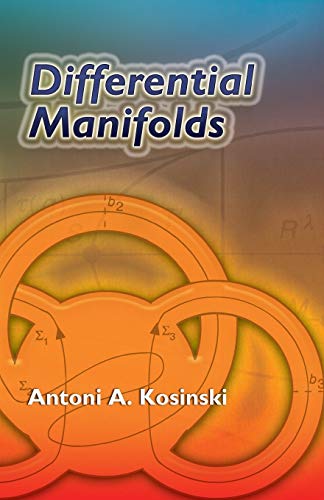
⭐This book contains a lot of information about manifolds, particularly those with differentiable structures. It used to only be available with a boring green cover and it was expensive. Now, its cover is colorful and has a wacky picture on it. I thought that this would surely make the price go up but it got cheaper! The picture on the front cover concerns operations on manofolds, particularly differentiable manifolds.
Keywords
Free Download Differential Manifolds (Dover Books on Mathematics) in PDF format
Differential Manifolds (Dover Books on Mathematics) PDF Free Download
Download Differential Manifolds (Dover Books on Mathematics) 2007 PDF Free
Differential Manifolds (Dover Books on Mathematics) 2007 PDF Free Download
Download Differential Manifolds (Dover Books on Mathematics) PDF
Free Download Ebook Differential Manifolds (Dover Books on Mathematics)